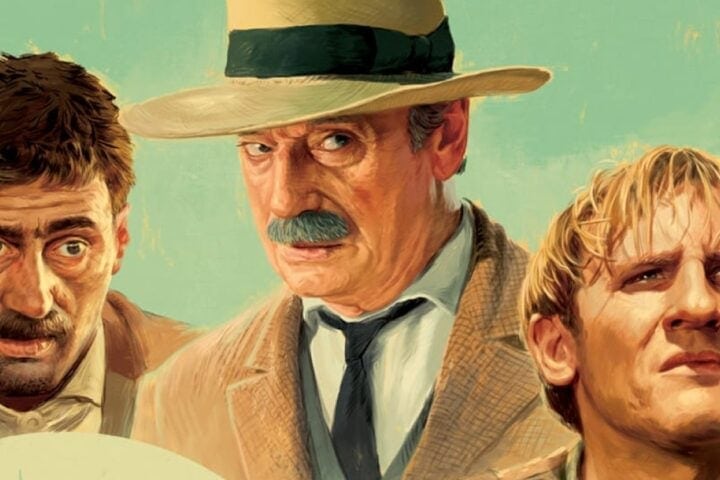
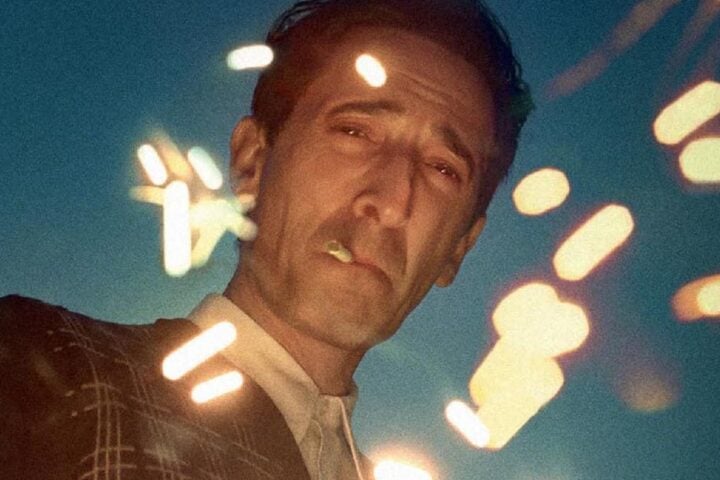
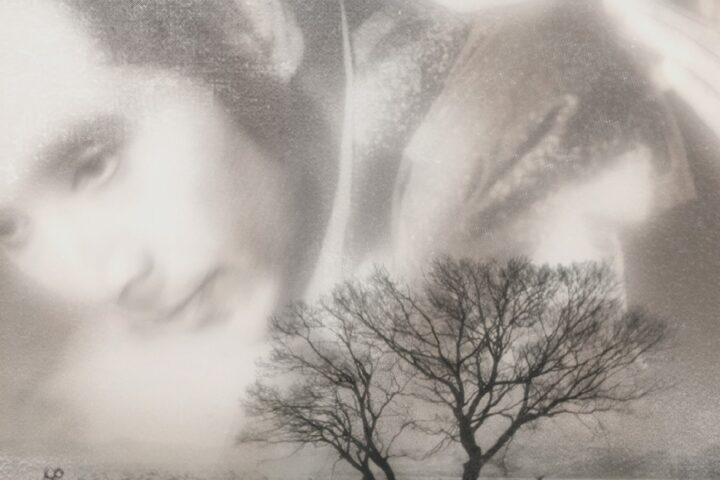
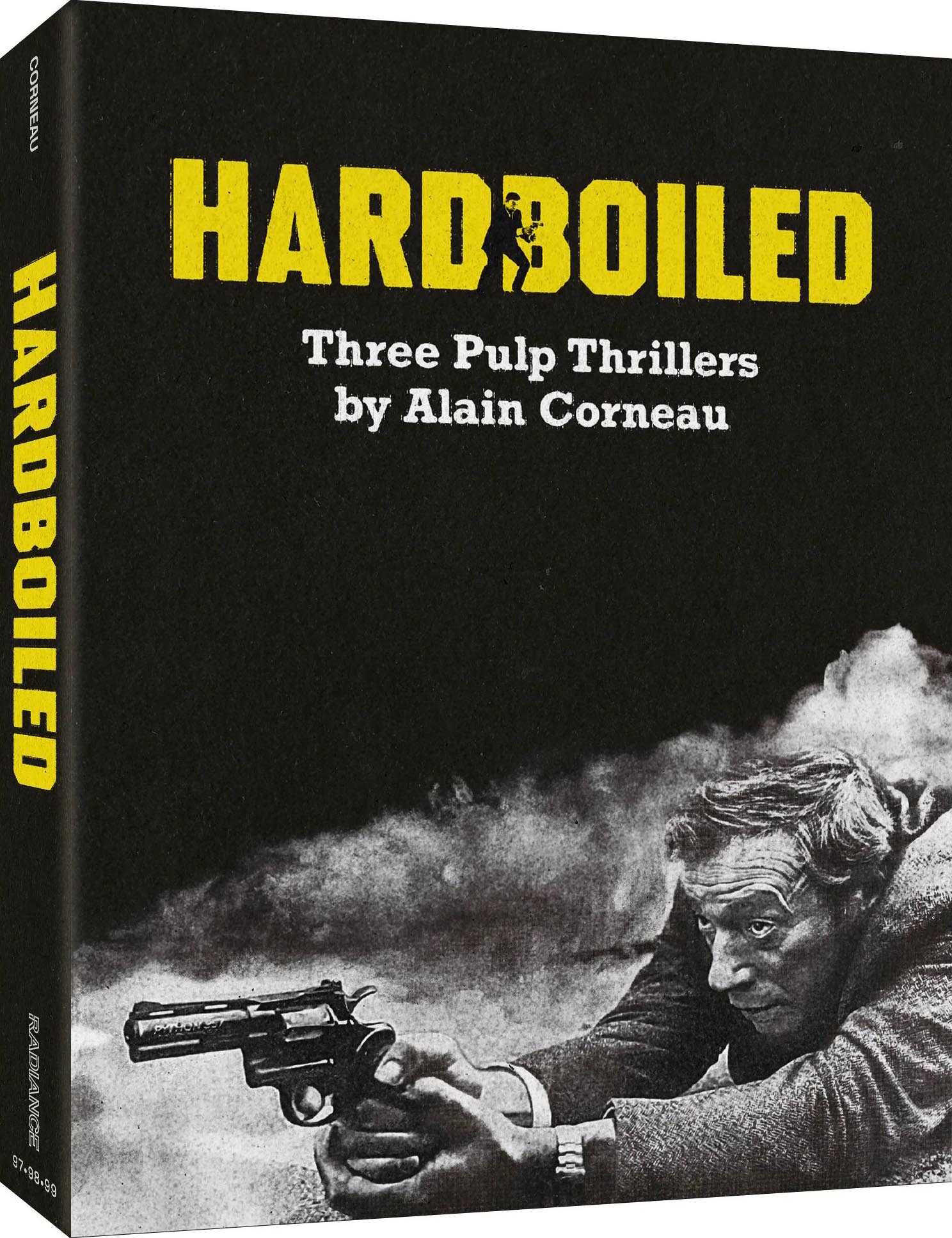
 Each of the films collected in Hardboiled: Three Pulp Thrillers by Alain Corneau emphasize the possibilities and discrepancies between reality as it is and as the protagonists see it or want it to be. Like so many leads in noirs and neo-noirs alike, these men are plagued by big, unattainable dreams and are left grasping at any hope or freedom they can find, only to be inevitably confronted by the harsh truth that everything good is fleeting. Nothing is set in stone but their own demise, and they remain prisoners of their own passions and delusions as the cruel indifference of the world they inhabit takes care of the rest.
Laced with irony as bitter as arsenic, Corneau’s 1975 film Police Python 357 finds Detective Ferrot (Yves Montand) investigating the murder of the woman, Sylvia (Stefania Sandrelli), with whom he was sleeping with. Unaware that his boss, Commissioner Ganay (François Périer), is the other man in the love triangle he was caught up in, Ferrot becomes slowly unmoored after Sylvia is murdered and he’s assigned to her case. What follows is a strange, existential cat-and-mouse game between two men who, while in close contact, are unaware of the other’s secret.
Corneau’s style here is distant yet alluring, with ellipses leaving out crucial bits of information and characters never quite speaking everything that’s on their mind. Throughout, the careful construction of both the narrative and compositions invites the audience to infer and formulate meaning that isn’t explicitly spelled out in the film, which is above all interested in Ferrot’s struggle to hide the inconvenient fact that all the evidence points to him as the murderer.
There’s a touch of Investigation of a Citizen Above Suspicion in Police Python 357. But where Gian Maria Volonté’s police inspector in Elio Petri’s film is a guilty man trying yet failing to expose his own guilt, Ferrot is an innocent man whose erotic obsession ultimately forced him to break his own code of honor simply to save his own skin. In Corneau’s film, corruption breeds corruption, so much so that even honest, upstanding people can’t escape its reach.
Where Ferrot at least tries to uphold a standard of decency, Patrick Dewaere’s Franck Poupart shuns it at every turn in Serie Noire. Transposing Jim Thompson’s 1954 novel A Hell of a Woman from the American South to the seedy streets of Paris, the masterful 1979 film is a relentlessly nasty bit of business, never letting the foolish, despicable Franck out of our sight. This narcissistic scumbag is as repulsive as he is exhausting, but Corneau and Dewaere slyly unearth a dark humor from his frenzied haplessness and dunderheaded scheming, to the point that the collision between his chaotic energy and overconfident idiocy verges on the absurd.
That Franck is something of a court jester who envisions himself as a king makes him all the more fascinating to behold as he stumbles from one bad situation into the next, temporarily weaseling himself out of trouble through feeble lies and self-aggrandizement. Often positioning himself as a victim or underdog, Franck is a tightly wound ball of anxiety. And while he tries to play it cool with both his naïve, forgiving wife (Myriam Boyer) and the 16-year-old Mona (Marie Trintignant), whom he attempts to rescue from the wretched aunt (Jeanne Herviale) who pimps her out, Franck can only keep up a facade of civility and virtue for so long.

Lest it seems like Franck’s concern for Mona is genuine, the fact that her aunt is sitting on millions of dollars of cash figures largely into his master plan. Yet, even with this scheme in the works, Franck can’t stay out of trouble and is so feverishly unrestrained that he can’t help bouncing around the city like a pinball—an unchecked id governed only by misguided whims and the staunch belief that he’s not nearly as clueless as he actually is.
In 1981’s Choice of Arms, one can see more than a bit of Franck in Gerard Depardieu’s Mickey. Depardieu’s hulking presence befits Mickey’s the bull-in-a-china-shop presence. Less a character study than Serie Noire, this latter film is a study in generational conflict, with the elder, retired gangster Durieux (Yves Montand) standing in as the old guard and Mickey representing the new, amoral wave of crime hitting France in the 1970s and 80s.
Everything from how the two men dress, speak, and move about the world to how they respond to pressure is diametrically opposed, yet that’s the very thing that draws them into each other’s orbits. If Choice of Arms is superficially the most mainstream film in Radiance’s terrific set, at least aesthetically, it’s still dotted with the rapier wit, idiosyncratic character details, and narrative digressions that define Corneau’s work. His bleak worldview and biting irony are also on full display here, but there’s also an emotional undercurrent to the proceedings that’s surprisingly and genuinely touching. The film finds traces of both the humanity and humility in its gangsters that had seemingly been snuffed out by years of toughing it out on the streets.
Image/Sound
If your vision of France is one of picturesque green fields and classic Parisian architecture, these three Alain Corneau films will shake you of that misconception, with Radiance’s breathtakingly filmic transfers perfectly capturing the grim and grimy textures of the settings. Each film is housed on its own disc, allowing the image detail and range of colors on display to be maximized. On the audio front, the uncompressed mono audio offers a pleasing depth, with countless gunshots and all three unique scores coming through with powerful resonance.
Extras
On the first disc devoted to
Also on the disc is an archival TV interview with Corneau and actor François Périer, in which the former talks about his adaptation process and latter about his approach to his character. Lastly, in a new interview, author Maxim Jakubowski focuses on the work of cinematographer Pierre William Glenn, and a bit more on Corneau’s adaptation of Fearing’s book.
The second disc includes the fantastic documentary Série Noire: The Darkness of the Soul, which touches on Corneau’s fascination with Jim Thompson and how he enlisted author Georges Perec to help out with Série Noire’s dialogue. (Radiance production manager Paul Martinovic’s video essay delves deeper into Thompson’s writing and the film adaptations of his work.) The disc also comes with an archival interview with Corneau and Marie Trintignant from 2002 and 1981 set interviews with Corneau, Patrick Dewaere, and Miriam Boyer.
On the final disc, critic Manuela Lazic provides a detailed analysis of Yves Montand’s career as a singer and actor, including his breakthrough performance in Wages of Fear. We also get some behind-the-scenes footage and on-set interviews with Montand and Catherine Deneuve waxing philosophic about their characters. Rounding out the set is an 80-page booklet with a treasure trove of writing from Andrew Male, Travis Woods, Nick Pinkerton, and Charlie Brigden, along with an archival interview with Corneau and a tribute to Patrick Dewaere by the director.
Overall
Hardboiled is one of Radiance’s best releases to date, featuring gorgeous transfers and superb extras that contextualize and illuminate the importance and impressive craft of each film.
Since 2001, we've brought you uncompromising, candid takes on the world of film, music, television, video games, theater, and more. Independently owned and operated publications like Slant have been hit hard in recent years, but we’re committed to keeping our content free and accessible—meaning no paywalls or fees.
If you like what we do, please consider subscribing to our Patreon or making a donation.