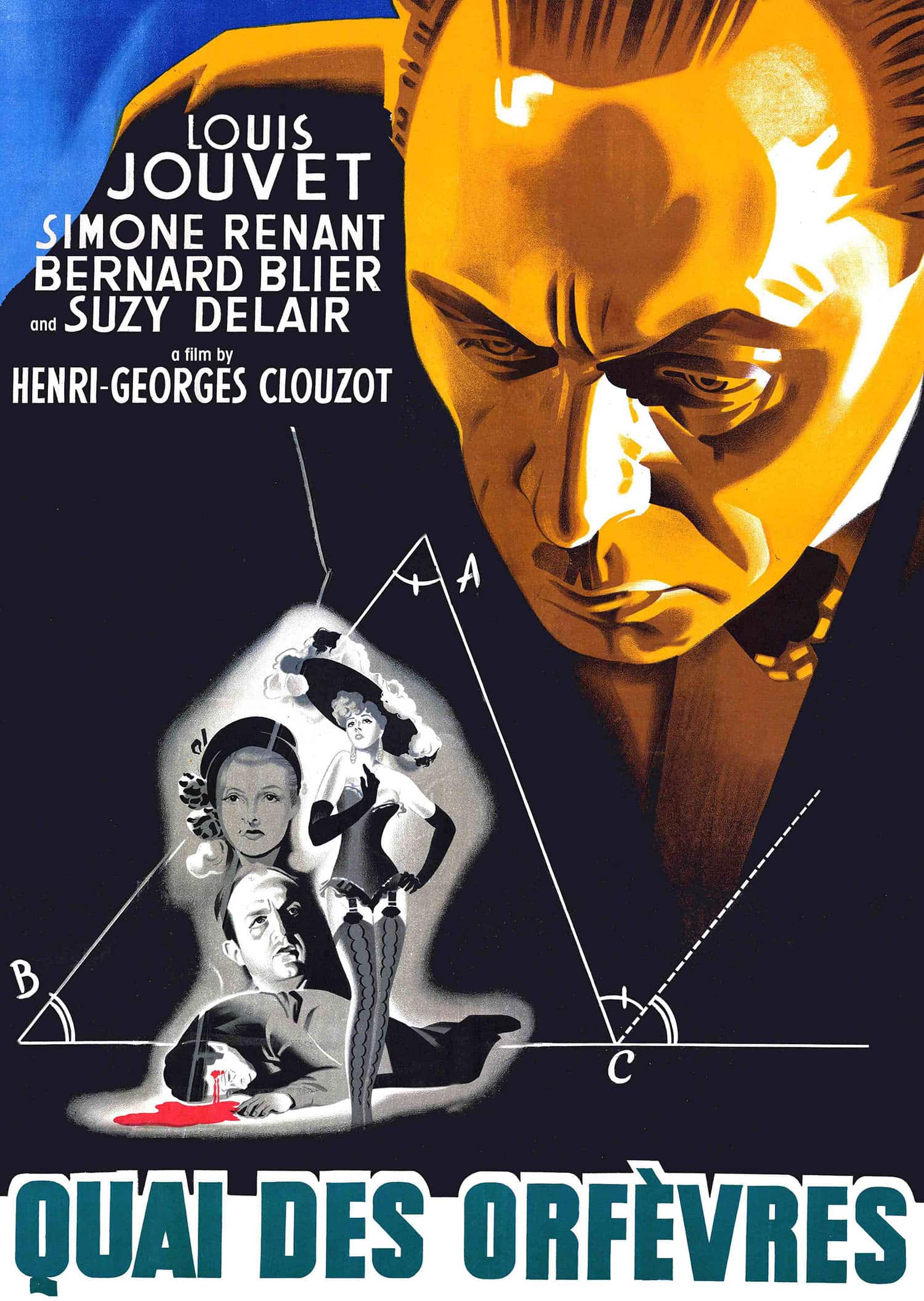
 Henri-Georges Clouzot’s classic noir procedural Quai des Orfèvres doesn’t conclude, as episodes of the ABC police drama Naked City once did, with a narrator solemnly intoning, “There are eight million stories in the naked city. This has been one of them.” But it might as well, for while Clouzot’s film is shot through with certain remarkable coincidences and narrative implausibilities, it’s not a tale of exceptional people doing extraordinary things, but rather ordinary, dissatisfied Parisians driven to desperate action by the unwieldiness of their emotions and the proscriptions of their social circumstances. The film’s characters—mostly show-business types swirling around the seedy subculture of Paris’s post-war cabaret scene—are flawed, even pathetic, figures, but they provide a lens through which we can view the pervading anxiety and malaise of a nation recovering from its own near-destruction.
The plot—loosely adapted from a potboiler by Stanislas-André Steeman, who reportedly hated Clouzot and co-screenwriter Jean Ferry’s major revisions to his novel—revolves around the torrid marriage of Marguerite Martineau, a.k.a. Jenny L’Amour (Suzy Delair), a sultry burlesque singer, and Maurice (Bernard Blier), her jealous, weak-willed husband. Jenny, who spends much of the film clad in provocative lingerie or luxurious furs, is coquettish and free-spirited. She’s genuinely committed to her husband but also not ashamed to flirt with the right man if it will advance her career. Such behavior drives Maurice insane with jealousy; a man of upper-class stock who, the film subtly suggests, threw away his respectable classical training to be Jenny’s full-time accompanist, he takes a more conservative attitude toward the overflowing carnality of his proletarian wife. As one theatrical producer memorably observes, “It’s his bad upbringing. His parents were bourgeois. He sees vice everywhere.”
The duo’s passions truly come to a head when Jenny starts leading on Georges Brignon (Charles Dullin), a loathsome, malformed movie producer with a fondness for coerced sexual encounters with much younger women. After finding apparent evidence of his wife’s infidelity, Maurice sets out on a carefully planned but haphazardly executed plot to kill Brignon and provide himself with a rock-solid alibi. But when he shows up at Brignon’s house, Maurice finds that he’s already dead. We soon learn that Jenny had been at his house that night and bopped him over the head with a champagne bottle after he tried to force himself on her. It’s then that the film largely shifts focus onto the investigation headed by Deputy Inspector Antoine (Louis Jouvet), a chatty, Columbo-esque policeman whose world-weariness belies his quiet fascination with the tawdry criminal underworld he spends his life immersed in.
Though there will be additional details revealed about Brignon’s violent demise, Clouzot isn’t interested in telling a whodunnit mystery. Nor is the film really a police procedural in the traditional sense. With a lesser filmmaker at the helm, this all might have devolved into a trashy melodrama, but in Clouzot’s assured hands, Quai des Orfèvres blooms into a cynical yet deeply humane film populated by complex, full-bodied human beings whose emotional lives tangle together into a romantic Gordian knot. Perhaps no figure in the film is more deeply complicated than Dora (Simone Renant), a photographer neighbor of the Martineaus who secretly pines after Jenny. Dora is a tough yet vulnerable woman whose self-awareness about her own sexuality has done little but make her deeply unhappy, and she forms an oddly intimate relationship with Antoine. Together, they’re two knowing outsiders, doomed to a life of observation rather than participation.
Clouzot renders his characters’ lives with a deep precision and a lack of moral judgment. Shot mostly on carefully furnished sets in shadowy black and white, the film’s mise-en-scène deepens what could be simply a tale of crime and passion into a sophisticated social drama. Small details, such as the way characters frequently keep their coats on indoors, evoke the discomfort of their living situations. By contrast, scenes of a crowded, smoky dance hall where everyone checks their overcoat—the fact that Maurice doesn’t do so on the night of the murder becomes a key clue in Antoine’s investigation—feel positively muggy, thus suggesting that one of the major draws of the cabaret for its largely working-class patronage is simply the respite it provides from the chilly winter weather.
Throughout, we receive tiny little peeks at the lives of the many people that populate the periphery of the film, such as the barfly taxi driver (Pierre Larquey), a witness in the case who refuses to speak to police out of a deeply held antipathy for authority. (Eventually, Antoine, in perhaps his most devious moment, forces the man to make a key identification by threatening his cabbie’s license.) Or the languid chanteuse (Joëlle Bernard) whose ennui-laden rehearsal in one scene suggests a lifetime of bitterness and disappointment. A sequence in the police station, in which Antoine reads out Maurice’s statement to a typist, would seem to be an opportunity for Clouzot to juice up the suspense, but instead it’s presented as a lightly comic slice of office life populated by men and women dully going about their daily routine. However, later, there are indications of the Paris police’s use of torture against some suspects, indicating a corrupt and brutal underbelly to the forces of law and order in France.
The resolution of the murder investigation is essentially contrived, letting the characters off the hook in unconvincing fashion. But by that point, it scarcely matters. Quai des Orfèvres is fundamentally an exquisitely detailed snapshot of a particular time and place, one that focuses on a relatively small group of characters but which constantly spans out to evoke an entire society. It’s fitting then that the film ends not by closing in on itself with, say, a shot of Maurice and Jenny embracing, but rather finishes by opening out. The final image is of Antoine and the adopted African son he’d brought back with him after serving in France’s colonial wars. The shot is from the point of view of Maurice and Jenny’s apartment, and we watch as the pair strolls out of the courtyard and into the city at large. This has been one story of post-World War II Paris, but, Clouzot suggests, there are many, many more.
Image/Sound
Adopting the same recent 4K restoration of Quai des Orfèvres that Studio Canal used for its recent Region B Blu-ray release, Kino Lorber’s disc presents cinematographer Armand Thirard’s stunningly rich 1.37:1 black-and-white images in pristine fashion. There’s depth even in the darkest shadows, and every nuance of the complex mise-en-scène is brilliantly sharp. One can discover details hidden in the deep background of the smoky interiors of the film’s dance hall scenes. The DTS-HD Master Audio stereo track is similarly excellent, offering a nice balance of simple dialogue scenes, aurally dense musical sequences, and a few nearly silent stretches. The dialogue is ever so slightly muffled in a few spots, though this seems to be a product of the original elements rather than any error in the restoration or transfer. This is a truly dazzling presentation of a sumptuous and visually varied classic.
Extras
Drawing on historical research, academic studies, and his own incisive analysis, critic Nick Pinkerton provides a sharp, informative commentary track. He places Quai des Orfèvres in the context of Henri-Georges Clouzot’s career while excavating surprisingly detailed mini-histories of even minor performers in the film. But the strongest element of the commentary may be Pinkerton’s own trenchant critical observations on the film itself, particularly his thoughts on Clouzot’s subtle visual touches, the story’s class politics, and the non-stereotypical treatment of lesbianism. The disc also includes a 17-minute featurette on the film consisting of interviews with Clouzot and some of the key cast members culled from a 1971 French TV program. This doc focuses heavily on Clouzot’s cynical worldview and frankly abusive working methods. While not exactly loaded with extras, the disc’s two major features will be exceptionally illuminating for fans of the film.
Overall
Kino Lorber’s release of Henri-Georges Clouzot’s post-war noir classic with a vivid presentation and some illuminating extras.
Since 2001, we've brought you uncompromising, candid takes on the world of film, music, television, video games, theater, and more. Independently owned and operated publications like Slant have been hit hard in recent years, but we’re committed to keeping our content free and accessible—meaning no paywalls or fees.
If you like what we do, please consider subscribing to our Patreon or making a donation.