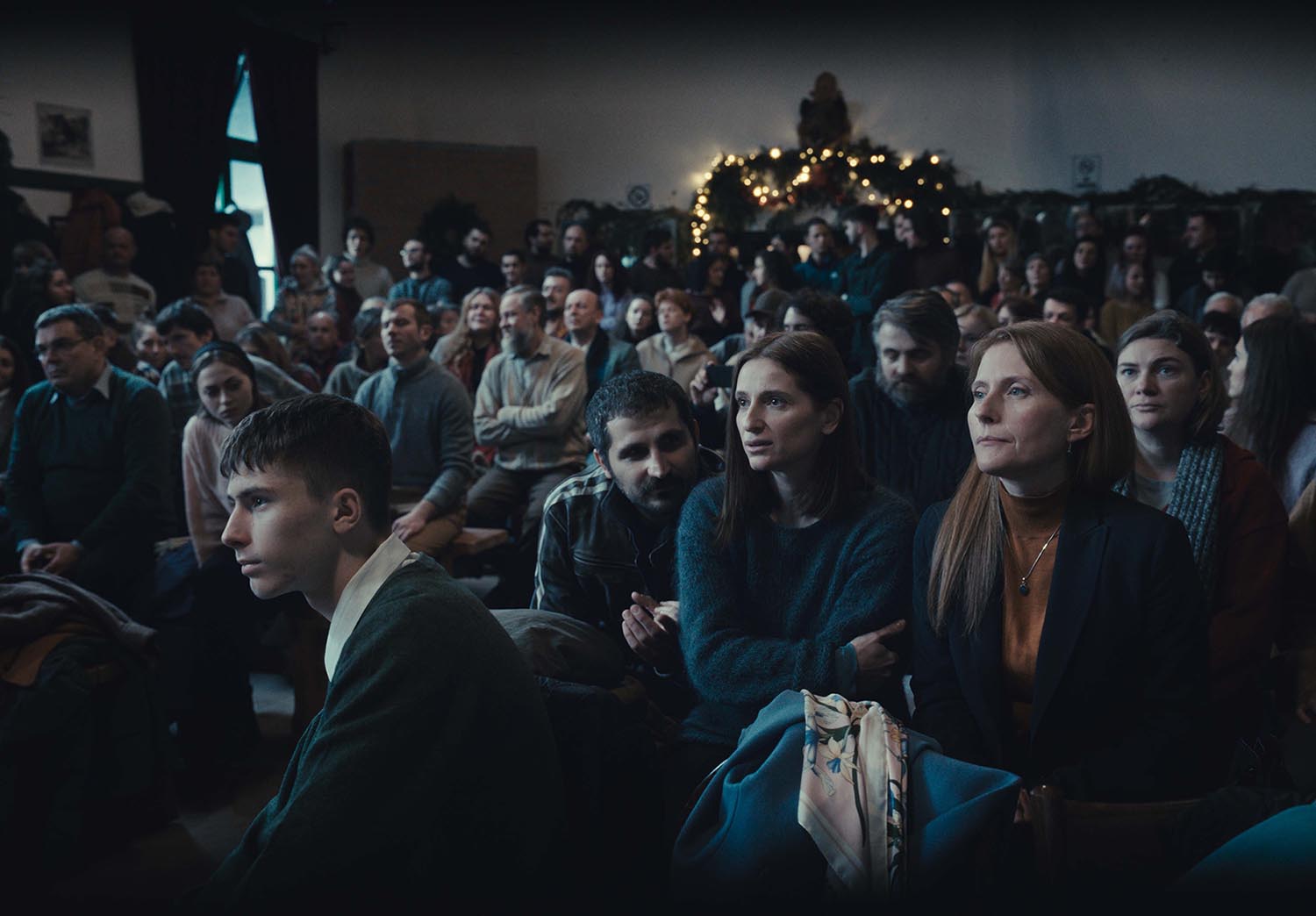
The initials of Cristian Mungiu’s R.M.N. might appear to be an abbreviation of the filmmaker’s country of origin, Romania, and thus set up the film as a portrayal of the nation in microcosm. But in its native language, the title refers to the same brain scan technology better known to English speakers as an M.R.I. The eye and ear for naturalism exhibited by this trailblazer of the Romanian New Wave—and, for 2007’s 4 Months, 3 Weeks, and Days, the country’s first to win the Cannes Film Festival’s prestigious Palme d’Or—accordingly moves from having a sociological interest into an outright anthropological one.
Again drawing inspiration from real events, Mungiu burrows deep into incident that transpired in a multi-ethnic Transylvanian village where a critical mass of residents protested a local bakery that brought in Sri Lankan employees to work. R.M.N. eschews lazy ripped-from-the-headlines topicality, seeking not just to fictionalize what happened. Instead, Mungiu aims to understand why the conditions were ripe for such a flare-up in the first place—and what makes humans at large so prone to indulge their emotions to scapegoat an innocent party.
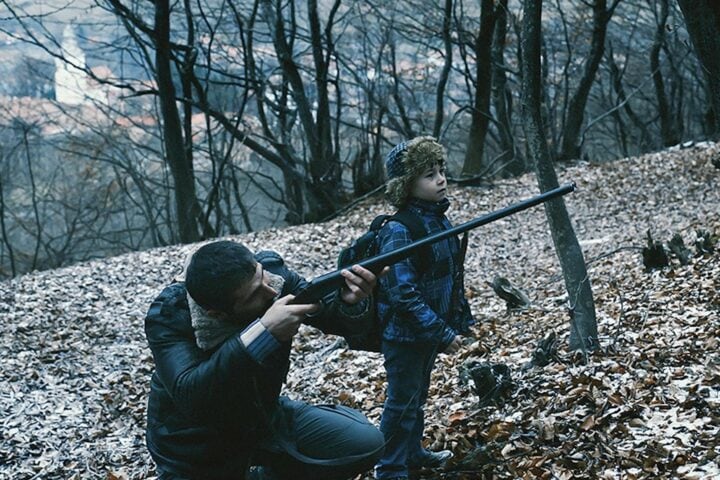
Mungiu tracks much of the action through the turmoil of Matthias (Marin Grigoire), who at the start of the film is himself a migrant worker employed in Germany to support his ailing father (Andrei Finti) and young son (Mark Edward Blenyesi). His return coincides with the arrival of the workers, Alick (Gihan Edirisinghe) and Mahinda (Amitha Jayasinghe), who’ve been imported by his former flame, Csilla (Judith Slate), out of economic necessity.
Both developments inspire questions from the townspeople, though only one incites their ire. R.M.N. keeps the tensions simmering throughout until they boil over in a bravura long take where all the village’s animosities find a voice. The single, unbroken shot keeps viewers tethered to the specifics of the moment, but Mungiu’s intellectual lens expands so expansively that it feels like the entire concept of multi-racial democracy is passing through a fiery crucible.
I spoke with Mungiu shortly before R.M.N.’s U.S. theatrical release. Our conversation covered what the film shares with his previous work, how he executed its centerpiece sequence, and what he learned from presenting it in the Romanian village that inspired the story.
Much has been made of the visuals in the extended take for the town hall scene, but can you talk about how you approached the sound?
I wanted to make sure, first of all, that I could select what I want from every other character later on in the mix. I knew that I had 25 or 26 people speaking, and I wanted those speaking in the microphone to be recorded with that specific sound. Even if I know you can edit later, it’s not the same kind of reverb. I bought three different sound engineers, and they planted a lot of microphones. But of course, when I was shooting, I couldn’t listen to everybody. They were giving me a mix down of people talking, so I had a lot of surprises when I started listening to the sound later on. Of course, as it happens, I finally chose the one take that was the best—and where one of the most important microphones didn’t work. There is this guy interfering at the end of the scene and talking quite a lot, and his microphone just stopped because of a battery or whatever. I had to recompose that from a lot of other different microphones.
What was interesting in the process is that, all of a sudden, it wasn’t just the lines that I had written down in the screenplay. Because what’s difficult for an actor in that scene is what you do in between your lines, not when you deliver them. I was trying to tell each of them what to focus on, what’s their opinion, but still, it was up to them to invent something. And I allowed them to have comments. These comments couldn’t be heard in the mix. But later on, I could listen to each of the comments, and they were strong enough that I could place them between the lines of dialogue. That was a very interesting construction on the mixer. You have a lot of extra lines of dialogue, which are like comments in this Greek choir. Comments from the collective character.
Did all those comments illuminate something about the scene that wasn’t apparent to you on the page?
If I learned something, it was that people immediately had very stereotypical [variations of] lines that represent very populistic kinds of [phrases] that everybody knows. It helped me to better describe a conflict that I wanted to have in the film, which is the conflict between the individual and the group. How do you lose your individuality when you’re part of the group? Because you conform and it’s so difficult to speak against everybody else. They are stronger, they are like a mob, and all of a sudden, it’s difficult for you to just have your own opinion.
That was a theme that really interested me. If you remember before this town hall meeting, there’s an intermediary shot when I show them crossing from the church to the town hall. That has a meaning as well for me because they start coming as people, and they just walk randomly. But by the end of the shot, they just march as an army, somehow. It’s part of the way in which I was trying here and there to suggest a few things for people. Of course, nobody noticed, but it’s not important that people don’t notice. It’s important for you that you are, in your mind, coherent with the themes that you want the film to contain. You never know who’s going to decipher which of them, but some of them are going to be deciphered!
People often focus on the naturalistic sequence shots in your work, but sound plays an equally important role because it can often serve a more expressionistic function. How do you envision your sonic approach complementing your visual one?
The sound is very important for me because I don’t use non-diegetic music. That’s the reason why I’m treating somehow the sound as a certain kind of music that suggests, if you want, the state of mind and the emotions of the characters. I use a lot of added sound. I add up a lot of things for the rhythm because this is what music does in a film. But I don’t like that because it comes as a very obvious comment from the filmmaker. I try to reveal what’s inside a character when they fell the anxiety and tension of a given situation. And then you feel very agitated, but there’s no music. I try, rather, to get there with the rhythm coming from the sound.

There are lots of bells tolling in my films, and a lot of trains passing. There’s a lot of wind all the time, and a lot of thunder. It’s not easy to work with me on the sound, to be honest! There are very many people trying to edit the sound because it’s not that I know precisely what I want, but I know what I want to have as a feeling. Then I mix it in a way in which it nearly challenges what the characters say. I discovered that if these two levels are quite close to one another, whatever the characters say is going to be perceived as being more natural. It’s important for me to show that everything happening in the film reveals a bigger life than just what you see on screen.
You mention not having non-diegetic music, but that very notable cue nodding to another film feels like something new in your work. While elements like the centrality of the sequence shot remain largely the same from your first feature, this film shows an openness to adapting your style by drawing some inspiration from the cinema—from Modern Times to In the Mood for Love—in addition to reality. How do you make these determinations about your aesthetic philosophy?
When I think about how I’m going to make a film, or even how I’m going to write the film, I start by double checking if I have new ideas about the way I see cinema. But, you know, it’s not easy to come up with a new, radical way! You can adjust styles if the final use of the film would be different. There’s more music in the film, but the music is coming from the situation always, even if this is something somewhere in the middle. And then, of course, I knew very well that I wanted to have [those references] to Chaplin and In the Mood for Love [and for them to be] very clear. But if you want, there’s an Altman kind of mixing up a lot of characters and situations at the same time, which I wasn’t necessarily aware of. It’s just coming from the situation somehow. But I never start having a film as a model because I’m always trying to adapt reality. [Taking] a situation which was real, but which needs to have a different meaning when you fictionalize it.
Are you able to use any of your previous films as a model? I think of something like Beyond the Hills, which also speaks to how violence can creep into an insular community, as the kind of work that might offer some guidance to R.M.N.
I think if they have something in common, they speak about what is evil in the world today and how you can distinguish good from bad. For example, in Beyond the Hills, you can imagine that [the characters think] they’re doing a lot of very good things and, still, that’s very relative. R.M.N. is about the nature of evil, and it’s about the source of this evil. As much as we always tend to look outside to identify the source of the evil things in the world, they might be inside.
That is one of the ideas I hope people will get from the film: Before finding somebody responsible or guilty outside, make sure that the violent animal is not somebody deep down inside of you. We all have a lot of instincts that we are not aware of. And the moment we have to react instantly, you will be surprised to see what comes out. This is why I’m always saying that you need to be prepared. You need to spend some time with yourself and to understand and forgive yourself that you’re not just human. You’re also an animal, and you need to survive. In certain situations, you won’t act at all [in line with] the principles that you claim to have. We’re not at all perfect human beings, but at least we can try to be a little bit more truthful.
That also reminds me a little bit of Graduation, where you’re poking holes in the myth of either a new generation or just the passage of time itself will inevitably move society in a better direction. Is this passing of the generational torch of particular interest from a Romanian perspective given that the country is now beginning to have a generation that didn’t live under the old regime?
That’s true, but to be honest, I think that I’m always thinking globally rather than nationally. I think I have more things and fear in common with people living everywhere today than specifically with people living [in Romania]. But, of course, I do see as a problem which exists a lot in a place like the one where I’m still living. Whenever people live in a territory like this where there’s still a lot of poverty, they will try to figure out which are the survival modes, and they will tend to apply these with more accuracy and with less principles than somebody coming from a more civilized country with hundreds of years of wealth. There are these lessons of survival, which are mostly taught in societies where you need to survive, and these people will tend to pass them over to their children. This is why there’s always a clash between East and West, because always poverty is coming more from the East. This is a theme which really interests me a lot, and I might continue thinking about it and working about it in my next films.
Is this something you’re exploring across the decades spanned in your upcoming book, Radio News, and the episodic series format you’re eyeing for its adaptation?
First of all, I wrote this because it’s a personal story. When I wrote it down, it wasn’t a book. It was just my attempt at giving some meaning to the life of my grandmother. This was some 25 years ago when she passed away, and she was calling “home” the land she had to leave behind when she was 17. She felt that her whole life was ruined because of all these historical changes that she could never, of course, control. Because of this accident that she was born in a territory, which was disputed by different other countries. And I think this is also the case of what happens today in Ukraine. And, actually, she lived very close to Ukraine in this Republic of Moldova, which is a little bit of a place passing from one country to another. As an individual, you just want to continue with your life. But somebody will just give you a rifle pointed in a certain direction, and you are asked to shoot in that direction because these are the enemies. Eventually, 20 years later, the enemies are in the opposite direction, but you’re still living there. I think that this is quite interesting. It’s going to be published as a book this year. I wrote it as a screenplay, but I think I need more space. So, if anybody from a streaming platform is here…
R.M.N. came out almost a year ago in Romania. What were the reactions like there?
I did something once I came back from Cannes, and as soon as I had a formal premiere in Bucharest, I organized a tour in Transylvania. I accompanied the film for 30 days in every small little, multi-ethnic village and with population speaking different languages. The first screening that I organized in Romania was precisely in the town hall of the real village where it took place. And I really wanted to have this as an experience because there were the same people who were there when they voted, and they shot the thing and placed it on the internet. And now they were the audience of that event, fictionalized into a film. It was very interesting because there was a lot of press coming from Bucharest, everybody hoping that there’s going to be a fight.
But it was a very good experience by the end. They realized it was a fictionalized work starting from what happened to them. Little by little, they understood that cinema has a kind of a healing property. It was easier for them to relate to what happened because they watched the film. And the other interesting thing that happened is that they came to talk to us after this official Q&A to explain, from their perspective, [how it was] all a misunderstanding. They are not xenophobic; they were just trying to preserve their traditions. They do not have anything against these people. And they even told me that the priest who was working there doesn’t work there any longer, and the workers are still there in a factory. They felt guilty somehow, and they felt this needed to explain that everything came from their need to respect a very traditionalistic society in a country where people have a different language and a different religion.
You seem to be enjoying asking people what they think the ending means. Have you been surprised by the interpretations?
I only ask them when they ask me! I did something which worked quite well. I had some screenings where there was too little time for the Q&A, and I told people, “Look, I know that the ending is not very clear. It’s interpretable. If you want, just ask me on Instagram, and I’m going to answer to you.” I got such interesting interpretations about the ending of the film, and I really answered everybody. I encourage people to find their own interpretation because I won’t be there every time when they watch the film. But for the people listening to our conversation today, what matters for me is to understand that the film, by speaking about somebody else, speaks about them as well. And as Matthias at the end of the film needs to make a choice between his darker side—represented by the forest, his subconscious, and his instincts—and his lighter side—represented by empathy that you feel for the others—the spectators should think about that thing as well and try to make the right choice.
Since 2001, we've brought you uncompromising, candid takes on the world of film, music, television, video games, theater, and more. Independently owned and operated publications like Slant have been hit hard in recent years, but we’re committed to keeping our content free and accessible—meaning no paywalls or fees.
If you like what we do, please consider subscribing to our Patreon or making a donation.