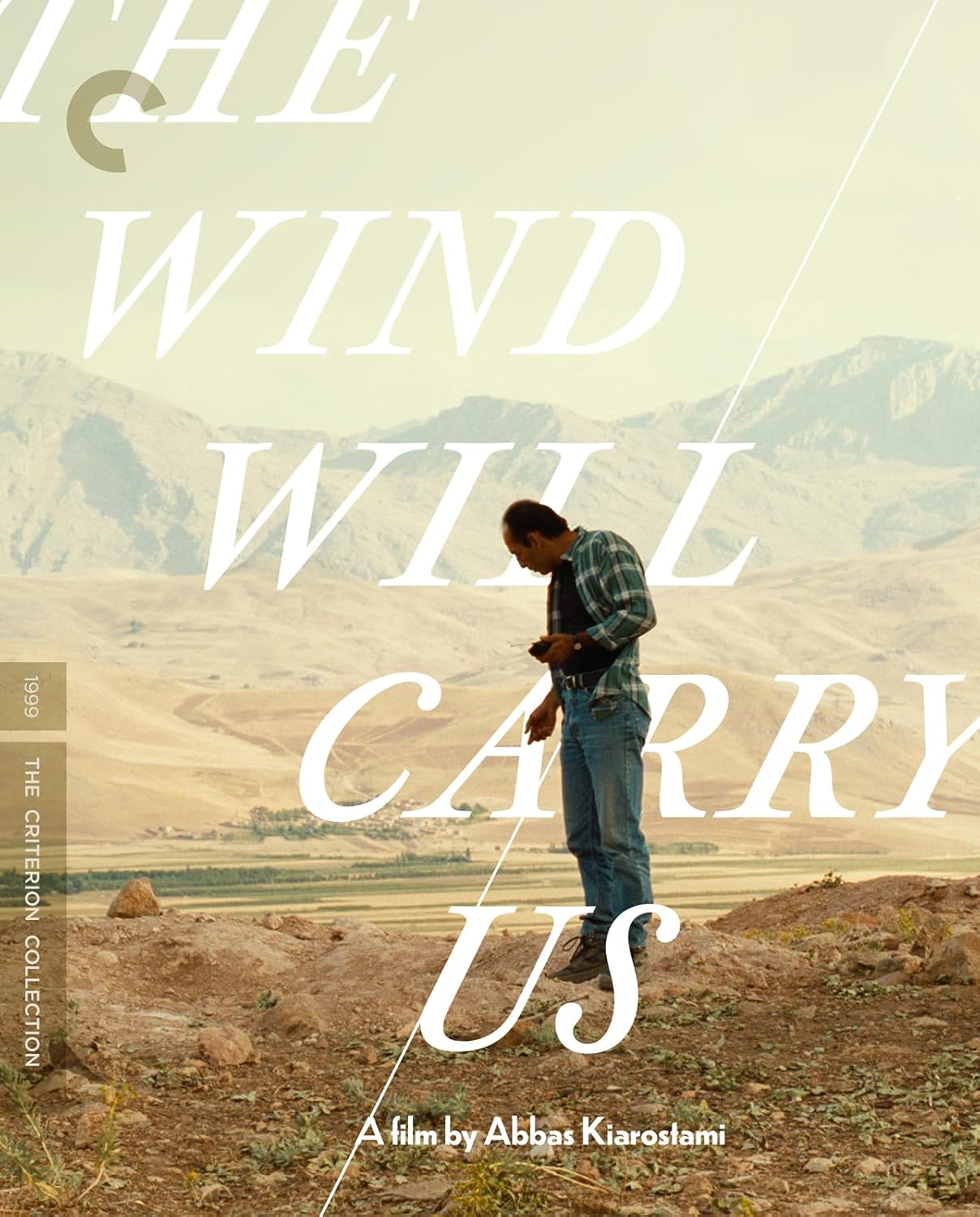
 Abbas Kiarostami’s The Wind Will Carry Us takes its title from a poem by the Iranian artist Forugh Farrokhzad, a controversial figure who preached progressive political and feminist doctrine through a variety of written, verbal, and visual mediums before dying in a car accident in 1967 at age 32. In Kiarostami’s film, the poem is recited in what could be called its centerpiece scene—it’s the only one set indoors—by our unnamed male protagonist as he attempts to seduce a young girl in a dimly lit grotto while she collects milk from the family cow.
The encounter isn’t quite as provocative as it might read, and indeed Farrokzhad’s words convey much of the sequence’s visceral and thematic weight. Preoccupied with notions of transience and temporality (“The moon is red and anxious…The clouds await the birth of rain…One second, and then nothing”), the passage is indicative of the film’s larger considerations of death and the incremental accumulation of time, as well the formal and nominal characteristics marking it as a cumulative work for its creator, if not cinema itself, at the turn of the millennium.
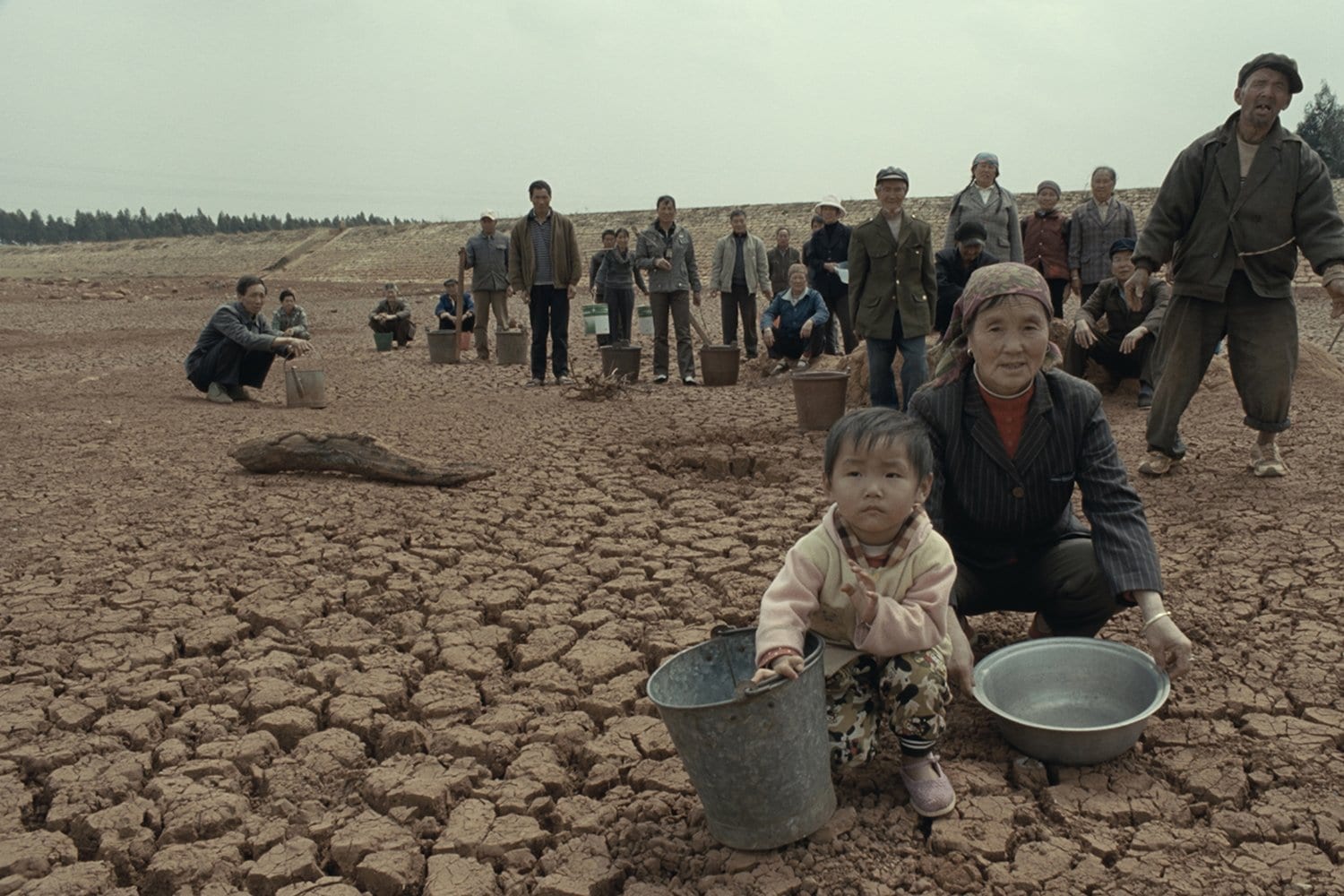
Advancing along the horizon toward Siah Dareh, a remote Kurdish village some 400 miles outside of Tehran, a three-man film crew arrives in anticipation of the death of an elderly woman whose ceremonial burial and attendant mourning rituals they hope to turn into a television documentary. When she fails to pass away within the first few days, instead showing signs of recovery, the men are forced to wait out the inevitable, to the frustration of not only themselves, but also their bosses back home and the local townsfolk, who view these outsiders (who identify themselves as “engineers”) as nothing more than opportunists.
The majority of the film focuses on the anonymous producer (Behzad Dourani) in charge of the impending shoot and his day-to-day explorations of the village. He’s led on most of these tours by a young boy named Farzhad (Farzhad Sohrabi), who seems more than happy to accompany the stranger as long as it doesn’t interfere with his studies. There’s little traditional drama in The Wind Will Carry Us; instead, unassuming moments are allowed to play out without much fanfare, humor, and ironies emerging from the routine activities of visitor and villagers alike. Thus the slightest hint of tension, such as the aforementioned scene set in a ghostly enclave or a late moment in which a laborer falls into a pit, carry an immense sense of gravity.
Kiarostami chooses to focus on only a handful of individuals, relegating a majority of his sometimes vital characters to off-screen voices. In fact, the most important information in the film is almost always approached from discrete angles, if not simply elided entirely. We never see, for instance, the other two members of the production crew, though we hear them in conversation throughout. Not even the ailing old woman is seen or heard, taking on instead a kind of spectral role, simultaneously advancing and prolonging the narrative.
Kiarostami, in turn, positions his camera in ever-expansive yet highly constricted formulations, moving from extreme long shots of the surrounding landscape to a static, almost structuralist tableau of the village architecture, to slyly intricate shot/reverse-shot encounters, most of which isolate the performer in conversation with an unseen partner, themselves often filmed on an entirely different occasion—and usually opposite Kiarostami himself. These repetitive setups—and the repeated activities depicted within them (a running joke about the lack of cellphone reception is almost frustrating in its familiarity)—enhance the film’s parallel function as a bleak comedy, while reinforcing the mundane anticipation that fuels such situational irony.
After premiering at the Venice Film Festival in the fall of 1999, The Wind Will Carry Us would be released Stateside the following year and, appropriately for a film of such comprehensive thematic and aesthetic value, has retroactively come to represent a key moment in the evolution of contemporary art-house cinema. Not only was this was the last film that Kiarostami would shoot on 35mm (all his subsequent features and shorts have been shot digitally), but it also brought to a close a decade of stylistic innovation and refinement.
Traces of his other films—Where Is the Friend’s Home?, Life and Nothing More, Taste of Cherry, and more—are present here, and likewise in many ways, from formal reconciliation to narrative consolidation, it remains his defining work. As the film comes to a close, and the producer finally packs up to leave the village, professionally unfulfilled but spiritually stirred, we watch as he tosses into a stream a single human bone, a remnant of the past whose future is unwritten. There may be no better metaphor for our post-millennial cinematic landscape.
Image/Sound
When it was initially announced that Criterion would be adding the first Abbas Kiarostami title to its collection since the Koker trilogy’s inclusion six years ago, the response was a study in cognitive dissonance. On the one hand, obviously it’s good news when the preeminent international cinema auteur of his generation gets more real estate in the Criterion closet. Nonetheless, there were also some grumblings that The Wind Will Carry Us is only getting a Blu-ray release when UHD has increasingly become Criterion’s rule, not the exception—especially given the release is sourced from a new 4K restoration.
While I spiritually side with those who would much rather have seen Criterion bring Kiarostami into the 4K era, the fact is that the film looks astonishingly alive here, especially compared to its prior HD incarnation on Cohen Media’s 2014 release. The Cohen transfer certainly had its fans, but to my eyes it seemed muddy and overly muted, as though it’d been fed through a Hipstamatic filter, crushing all contrast out of the images. Criterion’s remaster, in contrast, appears sharp, bright and teeming with energy. Yes, you would probably be able to see even clearer delineation in those rolling wheat fields had Criterion gone all out and offered 4K, but at no point in my active viewing experience did I think to myself, “What a shame this is, up on my screen.” Typically, it was the opposite. The only possible flaw I could find was a slight tilt toward the greenish side of the color spectrum, but hardly a deal-breaker when the rest of the image presentation is such an improvement over any other previous home video version.
The monaural sound presentation is far more active and roomy than you might think based on that monaural tag, with plenty of ASMR-adjacent details and subtle ambient textures. Like The Wind Will Carry Us itself, it’s not an overt system workout, but if you submit to its wavelength, it’s about as rewarding an experience as exists in all cinema.
Extras
Against the film’s emphatic themes of transience and impermanence and letting go, it’s worth noting that not one of the bonus features that appeared on the earlier, now long out-of-print Cohen Media set have survived the transition over to this release. That means that the feature-length commentary track from film critic Jonathan Rosenbaum and professor Mehrnaz Saeed-Vafa is now effectively lost to the sands of home video time. As painful as that omission is (especially as the pair appear on Criterion’s releases for both Close-Up and the Koker trilogy), there’s something about Kiarostami that arguably resists the intellectual hardening, however benevolently presented, of his work into any kind of rigid critical reading.
True to that supposition, Criterion’s presentation of extra features here is remarkably more about context than content, largely turning the lens back on Kiarostami himself. Most notable is Yuji Mohara’s feature-length, shot-on-DV documentary A Week with Kiarostami, which shows him at work on The Wind Will Carry Us, surprisingly exacting given how effervescent the final product. If the maxim in dancing is that it takes a lot of work to look effortless, the same seems to hold true in directing, at least in Kiarostami’s world.
Even more edifying, though, is a nearly hour-long 2002 interview with Kiarostami, conducted for distributor mk2. Capturing him at arguably the high point of his international reputation, the auteur is notably comfortable expounding on the meanings behind his works. Rounding out the package is a deeply felt booklet essay by novelist Kaveh Akbar and a video essay, narrated by Massoumeh Lahiji, about Kiarostami’s lesser-known work as a poet of the written word.
Overall
While far from Kiarostami’s final film, The Wind Will Carry Us certainly feels as much like a career summation as anything he ever did, and a wryly self-critical one at that.
Since 2001, we've brought you uncompromising, candid takes on the world of film, music, television, video games, theater, and more. Independently owned and operated publications like Slant have been hit hard in recent years, but we’re committed to keeping our content free and accessible—meaning no paywalls or fees.
If you like what we do, please consider subscribing to our Patreon or making a donation.