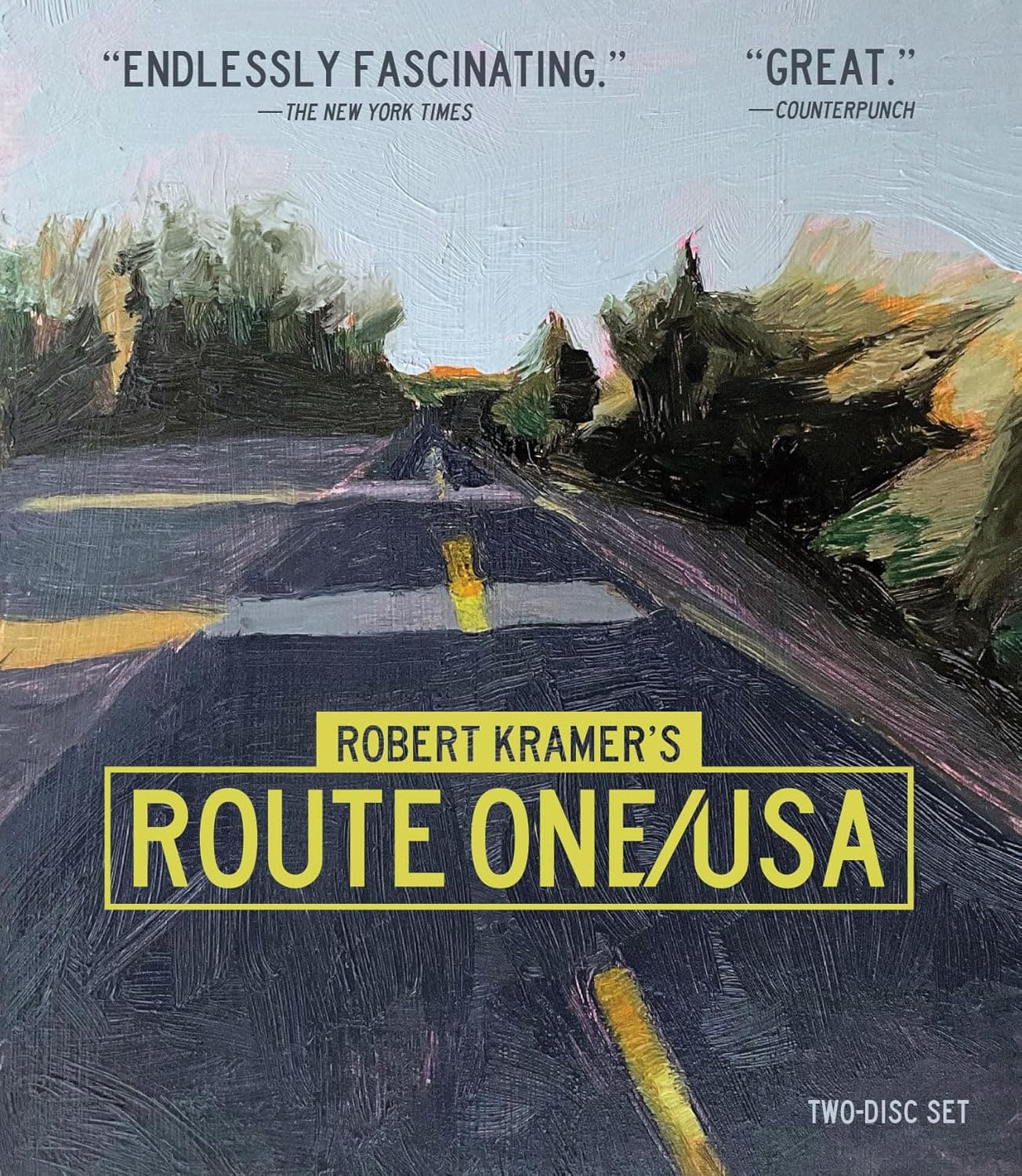
 After living abroad for a decade, filmmaker Robert Kramer returned to the United States in the late 1980s. Curious to discover more about the country he left behind, he decided to travel the full length of Route One, from Fort Kent, Maine, to Key West, Florida, with his actor buddy Paul McIsaac.
Kramer and McIsaac’s travels and encounters with people of all walks of life serve as the raw material for Kramer’s sprawling Route One/USA, with McIsaac playing Doc, a doctor who’s returned to America after working in Africa for the past decade. Throughout, this character—a playful fusion of Kramer and Isaac’s personalities—serves as on-screen interviewer, narrator, and philosopher, compellingly adding a fictionalized flourish to a film that otherwise presents itself as a work of pure cinema vérité.
Near the start of Route One/USA, Doc muses, “We’re going back, not going home,” and over the course of the film, made in the twilight of the Reagan era, one gets the sense that these two middle-aged leftists never quite felt like America was home for them or others like them. Throughout, their attentions tend to veer toward the struggles of the country’s dispossessed, from inner-city kids at an underfunded elementary school to a trans sex worker at Fort Bragg.
While looking at sea turtles in an aquarium, Doc ponders “a life under the surface, beyond the ordinary,” which aptly describes the film’s guiding principle. Kramer is less interested in America as it presents itself—though the glimpses of a Pat Robertson for President event and protestors outside of an abortion clinic, as well as an interview with a racist cop, do give us a sense of that—than America’s typically unseen realities. A work of poetic portraiture that’s prismatic and expansive, yet intensely intimate, Route One/USA unfurls as an extended series of snapshots of America, and while it’s leftist in spirit, there’s no grandstanding here.
Kramer’s assemblage of these snapshots is more intuitive than functional. For one, there are no on-screen indicators of which town, city, or state we’re in or how much time has passed over the course of Kramer and McIsaac’s journey. More than anything else, this four-hour-plus film is structured by its interest in ordinary Americans just struggling to get by: the unhoused, AIDS patients, Vietnam veterans suffering from PTSD, and more.
At one point, a man describes how trees, for the way they spread diseases underground, are “killing their homeland.” Throughout their odyssey down the East Coast of the United States, Kramer and Doc bear witness to another homeland dying from within, yet still brimming with passion, kindness, and humanity. So much of what we see on screen echoes America as it is nearly 40 years later, lending a profound resonance to Doc’s statement early in the film that “everything’s different except nothing has changed. The same battles are going on here.”
Image/Sound
Icarus Films has sourced a new restoration for this release and the transfer is beautiful, retaining the soft grain and lush textures of the 16mm print. The color balancing leans toward the naturalistic and the overall image has impressive depth and detail, whether in the countless wide shots of vistas and urban neighborhoods or close-ups that reveal the contours of Paul McIsaac’s face. The audio, while somewhat limited by the on-the-fly tactics of the sound recording on the shoot, still nicely balances the near-constant hustle and bustle of background noises with the clean dialogue that’s pushed forward in the mix.
Extras
The lone on-disc feature, Richard Copans’s 75-minute documentary Looking for Robert from last year, effectively serves the role of various supplemental materials combined. Copans, who produced Route One/USA and worked extensively with Robert Kramer, offers insight into the director’s process on this and other films and also discusses how he’s held in high regard in Europe. He provides a wonderful overview of Kramer’s career, while also leaving time to cover the recent restoration process of Route One/USA. The release also comes with a 12-page booklet with an essay by Erika Balsom, who discusses Kramer’s voluntary exile from the United States and the sly and subtle ways in which his filmmaking reflected his political perspective.
Overall
Robert Kramer’s sprawling, complex, yet intimate portrait of America at the end of the Reagan presidency goes a long way in showing how we got to our current sociopolitical moment.
Since 2001, we've brought you uncompromising, candid takes on the world of film, music, television, video games, theater, and more. Independently owned and operated publications like Slant have been hit hard in recent years, but we’re committed to keeping our content free and accessible—meaning no paywalls or fees.
If you like what we do, please consider subscribing to our Patreon or making a donation.