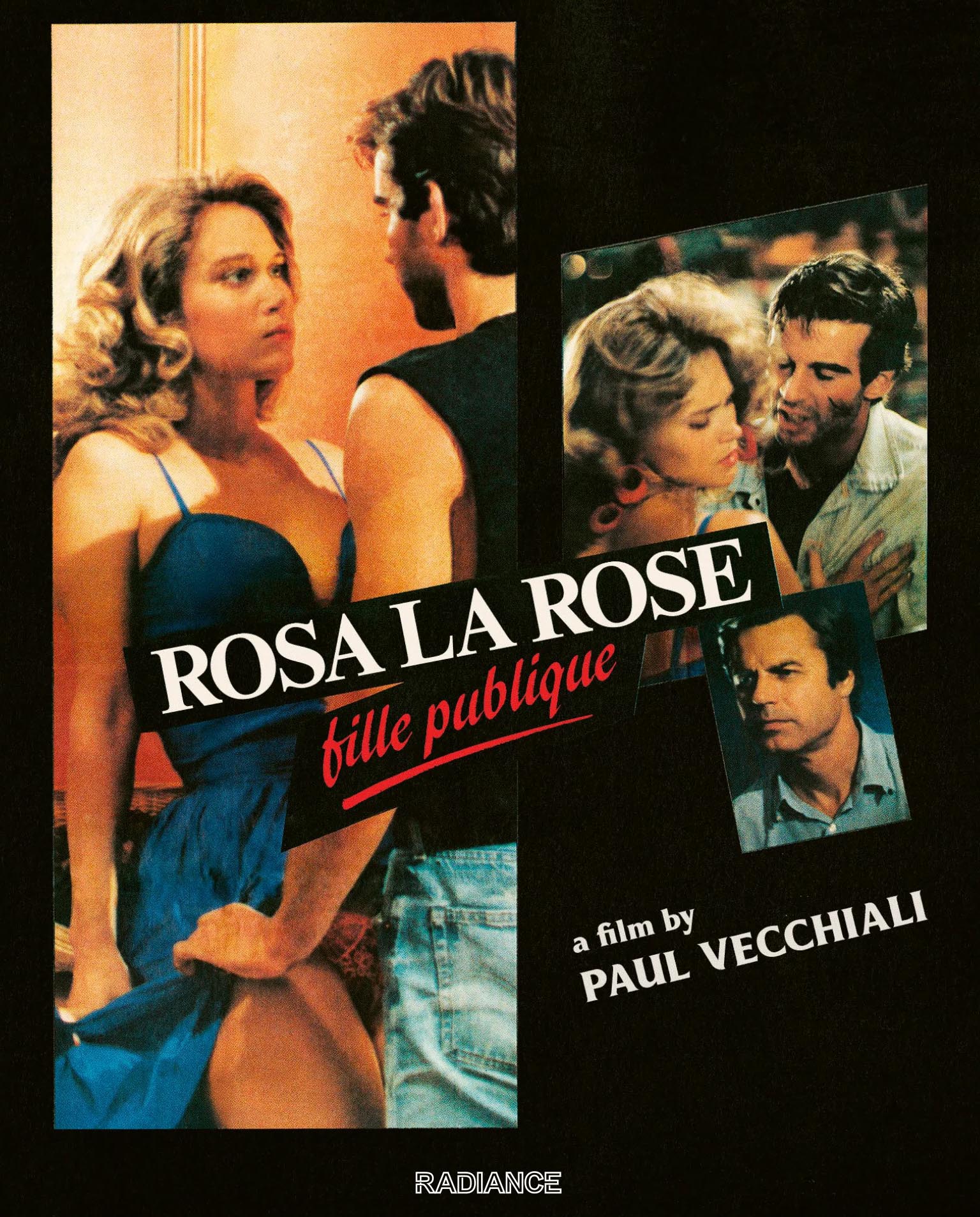
 Paul Vecchiali’s Rosa la Rose: Fille Publique opens with sex worker Rosa (Marianne Basler) spinning toward the camera and responding to a potential client (Pierre Villaret) that her services cost 500 francs and that she doesn’t do overnight visits. As the man mulls what he’s been told, Rosa struts around in her vibrant blue dress, hands on her hips. She quickly takes on the next man (Mathieu Rivolier) who shows up, leading the two johns to start fighting when the first man decides that he wants her as well. Rosa, ever the people pleaser and pleasure seeker, effortlessly calms the two men down by suggesting a threesome, evincing a hypnotic power over the men.
This little drama continues unfolding in a single take that tracks Rosa as she moves up and down the street like a lioness, equal parts sensuous and vigorous. As the trio walk off to their afternoon delight, the camera rises to follow them before delicately lowering into a close-up of two older sex workers (Catherine Lachens and Evelyne Buyle) complaining that they don’t get one-tenth of the customers Rosa does. The camerawork is sleek, purposeful, and theatrical, capturing the beauty and vibrancy of Rosa and her naïve yet joyous way of seeing the world and the pitfalls of sex work that she remains blissfully detached from until it’s all too late.
Despite Rosa appearing to take pleasure in her work, Vecchiali clearly presents it as work— more managerial and performative than physical—while also highlighting the potential fate awaiting the gorgeous ingénue. Bidding her first two clients adieu, she blurts out, “Watch out for AIDS!” Those four words tacitly acknowledges the potential dangers of her work, though the glowing smile on her face indicates how content she is to expel such thoughts from her mind.
In the first half of the film, whether Rosa is meeting a wide array of clients’ desires or performing a dance number at her 20th birthday party, she’s the virtual embodiment of joie de vivre. The birthday party scene also introduces us to the communal aspects of her found family, with the sex workers performing for their pimps, protectors, and loyal customers in an exuberant manner. But like the carnivalesque sequences in many of Federico Fellini’s films, the sorrow and heartbreak awaiting those on the fringes can only be held at bay for so long—an air of melancholy ever-present even on the happiest of occasions.

Rosa’s free-spiritedness is subtly undermined during the party. This sequence hints at her perceived divineness by framing her in the middle of a composition reminiscent of DaVinci’s The Last Supper and at her persistent objectification via the gazes of three males who will, unknowingly, cement her fate. Her comfort at role-playing is shown in her encounters with numerous johns, while her ease with assuaging the needs of those close to her are revealed in her interactions with her pimp Gilbert (Jean Sorel) and the kindly virginal teen (Laurent Lévy) who dutifully follows her around town and helps her whenever she needs it.
It’s only love, arriving suddenly in the form of painter Julien (Pierre Cosso), that destabilizes Rosa, forcing her to confront her reality head-on. And while Rosa la Rose unfolds like something akin to a Shakespearean tragedy, it never loses its compassionate, nonjudgmental eye for the world it depicts. Vecchiali understands that while Rosa is, as the title suggests, a public girl, she’s still her own woman even if being so eventually leads to her own demise.
Image/Sound
The new 2K restoration presented here looks fantastic and is particularly impressive for the breadth of its color palette, which plays a key role in Rosa la Rose’s subtle balancing of fantasy and reality. The colors of Rosa’s outfit and some of the sets practically pop off the screen, while the dour colors of other characters’ costumes and the dingy streets of the small Parisian neighborhood in which the film is set contain a wide range of shades of browns and greys. Meanwhile, skin tones look very naturalistic and detail is strong throughout. On the audio front, the uncompressed mono track nicely balances the street noise, background chatter, and composer Roland Vincent’s memorable score with the dialogue.
Extras
Critic David Jenkins’s interview is a wonderful introduction to Paul Vecchiali, touching on the director’s youth, his two-year stint at Cahiers du Cinéma, his filmmaking career, and his fondness for Max Ophüls and Jean Renoir, as well as the 1940s and ’50s French films that his cohorts at Cahiers du Cinéma disdained. We also get a pair of short interviews, in which Vecchiali, in the first, and Marianne Basler and Jean Sorel, in the second, discuss their attempts at de-stigmatizing sex work, while also presenting the joys, challenges, and dangers that come with it. Lastly, there’s a 28-page booklet with two archival reviews and a new essay from writer and artist Marina Ashioti on the political and humanistic dimensions of Vecchiali’s film.
Overall
Paul Vecchiali’s highly stylized, compassionate, and unflinching examination of a day in the life of a Parisian sex worker gets a beautiful new transfer from Radiance.
Since 2001, we've brought you uncompromising, candid takes on the world of film, music, television, video games, theater, and more. Independently owned and operated publications like Slant have been hit hard in recent years, but we’re committed to keeping our content free and accessible—meaning no paywalls or fees.
If you like what we do, please consider subscribing to our Patreon or making a donation.