
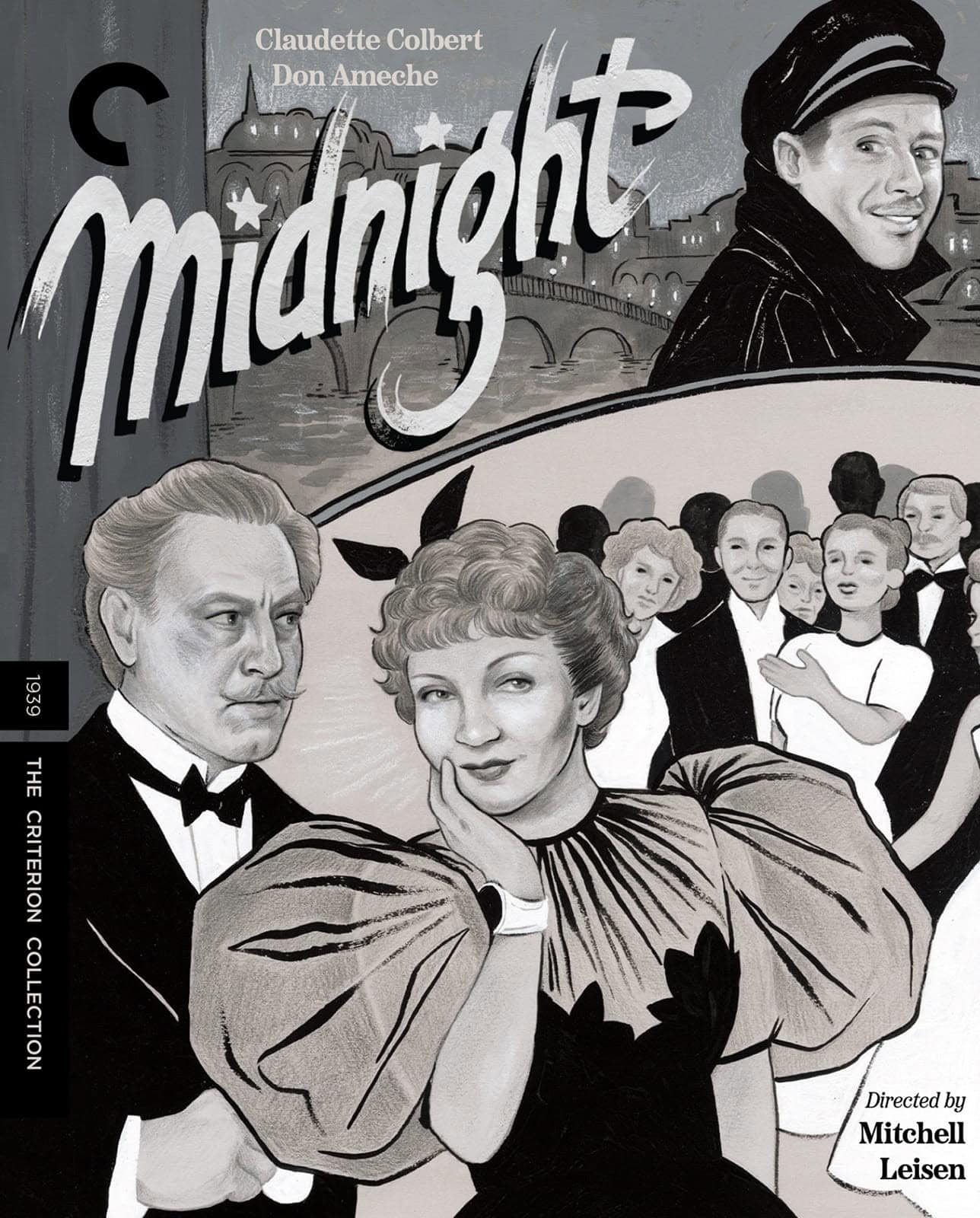
 The title of Mitchell Leisen’s classic 1939 screwball comedy Midnight is a clear allusion to Cinderella, foreshadowing the penniless American showgirl Eve Peabody’s (Claudette Colbert) inevitable entry into high society. It’s within the opening 10 minutes that Eve will meet her prince—or rather, two of them. First, she’s whisked away by the cabbie Tibor Czerny (Don Ameche), with whom she shares an instant attraction as he takes her to some working-class hotspots around Paris before she accidentally finds herself being escorted into a socialite’s swanky party. It’s there, during a game of bridge, that she captures the attention of the wealthy playboy Jacques Picot (Francis Lederer), much to the chagrin of his lover, Helene (Mary Astor), and to the delight of her husband, Georges Flammarion (John Barrymore), who sees Eve, the charming imposter, as the means to breaking up his wife’s affair.
As with many a screwball comedy, deception, role reversals, and delightfully comedic bits of irony are woven into the fabric of Midnight, but it’s the escalating tension between Eve’s twin desires—wealth and love—that gives the film, written by Billy Wilder and Charles Brackett, a barbed edge befitting its shrewd and tough but effortlessly charming heroine. Eve has had enough of being poor and falling for broke men, which is why she eventually runs off from Tibor in search of the sugar daddy she came to Paris to find in the first place.
Yet, it’s telling that when she’s forced to give a fake name to her crew of potential benefactors, it’s Tibor’s name that Eve instinctively takes: Baroness Czerny. While she plots with Georges, the lone upper-cruster to sniff out her fraudulence, to win over Jacques, Tibor scours the city trying to find her. In the world of the film, as Eve runs away from love, Tibor hunts it down, determined to prove to her, once and for all, that money really isn’t all that it’s cracked up to be. Yes, there’s a sense here that Tibor has been written as the man who must save the woman from herself, but any misgivings over that traditional aspect of the narrative is easily forgotten given the richness of Eve’s characterization. For one, despite her gold-digging tendencies, Eve is definitively more cunning, quick-witted, and charming than Tibor.
It isn’t that Tibor doesn’t possess those qualities, but neither is he Eve’s knight in shining armor. As Eve has Jacques wrapped around her finger, and a future free of financial worries within her grasp, it’s Tibor who must prove himself worthy of her. And just as Eve has outwitted most of the snobby socialites she rubs arms with, Tibor is forced to do the same to carefully unravel the web of deceit Eve has spun around them. While he finally catches up with Eve, exposing her as a fraud proves terribly, and surprisingly, difficult. But it’s through this accelerating battle of wits that true love blossoms and the film’s whip-smart and sharply observed humor reaches its peak.
It was his frustrating experience on Midnight that caused Wilder to want to direct his own scripts. Wilder’s quintessentially caustic sense of humor is certainly present in the final product, but one can sense where Leisen, to Wilder’s chagrin, may have shaved off some of that humor’s sharpest edges. Yet, it’s the realistic character psychology that Leisen and, presumably, Brackett, brought to Midnight that so perfectly counterbalances the film’s more searing commentary on the battle of the sexes. And despite any behind-the-scenes scuffles, one can sense none of this discord, as Midnight is as tautly scripted, brilliantly structured, and exquisitely acted as any screwball comedy to come out of classic Hollywood.
Image/Sound
The Criterion Collection’s transfer from a new 4K digital restoration is simply luminous. The image detail is especially impressive, capturing the various textures of Midnight’s many elegant and elaborate costumes, the rain-soaked cobblestone streets of Paris, and the opulence of the mansion where much of the film’s second half takes place. Contrast is also strong throughout, and the tight, even grain retains the celluloid textures of the film’s original presentation. The uncompressed mono audio track features a nicely balanced mix that, fitting for a screwball comedy, foregrounds the dialogue, which is clean as a whistle.
Extras
Author and film critic Michael Koresky provides a well-researched and engaging commentary track that’s determined to raise Mitchell Leisen’s profile among cinephiles. Koresky discusses the director’s queerness and the ways it surreptitiously works its way into his films, as well as touches on Midnight’s class fixations and how Leisen, like Ernst Lubitsch, went out of his way to ensure that his supporting players were given the moment to shine.
In a program featuring a 1969 audio-only interview with Leisen, he talks about the production, his fond memories of the cast, including John Barrymore reading cue cards, and his productive yet tumultuous working relationship with Billy Wilder. Also included are a Lux Radio Theatre adaptation of the film from 1940 and a booklet with an essay by critic David Cairns, who writes of the film’s unique blend of hard-edged cynicism and kind-hearted playfulness.
Overall
One of the most gorgeous and shrewdly constructed of 1930s Hollywood’s screwball comedies gets a sparkling new transfer courtesy of Criterion.
Since 2001, we've brought you uncompromising, candid takes on the world of film, music, television, video games, theater, and more. Independently owned and operated publications like Slant have been hit hard in recent years, but we’re committed to keeping our content free and accessible—meaning no paywalls or fees.
If you like what we do, please consider subscribing to our Patreon or making a donation.



I’m confused- you say “Midnight is tautly scripted, brilliantly structured, and exquisitely acted” but give it only 3.5 stars