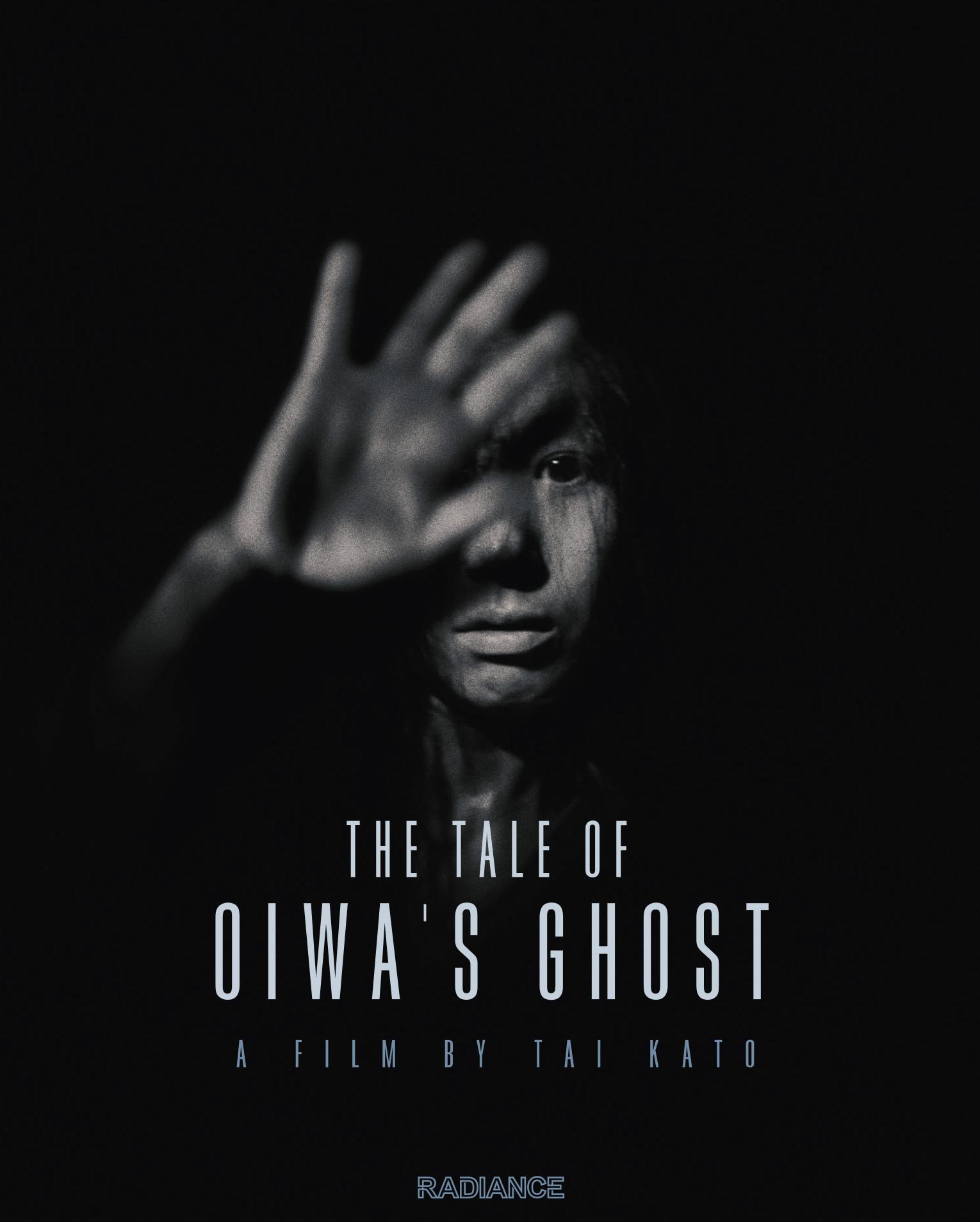
 One of the most famous Japanese ghost stories, Yotsuya Kaidan, or The Ghost of Yotsuya, saw two film adaptations in 1959 alone. The directors of those films, Nakagawa Nobuo and Misumi Kenji, respectively, used color to expressionistically convey the anger of the betrayed and murdered wife, Oiwa. To differentiate itself from those productions, Katô Tai’s 1961 adaptation not only was shot in black and white and went with the title The Tale of Oiwa’s Ghost, but it shifted the focus from feminine vengeance to the horrors of masculine power and insecurity.
When we first meet Oiwa’s (Fujishiro Ayuko) husband, Iemon (Wakayama Tomisaburô), he’s already accidentally murdered a man in a fight, which led him to be estranged from his wife and her family. Unlike the lead of Misumi’s 1959 adaptation, Wakayama’s Iemon is fully complicit in his wife’s downfall. And his consistently vile behavior is typical of that of a serial abuser, as in his need to control Oiwa until the very moment he chooses to dispose of her in favor of his beautiful young neighbor Oume (Mihara Yumiko), whose wealthy parents conspire with him.
From the opening scene of The Tale of Oiwa’s Ghost, Iemon is irredeemably despicable, complaining about missing his wife only for her “beautiful body.” He then murders her father (Akashi Ushio) as a surreptitious way of convincing her to move home, where he soon beats her and sells some of her possessions for quick cash. Wakayama regularly played villains throughout the 1960s, but his Iemon is one of the most impulsive and sadistic of the bunch, driven by greed and lust in a society built around servicing male desire.
For all its foregrounding of Iemon’s viciousness, the film isn’t interested in merely relishing in his cruelty, but depicting it as a piece with the collective misogyny of Edo-era Japan. We see Oiwa’s young sister, Osode (Sakuramachi Hiroko), being sold into indentured servitude and then forced into sex work. Meanwhile, other men, such as Iemon’s cohort Naosuke (Jushiro Konoe) and brothel owner Takuetsu (Watanabe Atsushi), are equally duplicitous, and unhesitant to use and dispose of women at their will.
Like these other men, Iemon, a destitute samurai, is first and foremost searching for a way to move up the social ladder and get back in the good graces of the shogun. Oume’s family offers him that opportunity, making the naïve beauty yet another in the film’s long line of female victims of male megalomania. The filmmakers clearly sympathize with these women, often presenting the women in the film in close-ups that tenderly capture their humanity, with chiaroscuro lighting that both intensifies their beauty and foreshadows the supernatural retribution that’s inevitably to come in this familiar tale.
While that ghostly vengeance is relegated to a single sequence late in the film, it’s quite the showstopper, an intense spectral showdown heightened by a simultaneous thunderstorm and earthquake. Yet, as spectacular as this stylistically evocative horror scene is, it’s a brief but intoxicatingly gorgeous dream ballet between Iemon and Oiwa that leaves the film on a powerful note of emotional anguish—a painful reminder of what Iemon had and squandered, juxtaposed with the bloody, ghoulish aftermath of the violence his actions set into motion.
Image/Sound
For this release, Radiance has sourced a high-def transfer by Toei Studios. The contrast ratio is strong, enhancing the otherworldly quality of the film’s numerous chiaroscuro shots, while details are crisp and clear in close-ups and deep in the frame. There are a few very slight remnants of damage, but this is overall a clean transfer, with nice, even grain distribution and impressive depth. On the audio front, the clangs of swords and knives in the more action-oriented scenes are nicely balanced with the background ambiance and score, while the silences of the more emotional sequences are entirely free of hisses and pops.
Extras
In her new introduction to The Tale of Oiwa’s Ghost, filmmaker Mari Asato discusses the source text’s history as a kabuki play and its tenuous but important connection to The 47 Ronin. She also gets into director Katô Tai’s relationship with mentor Ito Daisuke and various visual techniques he learned from him. Also included is a seven-minute visual essay on tormented female ghosts by Lindsay Nelson that shows clips from various films that highlight the visual similarities between the many incarnations of The Ghost of Yotsuya. Rounding out the package is a booklet with an excellent essay by film historian Tom Mes that covers Katô’s career and argues that he’s one of the great Japanese directors of his time.
Overall
Katô Tai’s take on one of the most famous Japanese ghost stories homes in on the emotional undercurrents of the tale, and it’s all the better for it.
Since 2001, we've brought you uncompromising, candid takes on the world of film, music, television, video games, theater, and more. Independently owned and operated publications like Slant have been hit hard in recent years, but we’re committed to keeping our content free and accessible—meaning no paywalls or fees.
If you like what we do, please consider subscribing to our Patreon or making a donation.