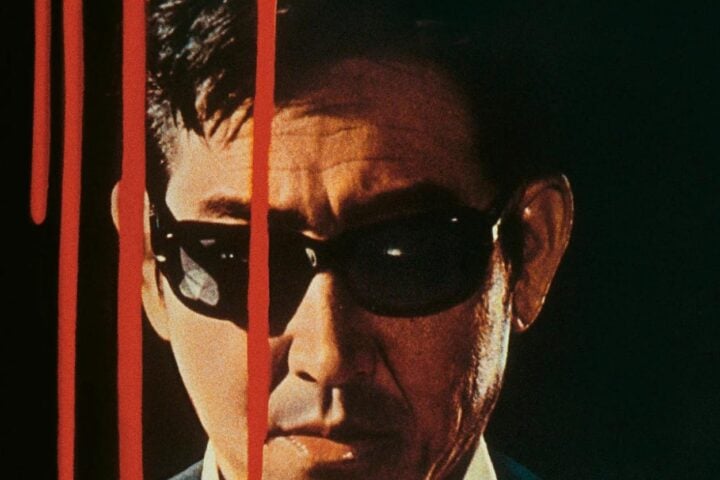
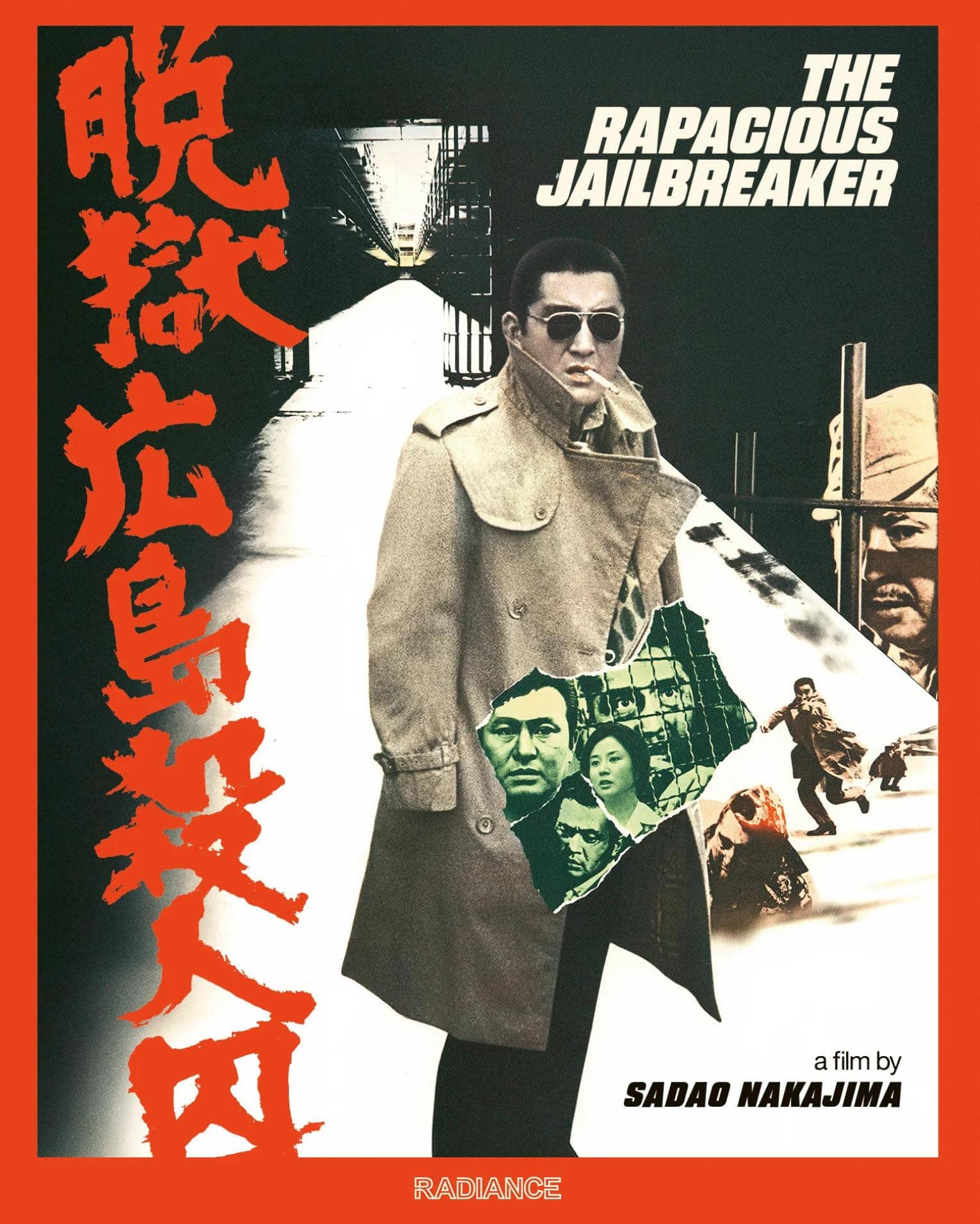
 Set amid the wreckage of post-World War II Japan, Nakajima Sadao’s The Rapacious Jailbreaker locates the chaos and instability of the era almost entirely within the wild journey of its ruthless, tenacious protagonist, Ueda Masayuki (Matsukata Hiroki). A black marketeer in times of economic turmoil, Ueda is first arrested after murdering two people in a drug deal gone bad, and almost instantly he rejects the idea of serving out his entire 20-year sentence, considering the notion of justice as impossible in a society so wholly corrupt.
But Ueda’s objections aren’t based on purely moral or philosophical considerations, as his is mainly an unbridled, primal rebuff of the abusive, fascistic treatment he sees in prison in his first few days. Prisoners are humiliated via excessive inspections, ignored by doctors, and viciously beaten for the slightest infraction. And through it all, Nakajima paints a vivid and unnerving portrait of a social institution still grimly clinging to the barbaric and degrading ethos of Imperial Japan.
In the face of such depravity, Ueda becomes single-minded in his pursuit of escape, to the point that he doesn’t think of what he can expect on the outside. In his first of multiple escapes, he gets himself thrown into solitary, where he extracts a nail from the wall and chisels away at the hole in the ground serving as a toilet. As he pulls himself out on the other side, his feet dangling in sewage, Ueda becomes stuck and, after hiding behind a lid to avoid the gaze of passing guards, yanks himself through, badly bloodying up his hips in the process.
There’s something almost bestial about Ueda’s increasing persistence. After a brief taste of freedom—just long enough for him to stop home to have sex with his wife and catch a movie before—he finds himself back in the arms of the law. Each escape attempt and violent infraction adds more years to his sentence, and after murdering a vengeful yakuza determined to fight him, Ueda further alienates his wife, who’s the only family he has on the outside.
Throughout, Nakajima highlights the similarities between life in prison and life on the outside for the poor and powerless masses. For Ueda specifically, his ceaseless pursuit of escape becomes his sole reason for living. It’s nothing if not cyclical, and The Rapacious Jailbreaker is shot through with an undercurrent of absurdist humor when trying to underline that undeniable fact. As a pure genre exercise, the film is both invigorating and repulsive. But its grounding in reality (it’s based on the true story of a man who escaped prison seven times) puts a historical lens on the rampant venality and immorality of Japan’s immediate post-war years, as well as the extreme measures some went to in order to reclaim their humanity during that time.
Image/Sound
Radiance’s HD transfer boasts strong image detail, particularly evident in the dingy prison interiors. Grain distribution is consistent, and the image shows no signs of ghosting or blurring during the wilder, more rapid camera movements. The lone negative is a fairly consistent flickering, but it’s mostly minor enough to not be a distraction. On the audio front, the mono track is at times echoey, but dialogue comes through cleanly, and the cacophony of sounds during the many fight, prison break, and chase sequences are nicely balanced.
Extras
Yakuza film expert Nathan Stuart provides an audio commentary that’s full of excellent scene and character analysis, while also covering the backgrounds and careers of director Nakajima Sadao and lead actor Matsukata Hiroki. Most interesting is his discussion of the film’s presentation of Japanese prison life in the mid-20th century and the lengths to which Nakajima went to in order to ensure that the film was as authentic as possible.
Also included on the disc is a wonderful video essay by author and critic Tom Mes, who gives a brief but comprehensive overview of Nakajima’s career and talks about how the director’s work in the jitsuroku eiga (“actual record films”) subgenre of yakuza film was distinct from that of the great Fukusaku Kinji. Rounding out the package is a 24-page booklet with an archival review of the film by critic Saito Masaharu and new, context-rich writing by author Earl Jackson.
Overall
Nakajima Sadao’s memorably brutal and absurdist The Rapacious Jailbreaker is bound to appeal to fans of the work of Fukasaku Kinji, the master of the jitsuroku eiga.
Since 2001, we've brought you uncompromising, candid takes on the world of film, music, television, video games, theater, and more. Independently owned and operated publications like Slant have been hit hard in recent years, but we’re committed to keeping our content free and accessible—meaning no paywalls or fees.
If you like what we do, please consider subscribing to our Patreon or making a donation.