
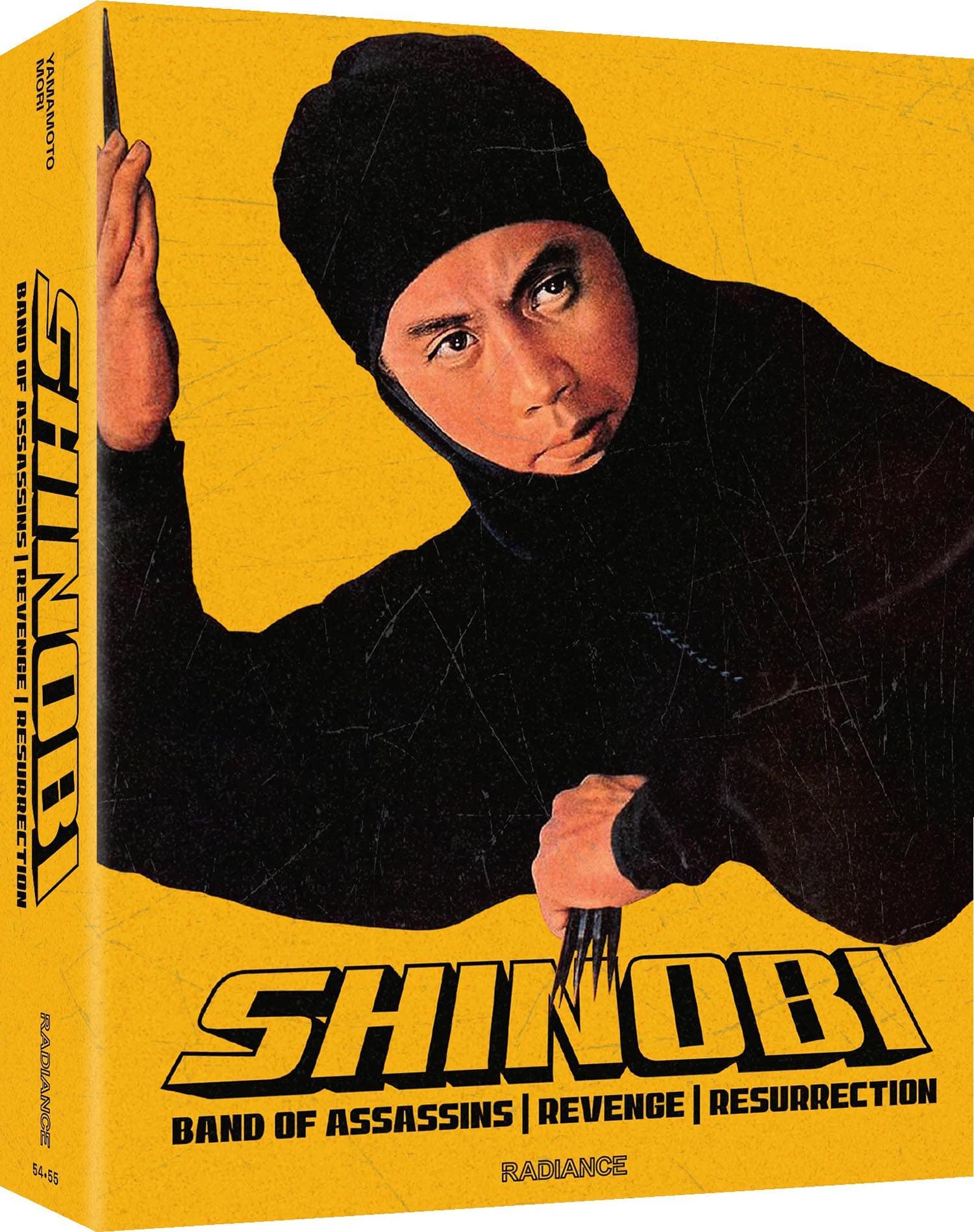
 From the opening of Yamamoto Satsuo’s first entry in the Shinobi series, Band of Assassins, we’re thrust into a tangled web of battling clans, all vying to be the first to kill bloodthirsty warlord Oda Nobunaga (Wakayama Tomisaburô). Even within individual factions, duplicity reigns supreme, with all the double crosses and dual identities obfuscating and complicating the motives of every virtually every major character. The film tends toward convolution through the flurry of personal and clan names constantly being introduced, but this tactic of disorientation is ultimately a deliberate and effective one that’s very much in line with the tactics deployed by its ninjas.
Among all these embittered and embattled clans is Ishikawa Goemon (Raizo Ichikawa), a highly skilled young ninja looking to quickly rise through the ranks. Like many of the lower-level ninjas and samurai in Band of Assassins, he, too, falls victim to the Machiavellian manipulations and power moves of those in positions of authority. Indeed, his own clan lord, Momochi Sandayu (Itô Yûnosuke), tempts Goemon into starting an affair with his wife, Inone (Kishida Kyoko), only to murder the woman, frame Goemon, and force him to work as a bandit in order to fund Sandayu’s efforts to overthrow Nobunaga and rule after his demise.
While Band of Assassins is filled with wild plot twists, surprising character reveals, and an array of ninja trickery—including disguises, secret corridors, elaborate poisonings, and cinema’s first appearance of the throwing star—Yamamoto’s film is quite grounded in reality. It draws on the historical events of Japan’s Sengoku era in the 16th century and major figures like the aforementioned Nobunaga, Hideyoshi Toyotomi, and Hanzô Hattori. And despite their skills at stealth and deception, the ninjas here rely more on their mental acumen and psychological gamesmanship than they do on their impressively sly physical movements. It’s all part and parcel of the film’s seamless, wildly entertaining fusion of historical fact and ninjutsu folklore.
Where Band of Assassins is relatively discursive in following the maneuvers of multiple clan leaders and political figures, Yamamoto’s follow-up, Vengeance, is more explicitly hitched to Goemon’s perspective. And while that earlier film saw those in power as the puppeteers surreptitiously moving commoners about like puppets, this film finds the controls shifting to Goemon, at least after Nobunaga’s men murder his infant son in a shockingly brutal manner.
Vengeance is more direct and easily digestible than its predecessor, with its revenge arc akin to that of many samurai films of the era. Its uniqueness, instead, lies in the manner in which Geomon enacts his revenge, which comes about less through bloody fights and assassinations than through psychological warfare. Rather than slicing his way up the food chain to Nobunaga, he plays into the weaknesses of the domineering warlord’s underlings, fomenting discontent among those who are left wanting more in return for their undying loyalty toward him.

The balance of mental and physical prowess in Goemon’s pursuits pays off in spades, particularly following a surprising mid-film event that leads him to expand his surreptitious manipulations to far more foes. And it’s in the film’s second half, where the excessively vicious displays of power and violence mirror those of Nobunaga’s in Band of Assassins, that Vengeance’s themes extend beyond those of mere justice and retribution. In this stretch, the film more explicitly examines the inevitably cyclical nature of violence and the dangers of power vacuums to give way to destruction that’s even more appalling than what came before it.
The final film in the trilogy, Resurrection, sees a change in the director chair, with Mori Kazuo, best known for directing three films in the Zatoichi series, taking the reins. There’s also a more distinct change in Goemon, who’s quest for vengeance now targets the warlord, Hideyoshi (Tôno Eijirô), directly responsible for his young son’s gruesome death in the previous film. Not only is Goemon more often confined to the shadows, where, with the help of Hanzô Hattori (Date Saburo), he employs various forms of ninja deceptions to disrupt Hideyoshi’s familial harmony and political stranglehold over Japan, but his unquenching thirst for vengeance has left him a shell of his former self and estranged from even his closest friends.
Despite its title, which refers to an event at the very start of its narrative, Resurrection is more of a dirge than a celebration of personal resurgence. While its lack of larger set pieces and battle scenes, along with its narrative being centered more on Hideyoshi than Geomon, is slightly disappointing, Mori’s film takes the Shinobi series into darker, more psychologically warped terrain, and in the end it more fully grapples with the myriad sacrifices and emotional costs of being a ninja. Even in a moment of triumph, Resurrection ends with Goemon disappearing in a misty forest, with nowhere to go and a close friend calling out to him but getting no response. His humanity, or what’s left of it at least, now dissipates among the fog.
Image/Sound
The HD transfers of Band of Assassins, Vengeance, and Resurrection boast fairly strong contrast, with high levels of detail in medium shots and close-ups. While there’s little sign of damage or debris, some of the edits are unnaturally harsh and jumpy. It would have been nice to have those smoothed out in the digital editions of the films, but it’s not a frequent enough occurrence to be a major issue. Otherwise, the image is sharp and clean throughout, with well-managed grain levels. On the audio front, there’s a bit of underlying hum that’s noticeable in most of the films’ quieter moments, but dialogue and music come through perfectly clear.
Extras
In an interview, artistic director of the Tokyo International Film Festival, Ichiyama Shozo, gives a nice overview of director Yamamoto Satsuo’s life and career, touching on his work on numerous contemporary, socially conscious dramas and his leftist political activism after World War II. Film scholar Mance Thompson provides an in-depth look at the history of the ninja in Japanese cinema in his illuminating video essay. He discusses the countless silent films in which ninjas appeared and how the Shinobi series changed and solidified the iconography of ninjas ever since its release. Lastly on the disc is an interview with film critic Toshiaki Sato, who focuses on actor Ichikawa Raizô, including his transition from a kabuki to film actor. The package is rounded out with six postcards of promo material from the films and a 40-page booklet with new essays by author Jonathan Clements and film and media studies professor Diane Wei Lewis, along with an archival essay by Takemura Yasukaze.
Overall
Radiance continues to shine a light on overlooked Japanese genre fare with this excellent Blu-ray set of the first three films in the Shinobi series.
Since 2001, we've brought you uncompromising, candid takes on the world of film, music, television, video games, theater, and more. Independently owned and operated publications like Slant have been hit hard in recent years, but we’re committed to keeping our content free and accessible—meaning no paywalls or fees.
If you like what we do, please consider subscribing to our Patreon or making a donation.




Fine review, but perhaps a few spoiler alerts would be polite? You give away a huge plot point in Band of Assassins.