 Julian Schnabel’s Basquiat is often at war with itself. At times, it effortlessly captures Jean-Michel Basquiat (Jeffrey Wright) and the Manhattan art world in which he flourished with bracing authenticity, only for it to become weighed down by biopic clichés that flatten out its characterizations. For every patient sequence that sits back and allows the audience to observe Basquiat at work, carefully detailing his process, there are two more that feel like they were ripped straight from the artist biopic playbook.
As great a song as Modern Lovers’s “Girlfriend” is, playing it over the scene in which Basquiat meets soon-to-be girlfriend Gina (Claire Forlani)—a composite of Basquiat’s real-life girlfriends, including Suzanne Mallouk and Madonna—is impossibly on the nose. And that scene is followed up by another in which Basquiat and his best friend, Benny (Benicio del Toro), see a character on TV utter what would become the painter’s famous catchphrase: “Boom for real.” Is there a group of white yuppies snickering at Basquiat in a fancy restaurant where they don’t think he belongs? Of course there is, just as we also get a few seconds in a later scene to see that the so-called gutter artist can appreciate classical music.
These latter two moments wouldn’t be as egregious if they were part of the film’s attempt to interrogate either the racism that Basquiat faced even outside of the art scene or explore the ways in which the artist synthesized his influences into his work. But these are one of many times in which Schnabel relies on shorthand to gesture at the complexities and contradictions of Basquiat’s life without digging deeper into how they affected him and his work.
Fortunately, Wright embraces the enigmatic nature of his character, bringing much-needed idiosyncrasy to the film. The playfulness of the actor’s performance mirrors that of Basquiat’s work, moving beyond mimicry in how he presents an artist as being deeply trapped in his internal world. At times, Schnabel, too, finds ways to depict the vibrancy of Basquiat’s mind, as in an early shot, later repeated, in which the painter gazes up at the New York skyline only to see the sky above the buildings replaced by a surfer riding giant ocean waves.
It’s in the quieter, more character-based scenes that the film at least begins to penetrate Basquiat’s mystique, homing in on his vulnerability, sense of wonder, and how he sees the world around him. But just as a hostile art world had noxious effects on him and his artistic journey, the film’s insistence on trying to fit a singular artist into a one-size-fits-all biopic template only results in sanding down all the roughness that informed his legend.
Image/Sound
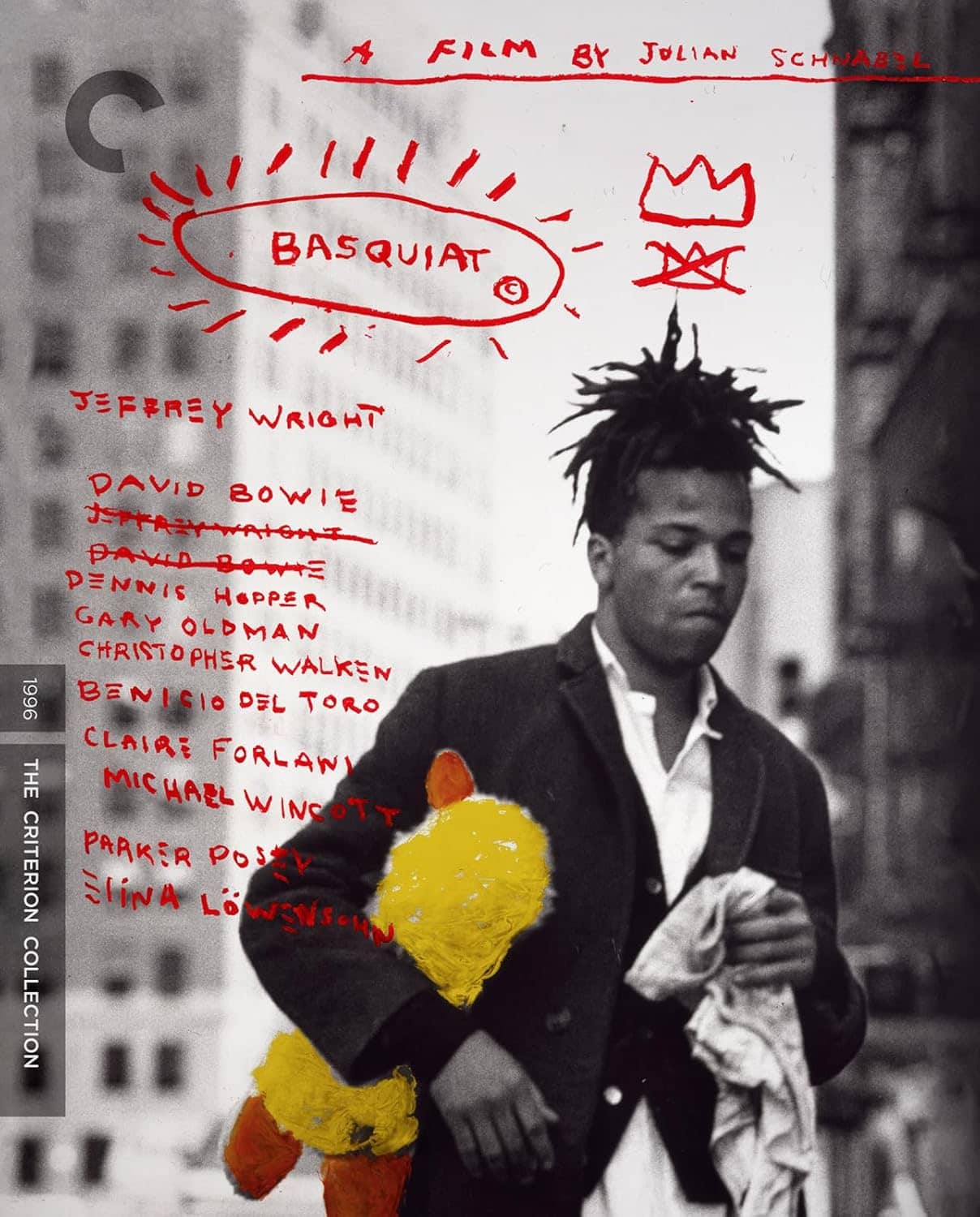
The Criterion Collection has included both the 2024 black-and-white version and the original color theatrical version of Basquiat, each which were restored in 4K. The black-and-white cut gets the preferential treatment by being housed on the 4K UHD disc, and the image clarity, grain distribution, and contrast is spectacular. In everything from the New York City exteriors to the close-ups of Jeffrey Wright’s expressive face, the sheer amount of detail present in every frame is especially impressive. Given that the color version is only in high-def SDR, it’s a step down from the black-and-white version in terms of image detail, but the colors are rich and vibrant enough to capture just how dynamically Basquiat used them in his paintings. The 5.1 audio mix is fully immersive, with the ever-present background sounds of the city subtly placed throughout the channels and dialogue sounding consistently clean and crisp.
Extras
In a commentary track that he shares with curator Giulia D’Agnolo Vallan, Julian Schnabel talks at length about meeting Basquiat and his own experiences in the art world beginning in the ’80s. The track is most interesting for his vivid recollections of No Wave-era New York, which was all about rampant drug use. Schnabel also appears, along with David Bowie, in a 1996 interview with Charlie Rose that’s most interesting for how they clash over their ideas about Basquiat’s work. We also get a new interview with Wright, who talks a lot about his early years in theater and starting out in the film world. Lastly, a foldout booklet includes an essay by film scholar Roger Durling, who discusses, among other things, Schabel’s use of composition in the film and the recurring theme of artistic freedom across his work.
Overall
Whether or not the new black-and-white version of Julian Schnabel’s film is even necessary is debatable, but Jeffrey Wright’s performance is a triumph in any color.
Since 2001, we've brought you uncompromising, candid takes on the world of film, music, television, video games, theater, and more. Independently owned and operated publications like Slant have been hit hard in recent years, but we’re committed to keeping our content free and accessible—meaning no paywalls or fees.
If you like what we do, please consider subscribing to our Patreon or making a donation.