
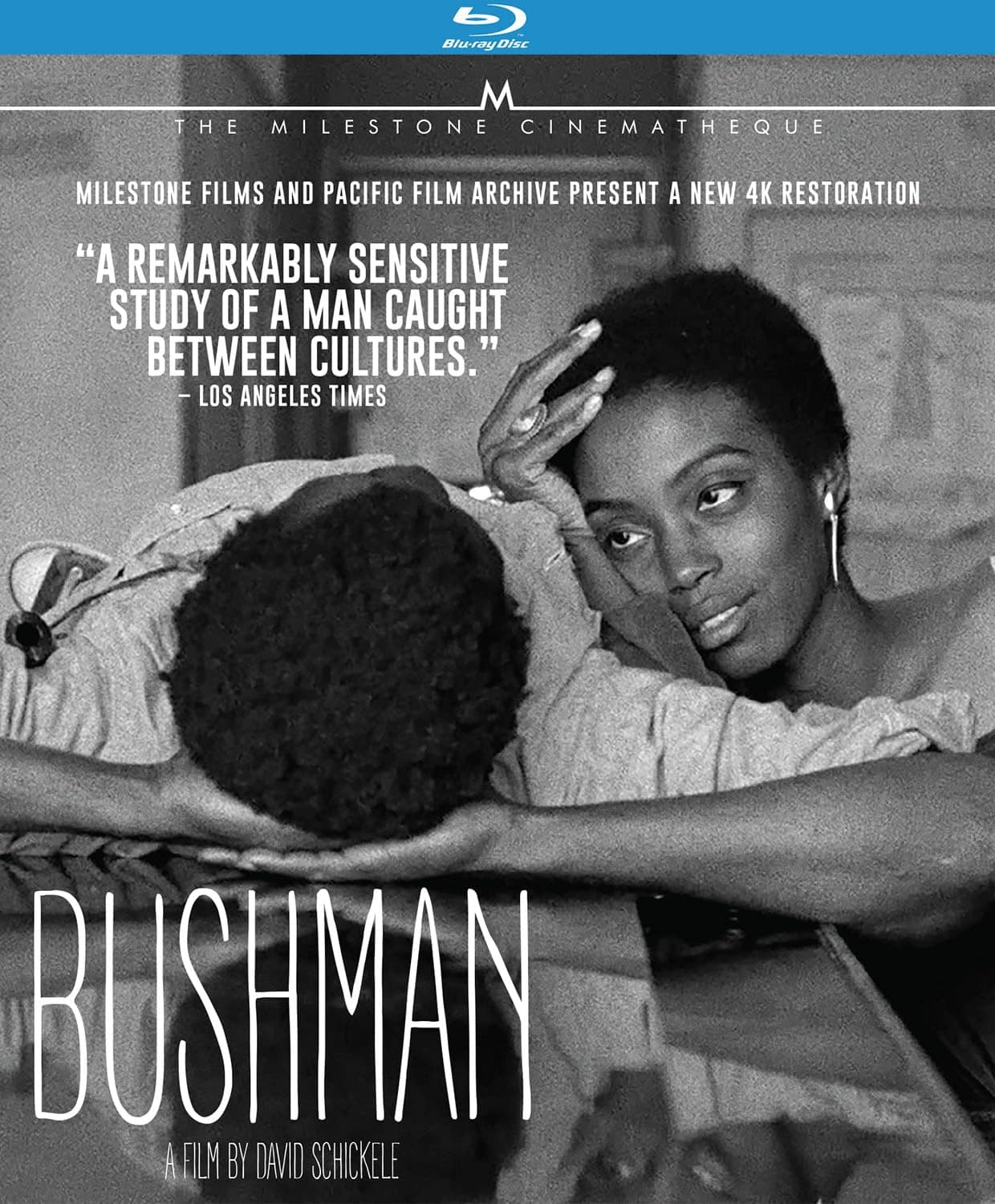
 David Schickele’s Bushman opens with Gabriel (Paul Eyam Nzie Okpokam), a young Nigerian immigrant, walking down a San Francisco highway and conspicuously balancing a pair of shoes on his head while trying to thumb a ride. The image announces the film’s neorealist intentions, alluding to postwar Italian films’ on-location, street-oriented settings, and even puns on the title of Vittorio De Sica’s Shoeshine. Which isn’t to say that Bushman intends to turn neorealism on its head exactly. Rather, it aims to consider how the contexts the bred neorealism might relate to the late-1960s, when the United States was at war in Vietnam and Nigeria was in year two of a civil war following its decolonization in 1960.
After a playful opening sequence in which Gabriel is picked up by a motorcyclist (Mike Slyre) who looks as though he just stepped off the set of Easy Rider, the film transforms into a more intimate drama largely set inside apartments and cafés, and along city streets (shades of John Cassavetes’s Shadows and Faces). As Gabriel talks with Alma (Elaine Featherstone), his Black girlfriend, he has brief flashes of his life in Nigeria. Time seems to keep intruding on Gabriel’s consciousness, and Schickele creates a collage of his thought process that generates a tension between Gabriel’s subjectivity and the film’s more objective docu-fiction style.
The conversations between Gabriel and Alma mostly revolve around recollections of past moments and ruminations on the social climate of the present. In the film’s best scene, Alma plays Aretha Franklin’s “Respect” on a jukebox, and Schickele lingers on her movements as she dances throughout an array of close-ups and wide shots that find vitality in ceasing to talk and letting one’s hands and feet speak for themselves. It’s part and parcel of how Bushman recognizes that one’s own body cannot be separated from desire and ambition, especially when so much of societal prejudice revolves around judgements predicated entirely on ethnicity.
Much of the episodic Bushman sees Gabriel, a professor of African literature at the University of San Francisco, interacting with white people, many of whom fetishize his Blackness. The most intriguing episode involves Felix (Jack Nance), a gay man who invites Gabriel into his apartment, which is filled with African artifacts. After the interaction becomes awkward once Felix tries to have sex with him, Gabriel leaves by giving Felix a reluctant hug, to which Felix responds with pleasure. Like numerous passages in the film, white people’s responses to Gabriel range from lustful to contemplative of his socio-political status as a Nigerian man in America.
The dramatic stakes of cultural and ethnic stressors become especially relevant once Okpokam is arrested during the making of the film on a phony charge involving the possession of an explosive device. Suddenly, Schickele is on screen, speaking directly to the camera: “Truth was no stranger than fiction, just a little faster.” Schickele had planned for his fictional portrayal to culminate with Gabriel being apprehended by the police and eventually “sent away,” but when it actually happened to Okpokam, who like his character was in the U.S. on a visa teaching African literature, an immense slippage was created between where the film ends and reality begins.
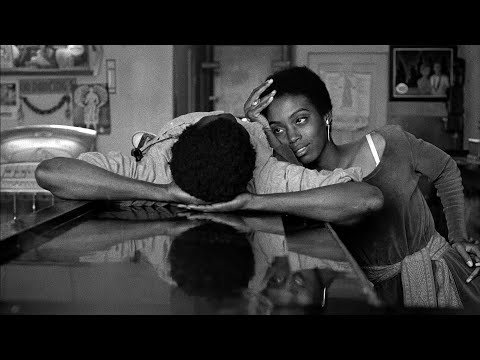
Rather than simply abandon the project, Schickele opted to pull back the curtain and transform the final 15 minutes of Bushman into a documentary about Okpokam’s arrest, time in jail, and eventual deportation in December 1969. Ironically, this conclusion is more resonant as a stopping point for the film than anything Schickele could have possibly conceived. It’s proof that when depicting the lives of immigrants, or any member of society who’s vulnerable to prejudicial persecution, fiction and reality can quickly become entwined.
Image/Sound
This 4K restoration of Bushman, overseen in part by Martin Scorsese’s Film Foundation, is on par with the nonprofit organization’s excellent work for many of the transfers presented in the World Cinema Project sets released by the Criterion Collection. Image detail, along with the presence of grain, is healthy and consistent. Black levels boast solid delineation. Given the film’s extensive use of close-ups, the image’s sharpness fitfully conveys the minutiae of varying reaction shots. The 2.0 DTS-HD audio boasts an impressive range, remaining mostly quiet and oriented around the film’s many intimate conversations, but it’s capable of getting suitably loud too, as when a track by Aretha Franklin blares from a jukebox.
Extras
This Blu-ray release of Bushman could easily have been marketed as an anthology of David Schickele’s work, given that his two other feature films are included as extras. Give Me a Riddle, from 1966, follows Roger Landrum, a U.S. Peace Corps veteran, as he visits the University of Nigeria at Nsukka, where he used to teach. Much like Jean Rouch’s Moi, Un Noir, from 1958, the film is a cinéma vérité-style work, shot on 16mm, about a white filmmaker documenting the lives of young Nigerian men. Tuscarora, shot on video and released in 1992, is unrelated to Nigeria. It chronicles a couple who created a pottery school in Tuscarora, Nevada, only for a large company to build an open pit mining operation nearby, threatening the town’s existence. Rather than leave, the couple, along with other residents, decide to stay and combat the intrusion of environmentally destructive big business.
A commentary track on Bushman by film historian Daniel Kremer and filmmaker Rob Nilsson examines the film’s production history and its subsequent absence from circulation on either home video or in repertory theaters for many years. The pair analyze Schickele’s directorial style, which allowed the actors to improvise and create scenes from a loose outline. They also talk about the tension between documentary and fiction that exists throughout the film, especially in the final turn once Opokam is arrested and subsequently deported. Rounding out the disc’s robust array of extras is the re-release trailer from Milestone Films for Bushman.
Overall
Bushman, a compelling docu-fiction hybrid about a Nigerian immigrant living in late-’60s San Francisco, receives an exceptional Blu-ray release from Kino Lorber and Milestone Films.
Since 2001, we've brought you uncompromising, candid takes on the world of film, music, television, video games, theater, and more. Independently owned and operated publications like Slant have been hit hard in recent years, but we’re committed to keeping our content free and accessible—meaning no paywalls or fees.
If you like what we do, please consider subscribing to our Patreon or making a donation.


