
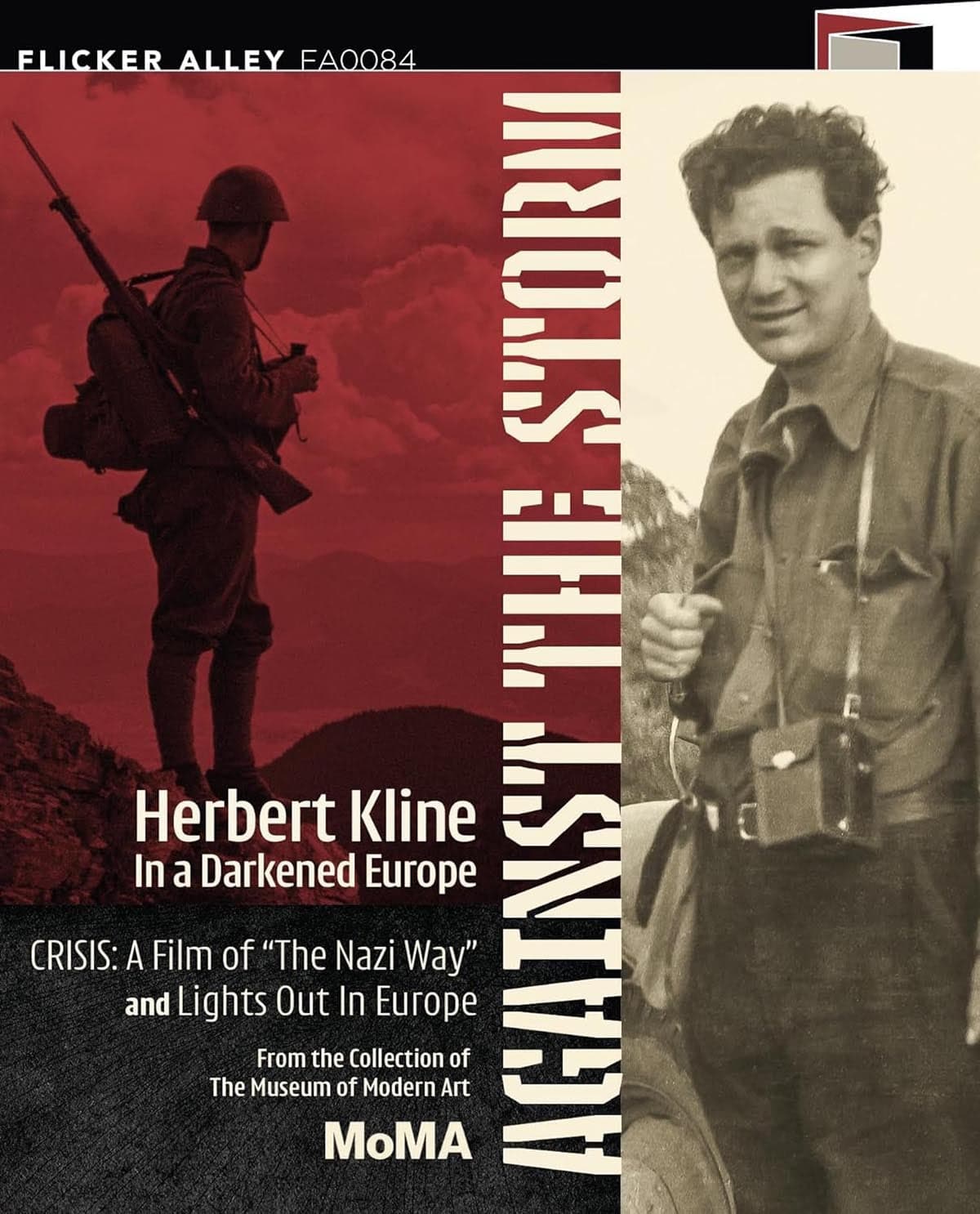
 When Herbert Kline, Hans Burger, and Alexander Hammid’s Crisis: A Film of the Nazi Way premiered in New York City on March 11, 1939, agitprop was largely affiliated with European styles of theater, literature, and film that confronted viewers and readers with political messages. The Soviets in particular helped to define this mode of art in conjunction with the Russian Revolution and its aftermath. Crisis, though, introduced a new form of agitprop that combined the style of an expository documentary with the exigency of a newsreel.
The film documents the circumstances that led to the occupation of Czechoslovakia, beginning with images of maps and narration by American actor Leif Erickson before portraying daily life in Prague. Crisis abounds in luminous shots of Prague’s many cathedrals and castles, presenting the city as a thriving, peaceful place that will shortly be uprooted by Nazi infiltration.
Redolent of Dziga Vertov’s The Man with the Movie Camera, the film’s sights and sounds take on starker and more haunting possibilities as it proceeds. Early on, Czech citizens try on gas masks inside a store as upbeat classical music plays on the soundtrack. But then, while the same people are examining photographs of the lasting effects of exposure to poison gas, menacing music sets in and we catch glimpses of horses and children wearing gas masks as well.
The mixture of innocence and catastrophic overtones embodies how Kline and his collaborators approached these circumstances with a clear sense of dramatic and artistic purpose. While Crisis never becomes reflexive like The Man with the Movie Camera (little attention is drawn to the presence of Hammid’s camera), it nevertheless finds the vitality in human life by burrowing into the spaces where people and families exist. In short, it shows the lives of innocent people being steadily transformed by forces beyond their control.
Given that Kline had to sneak the footage for Crisis out of Prague by posing as a Nazi sympathizer, it’s incredible that he went back into the fray to shoot Lights Out in Europe in mid-to-late 1939. In Warsaw and London, Kline documented the Nazi invasion of Poland. The citizens of London see movies, drink beer in pubs, and carry on seemingly without evident fear. Both Crisis and Lights Out in Europe show audiences attending vaudeville and comedy acts, which satirize Nazis in a manner that prefigures Charlie Chaplin’s The Great Dictator. There’s a real-time sense of blissful ignorance, or at least of being able to laugh at and chide the aggressor before the reality of the Nazi reign of terror had been fully understood.
Fredric March’s narration mirrors the events that it’s commenting on by adopting an objective tone, which reiterates how Kline’s approach isn’t incendiary or prone to rabble-rousing. The film, above all, is observational, and it and Crisis provide remarkable examples of how journalistic integrity combines with cinematic technique to produce works that can lay claim to conceptualizing both the state of being and state of mind in these cities during this time.
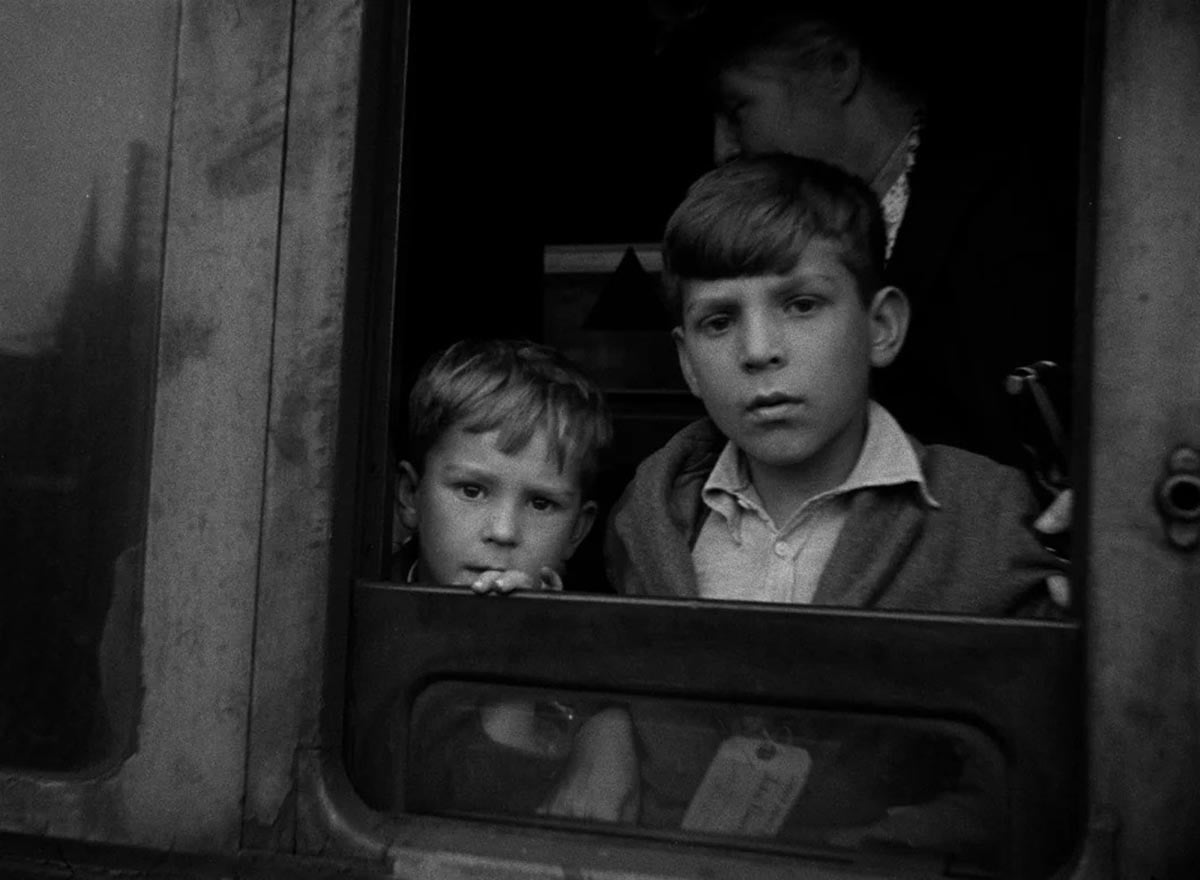
But the films are also unflinching. Late into Lights Out in Europe, after an air raid strikes the Polish Corridor, a young woman lies inside a train, shivering and dying from a bullet wound to the throat. While the moment certainly raises significant issues regarding documentary ethics, it’s also a moment that announces the passing of a previous era of both filmmaking and global life. For, in the years to come, such images would become commonplace as filmmakers set out to depict and document the multitudinous war-torn sites of Europe.
Image/Sound
Both Crisis: A Film of the Nazi Way and Lights Out in Europe have been restored in high definition from the best existing elements held by the Museum of Modern Art, and the results are nothing short of striking. Each film boasts dynamic contrast ratio, balanced grain distribution, and stellar detail, which is as notable in the extensive use of close-ups as it is the wide shots of the Czechoslovakian countryside. The mono audio is crisp and clean for each film, and there aren’t any moments where the narration is difficult to discern. The disc also contains optional English SDH subtitles for each film for the deaf and hard of hearing.
Extras
Two audio commentaries thoroughly contextualize each film’s production and stylistic traits. For Crisis, cultural historian Thomas Doherty considers the circumstances that brought Herbert Kline, Hans Burger, and Alexander Hammid together as creative collaborators. He also speculates on what it must have been like to view the film in the spring of 1939 in the United States. For Lights Out in Europe, film historian Maria Elena de las Carreras largely focuses on the film’s style, including the moments that were partially staged for the camera. Also included on the disc is a short newsreel, titled “Peace! The Four Powers Conference,” which profiles Prime Minister Neville Chamberlain’s return to the United Kingdom in 1938. In it, he speaks with premature hope and certainty that peace will prevail in Europe.
Another substantial extra is 1942’s “The White Eagle,” an Oscar-nominated documentary short narrated by Leslie Howard that chronicles Polish expats, both civilians and soldiers, now living in London. Directed by Eugeniusz Cekalski, its observational approach to an unfolding catastrophe echoes the style of both Crisis and Lights Out in Europe. Rounding out the robust supplements are an image gallery with archival images and promotional materials from MoMA and Syracuse University Special Collections Research Center, as well as a booklet containing a new essay by Doherty on both films’ production and distribution, which are accompanied by conservation notes by Dave Kehr, curator in the department of film at MoMA.
Overall
These essential wartime documentaries have been carefully restored in high definition by MoMA and given a bevy of insightful supplements on Blu-ray from Flicker Alley.
Since 2001, we've brought you uncompromising, candid takes on the world of film, music, television, video games, theater, and more. Independently owned and operated publications like Slant have been hit hard in recent years, but we’re committed to keeping our content free and accessible—meaning no paywalls or fees.
If you like what we do, please consider subscribing to our Patreon or making a donation.


