
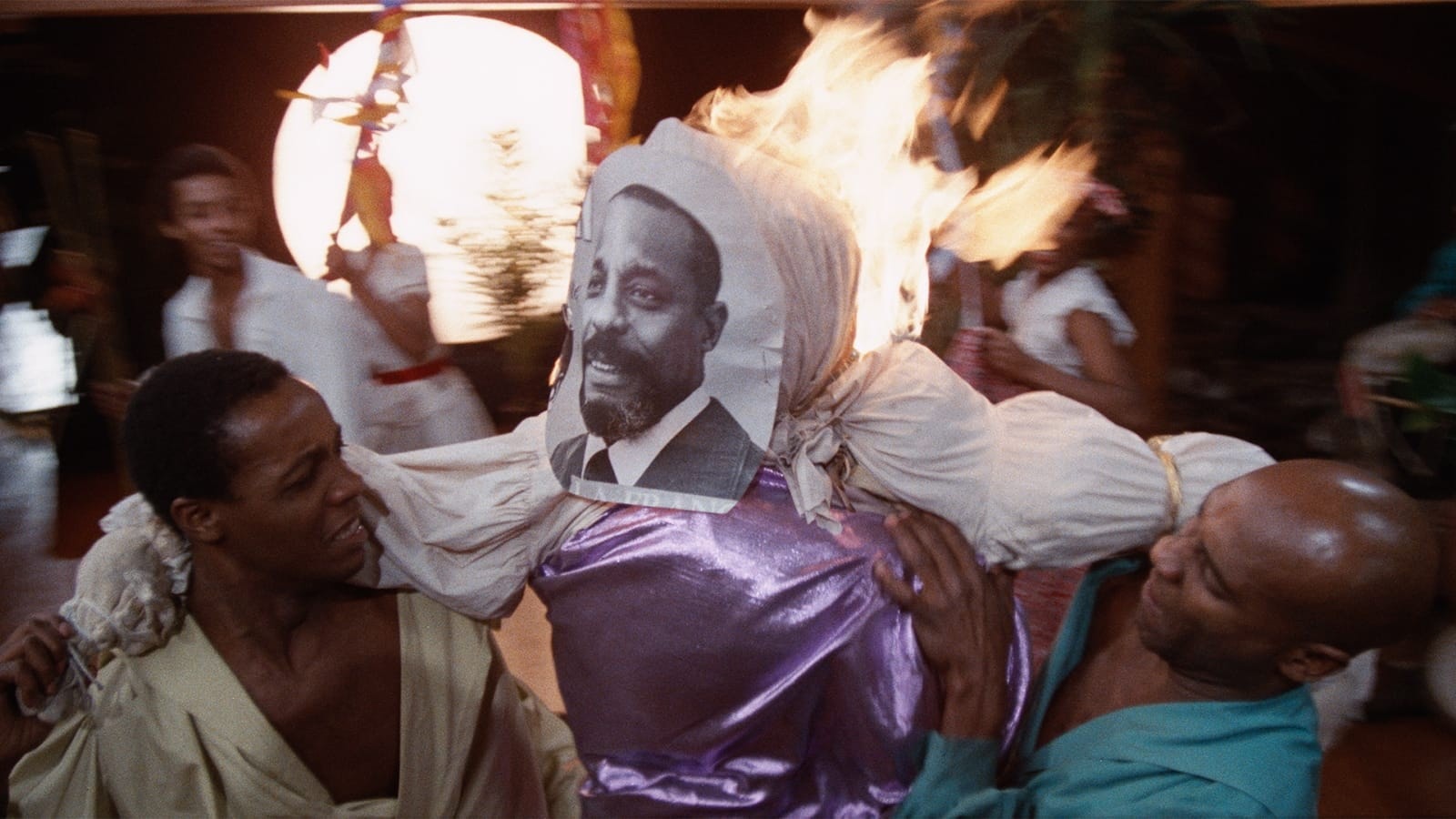
Med Hondo’s 1979 musical extravaganza West Indies: The Fugitive Slaves of Liberty is a satirical skewering of the legacy of French imperialism in the West Indies and beyond. From the outset, it defies categorization through its distinct sense of free association as it leaps from one colorful image to the next, often shunning context along the way. Throughout Hondo’s film, the xenophobic and racist rhetoric of haughty, predominately white French aristocrats, bureaucrats, and citizens is combatted, challenged, or lampooned by various African figures. Some are slaves, some are revolutionaries, while some are simply power hungry. The result is a deliriously iconoclastic anti-colonialist work that’s worthy of the finest films from roughly the same period by Ousmane Sembene and Dijbril Diop Mambéty.
Adapted by Hondo and Daniel Boukman from the latter’s novel Les Negriers, West Indies traces an epic history of colonial oppression and enslavement in the West Indies, stretching from the years of the African slave trade to the present, and it does so aboard a slave ship within an abandoned Citroën factory. Rarely does the energy of Hondo’s tongue-in-cheek sensibilities rarely slow as the sets change and seemingly hundreds of characters roam the highly theatricalized setting across the film’s nonlinear timeline. Like Hondo’s Soleil Ô, which burrows into the madness wrought by systemic racism through a blitz of narrative and stylistic techniques, West Indies is a bravura spectacle of intellectual and cinematic daring.
Much of the delight that underpins West Indies can be traced to the sense of humor with which it regards the pursuit of power, as a concept and ambition, as ludicrous and worthy of mockery. As the film opens, a tribunal of unnamed people convene to discuss how to eradicate “those little people” from the map. They’ve just watched a video of agricultural process, where farmers and laborers harvest crops and tend to the land. They shake hands, congratulating one another on simply having the desire to divide and conquer those who are not identical to them.

Shortly after these events, an election of an unknown sort is held and a Black man named La Parlementaire (Robert Liensol) is elected to rule an undisclosed territory. These elements are less a mystery to be unfurled than a prelude to a gag—so that the filmmakers can later have the man sit on a throne, simultaneously wearing a crown while holding a scepter and clutching a silver pistol. The man, who seemingly helped rig the election, simply luxuriates in having obtained power, as he doesn’t put forth any ideas, meaningful or otherwise, that would suggest that he’s ideologically motivated. The moment is emblematic of the film’s carnivalesque mode of satire, where the payoff often hinges on distilling corruption into a single irreverent image.
West Indies is deeply cinephilic, indebted to (and implicitly commenting on) Hollywood musicals and the films of Jacques Tati and Jean-Luc Godard, but its closest analog may be Dušan Makavejev’s 1974 picaresque comedy shocker Sweet Movie, which formulates its attack on ideologues through bizarre, and often musical, sequences that lambaste corruption run amok. But whereas Sweet Movie completely goes off the rails, with scenes of people, among other things, consuming and writhing in actual feces, Hondo utilizes his musical sequences to emphasize various forms of dance styles, including minuet, swing, and calypso, focusing on artistry and bodily expression first and foremost. Like in the dance films of Carlos Saura, these sequences are displays of pure movement, freed from the need to advance a linear story.
While West Indies at times finds itself in the grips of academicism through its soliloquies and asides, Hondo seldom presents them at face value, as they’re consistently undercut or challenged as yet another form of attempted persuasion. Hondo clearly comes from an anti-colonialist school of thought, following in the footsteps of writers such as Aimé Cesare and Frantz Fanon, but his film is no mere screed in the name of a particular agenda.
The kaleidoscopic sensibilities of West Indies are such that it verges at times on surrealist incoherence, with its absurdist inclinations overruling didactic political speech or sincere action. But it’s all the more thrilling and aptly liberating as a result of that. For all its far-reaching literary and cinematic reference points, there’s quite a bit of Luis Buñuel’s The Phantom of Liberty in the film’s DNA, namely in the way that the baton of the story is passed from one set of characters to the next. It’s yet another indication of Hondo’s fascination with the malleability of history, while also offering some kind of respite from his relentless stylistic fervor.
Since 2001, we've brought you uncompromising, candid takes on the world of film, music, television, video games, theater, and more. Independently owned and operated publications like Slant have been hit hard in recent years, but we’re committed to keeping our content free and accessible—meaning no paywalls or fees.
If you like what we do, please consider subscribing to our Patreon or making a donation.




This is a great film…but ‘cinephilic’ has to be one of the least appropriate descriptors for it. More than anything, it’s a glorified (two set?) stage play with a budget, making the sound anti-colonial observation that the more things have changed over the last 350 years…the more they’ve stayed largely the same, with the parallel absurdities, corruption, cruelty and idiocy still making their impacts felt across every era.