
“Don’t you want to be, like, a full man?” The ditzy, coke-addled Jenny (Sarah Hermann) isn’t being figurative when she asks that question to Feña (Lio Mehiel), a trans man, in Mutt, writer-director Vuk Lungulov-Klotz’s feature debut. She wants to know whether or not Feña has a penis. “I don’t need a dick for that,” Feña answers.
The didactic cadence of that exchange is the order of the day throughout this film, in which ignorant dolts are prone to sticking their feet in their mouths, followed by Feña responding with an edifying retort. Lungulov-Klotz’s screenplay evinces an obvious sincerity, aiming to examine the difficulties of post-transition experience, but these admirable ambitions are significantly limited by the writing’s often literal-minded dramatizing of its central concerns.
Part of what’s peculiar about Mutt is how it unfolds as if trans discourse hasn’t become widespread in the past decade, especially among young people in New York. If the film had been set in, say, the Deep South, it’s easy to imagine its perspective resonating more strongly. When Feña’s younger sister, Zoe (MiMi Ryder), shows up unannounced one day, her brother asks, “Do you know what being trans is?” Zoe says that she does, and that she even has a trans friend. To which Feña, as if he didn’t hear Zoe, replies, “I’m trans. I’m still me.” It’s yet another moment in the film where the exchanges between characters feel less real than self-consciously preachy.
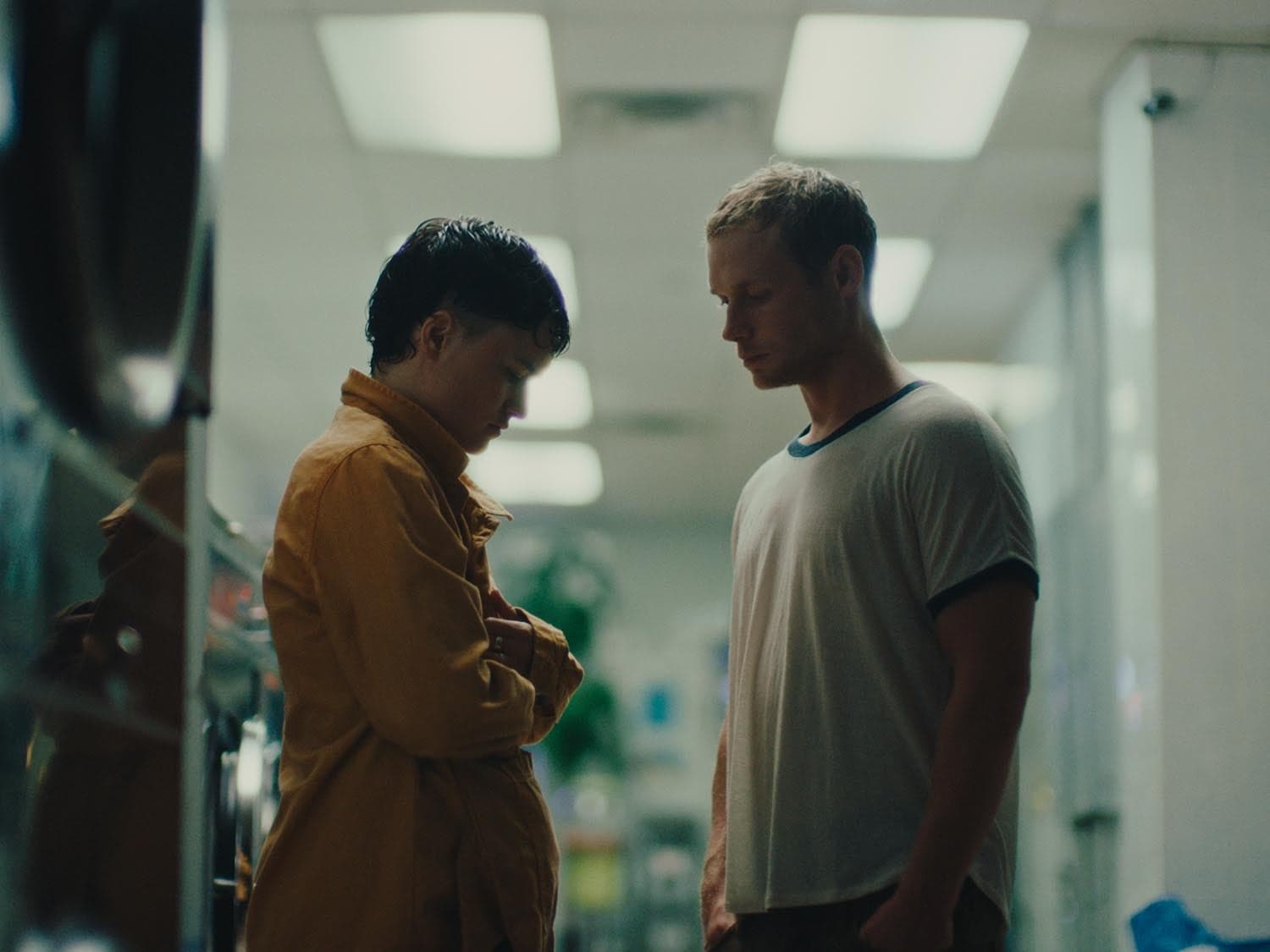
Mutt does boast one standout sequence. Inside a laundromat, after just having escaped the rain, Feña stands next to his ex-boyfriend, John (Cole Doman). There’s poignancy to the way in which Feña, who’s recently started using testosterone and had top surgery, insists on John looking away—to not wanting his body taken in by a lover who once knew it differently. Then, after being caught staring at Feña in the reflection of a washing machine window, John turns around and examines Feña’s torso, and with his consent. It’s a quiet and sexy moment for how Lungulov-Klotz lets the characters’ bodies, vulnerabilities, and desires speak for themselves.
That exchange is impressive for what it communicates in shorthand—a rare reprieve from the didacticism that follows. Later, these two characters are embroiled in an argument that ends with John screaming at Feña: “People don’t hate you because you’re trans. They hate you because you’re a fucking asshole!” Given such sound bite dialogue, it’s perhaps no surprise that the film’s final shot underlines, via beatific lighting, Lungulov-Klotz’s simplistic belief in Feña’s hard-knock life being one of Christ-like endurance. That Feña suffers so that other trans people won’t have to may be edifying to some, but it also reduces Mutt to an Afterschool Special.
Since 2001, we've brought you uncompromising, candid takes on the world of film, music, television, video games, theater, and more. Independently owned and operated publications like Slant have been hit hard in recent years, but we’re committed to keeping our content free and accessible—meaning no paywalls or fees.
If you like what we do, please consider subscribing to our Patreon or making a donation.





Are you trans? This reeks of cis privilege. You should check yourself.
This review is ridiculous and leaves me assuming the writer must be cis. Trans people, like myself, do have dialogues like this every day with family, friends and ex’s, even in cities like New York, where I grew up. To assume that everyone has suddenly embraced trans people and cis people no longer say ignorant things everyday is to be incredibly out of touch.