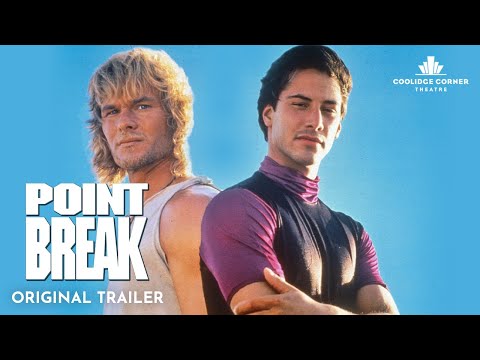
Arriving at the tail end of the machismo-laden action movie boom of the 1980s, Kathryn Bigelow’s Point Break represented a different kind of blockbuster. As Gus Van Sant did the same year with My Own Private Idaho and the Wachowskis would do with their Matrix films, Bigelow foregrounds the androgynous qualities of Keanu Reeves, presenting his rookie F.B.I. agent Johnny Utah as a lithe, sensitive soul who infiltrates a gang of bank robbers not through a projection of strength but an appeal to the criminals’ own, surprisingly delicate natures.
The film begins with Johnny arriving at the F.B.I.’s Los Angeles branch for his first assignment. There, he’s greeted and immediately insulted by the director (John C. McGinley), whose strict rules for personal conduct and mirthless commitment to the job paint him as one of the dying relics of the service’s original, Hoover-led era. The other agents, though, appear far more comfortable in the laidback atmosphere of L.A., none more so than Johnny’s new partner, the grizzled but approachable vet Angelo Pappas (Gary Busey), who’s been assigned to a case of a group of masked robbers who have successfully pulled off dozens of heists. Deducing that the criminals may be surfers, Angelo takes advantage of Johnny’s pretty-boy looks to embed his new comrade in the local surf scene.
When Johnny does eventually find the robbers, he quickly falls in with their charismatic ringleader, Bodhi (Patrick Swayze), a hippie philosopher of the seas who scarcely seems like the type to even have a use for the money that he steals. Just as Reeves projects a soft quality, Swayze’s dancer’s grace presents a different image of movie masculinity.
Bigelow captures Johnny’s first glimpse of Bodhi in besotted slow motion, his body elegantly slicing across a tubular wave and hair billowing in the salt air. Johnny barely has time to get acquainted with Bodhi and his crew before he falls under the man’s spell, clearly vibing to Bodhi’s gentle tone of voice and his lofty talk of oneness with the Earth when you’re cruising along the surface of water. The erotic frisson that emerges between the two is complicated by the woman between them: Tyler (Lori Petty), a short-haired spitfire who emits more macho energy in her caustic speech and aggressive body language than either of the men.
Those sexual undertones propel much of the film’s drama, even informing some of the action scenes. Point Break’s centerpiece involves a chase sequence where Johnny has to blow his cover to stop Bodhi’s crew from escaping a robbery. Through it all, Bigelow elegantly mixes handheld footage and carefully edited transitions that capture a pursuit in cars and on foot with a clarity of motion that still conveys visceral confusion, but the payoff runs counter to expectations.
Johnny can’t keep up with a masked Bodhi, and at one point the two lock eyes when the F.B.I. agent draws a bead on the thief. What follows is a deeply sad exchange. Though his face is hidden behind a thick rubber mask, Bodhi emanates a sense of betrayal that turns an absurd moment into one of pure anguish. Johnny is so shaken by that look that he can only turn his gun away and fire the clip into the air in a symbolic expression of thwarted gratification.
Still, underneath this charged subtext are glimpses of the social commentary Bigelow slipped into her early work. The gang’s use of ex-president masks is an on-the-nose connection to the cash that they steal, but deeper ironies emerge when Bodhi lets the facade of his anti-material philosophy slip to reveal the mercenary personality under the surface. Swayze handles the abrupt shift from laidback, even somewhat peaceful criminal to steel-eyed psychopath with such ease that Bodhi’s about-face seems less a twist than an acknowledgment of the greed that undergirds even the most ostensibly anti-establishment figures in modern America. That the charismatic, ingratiating Bodhi chooses Reagan’s face for his robbery mask is no coincidence.
Image/Sound
Shout! Factory sourced its UHD from a new 4K master struck from an interpositive, and the results are mostly strong. The film’s color palette of rich blues is replicated flawlessly, and most of the darker scenes show exceptional clarity. Occasionally, though, some on-location exterior shots suffer from a loss of detail. The disc comes with the original 2.0 stereo and a 5.1 mix included on Fox’s 2008 Blu-ray, and both tracks are well-rounded mixes that balance dialogue, action sound effects, and the score with no muddying overlap between elements.
Extras
Shout! ports over all the extras from Fox’s Blu-ray, including the making-of featurettes that offer insights into such topics as shooting on location in Malibu and Kathryn Bigelow’s approach to filming surfing, as well as eight brief, disposable deleted scenes that contain only a few minutes of cumulative material that were judiciously cut to improve the film’s overall flow.
Overall
Kathryn Bigelow’s idiosyncratically tender blockbuster receives a solid, if unspectacular, UHD upgrade from Shout! Factory.
Since 2001, we've brought you uncompromising, candid takes on the world of film, music, television, video games, theater, and more. Independently owned and operated publications like Slant have been hit hard in recent years, but we’re committed to keeping our content free and accessible—meaning no paywalls or fees.
If you like what we do, please consider subscribing to our Patreon or making a donation.