
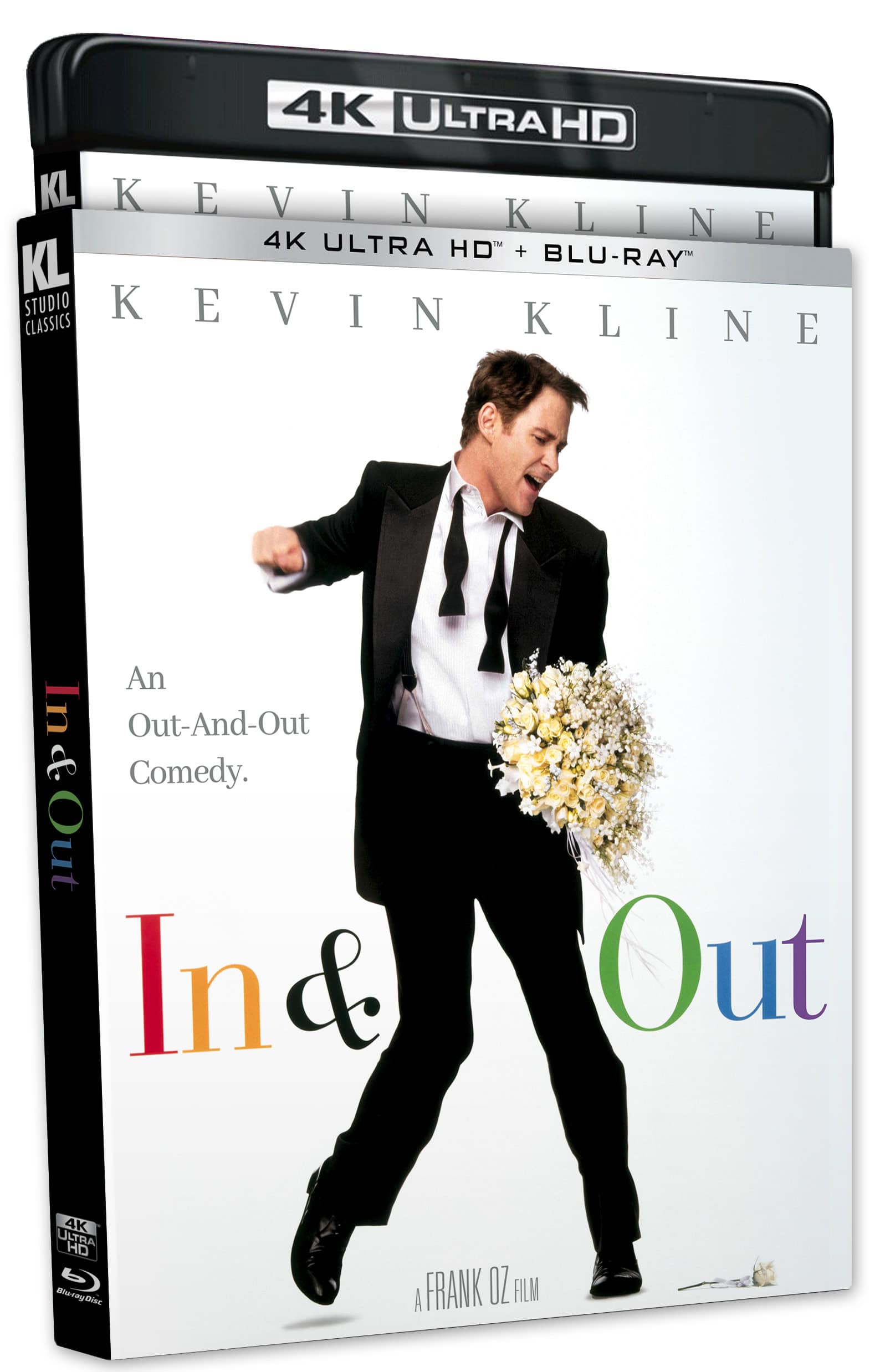
 The seed for In & Out, according to screenwriter Paul Rudnick, was planted during the 1994 Academy Awards when Tom Hanks, accepting the best actor Oscar for Philadelphia, thanked his high school drama teacher, who was gay. What if, Rudnick wondered, that teacher lived in a small Indiana town and wasn’t gay—or, more to the point, what if that teacher was gay and just didn’t realize it yet?
The comic tone of Frank Oz’s film recalls the 1993 episode of Seinfeld titled “The Outing,” in which Jerry is falsely labeled as gay in a college newspaper. That episode’s refrain, “Not that there’s anything wrong with that”—offered by the central characters as both a badge of liberal awareness and a declaration of their skittishness concerning the subject of gay sex—works as a comedic complement to the prestige orientation of something like Philadelphia. After all, the subject of being gay in mainstream American culture in the mid-’90s was generally either deadly serious or dreadfully funny, with more provocative work on the subject being done in indie films like The Watermelon Woman.
Not that In & Out, set in the fictional town of Greenleaf, Indiana, wants for an amusing comedic personality of its own. Its farcical engine runs on a mix of stereotyping and progressive thought, indulging in broad punchlines at its characters’ expense while still sincerely fleshing them out.
The basic plot is straightforward. During an Oscar telecast while accepting the best actor trophy, Cameron Drake (Matt Dillon) dedicates the award to his former English literature teacher, Howard Brackett (Kevin Kline), finishing his speech by saying “and he’s gay.” Howard suddenly finds himself needing to address the matter of his sexuality after the media arrives in Greenleaf, demanding the truth about his sexuality. Family, friends, and more are no less curious, from his fiancée (Joan Cusack) to his parents (Debbie Reynolds and Wilford Brimley) to his students, including Jack (Shawn Hatosy), who Howard recently helped get into college.
As far as In & Out is concerned, this news makes Howard the only gay man in town and, since he’s a teacher, raises questions with the high school principal (Bob Newhart) about his potentially harmful influence on students. Rather than mount even a semi-serious inquiry into such ignorance, the script pokes at the differences between gay and straight cultural taste. The most ludicrous scene has Howard listening to an audiobook about how to be a man, which begins with a challenge to both untuck his shirt and pose as if he’s in a barroom, and ends with Howard dancing wildly to Village People’s “Macho Man,” much to the tape’s narrator’s inexplicable, real-time chagrin (“Stop it! Stop shaking that booty!”).

That Howard’s apparent homosexuality has everything to do with his affection for Barbra Streisand’s 1983 film Yentl rather than, say, whether he’d rather top or bottom, indicates how In & Out essentially exists at the level of a network sitcom. In fact, the film’s only remote brush with gay sex involves a kiss with Peter (Tom Selleck), a gay entertainment reporter who’s both on the scene to cover the story of Howard’s sexuality and determined to bring Howard out of the closet. One can easily see a bridge between this film’s cheeky sense of humor and Will & Grace, which premiered on NBC nearly a year to the day after In & Out hit theaters.
The film’s tameness, though, isn’t necessarily to its detriment as farce. It’s clear that In & Out is as influenced by Seinfeld as it is by the double-entendre-laden work of Preston Sturges and Frank Capra’s films, which often march a misunderstood hometown hero toward a redemptive end. Howard’s redemption, then, is inevitable, and In & Out even stages the moment in Capra-esque fashion, with Cameron Drake, after learning that Howard was fired from his job after coming out, crashing the school’s graduation ceremony and each townsperson in attendance standing up, one by one, to announce “I’m gay!” in solidarity to preserve Howard’s job.
Yes, Howard is thin, neat, and loves both Funny Girl and its oft-maligned sequel (“She was under contract!” he protests in defense of Streisand and Funny Lady), but the way the film sees it, he should still retain his charge reciting Shakespeare to dunderheaded teens. In & Out doesn’t lack for memorable lines, but it’s Cusack’s Emily, jilted and desperate outside the local watering hole, who desperately screams to the heavens the film’s most essential question: “Is everybody gay?” The film’s lightly sardonic answer is, well, no, but maybe just a little.
Image/Sound
This HDR/Dolby Vision master, created from a 4K scan of the 35mm original camera negative of In & Out, brings the fictional town of Greenleaf, Indiana, to vibrant life. From daytime to nighttime scenes, color gradation and separation are stellar, and there’s no sign of digital noise reduction. Film grain is subtle but consistently present, faithfully rendering cinematographer Ron Hahn’s images.The 5.1 DTS-HD audio track is cleanly mixed, with dialogue clear throughout. The track also has enough depth and force to let you dance your heart out like Howard to “Macho Man” if you’re also looking to rebuff your masculinity.
Extras
Any question you’d like to know about In & Out’s conception, production, and more is answered at one point or another throughout the extras collected on this release. A recently recorded commentary track with Paul Rudnick, moderated by author and film historian Lee Gambin, digs into how Rudnick conceived and wrote the screenplay, as well as how he feels about some of the criticisms levied against the film in its initial release. It’s an excellent conversation, driven by Gambin’s typically focused and informed line of questioning and Rudnick’s humor.
In new interviews, Frank Oz touches on a number of topics, including his recollections of working with the actors and how it took 36 takes to get the kissing scene between Kevin Kline and Tom Selleck to his liking, and composer Marc Shaiman provides insight into discussions he had with Oz on striking the right combination of tones for the film’s score. Also included are behind-the-scenes footage, theatrical trailers for other Kino Lorber releases, and a compilation of vintage interview clips with Kline, Oz, Rudnick, Selleck, Joan Cusack, and Debbie Reynolds.
Overall
In & Out struts onto 4K UHD with a superb transfer and a positively gay array of extras.
Since 2001, we've brought you uncompromising, candid takes on the world of film, music, television, video games, theater, and more. Independently owned and operated publications like Slant have been hit hard in recent years, but we’re committed to keeping our content free and accessible—meaning no paywalls or fees.
If you like what we do, please consider subscribing to our Patreon or making a donation.





Did they watch the 4k disc I wonder? Or just parrot some ‘4k is better’ mantra? This is the least worthy of upgrade 4k disc I’ve seen for several months.