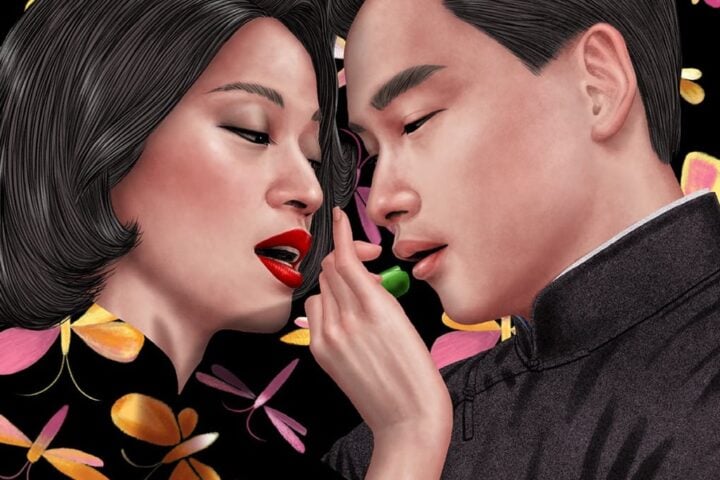
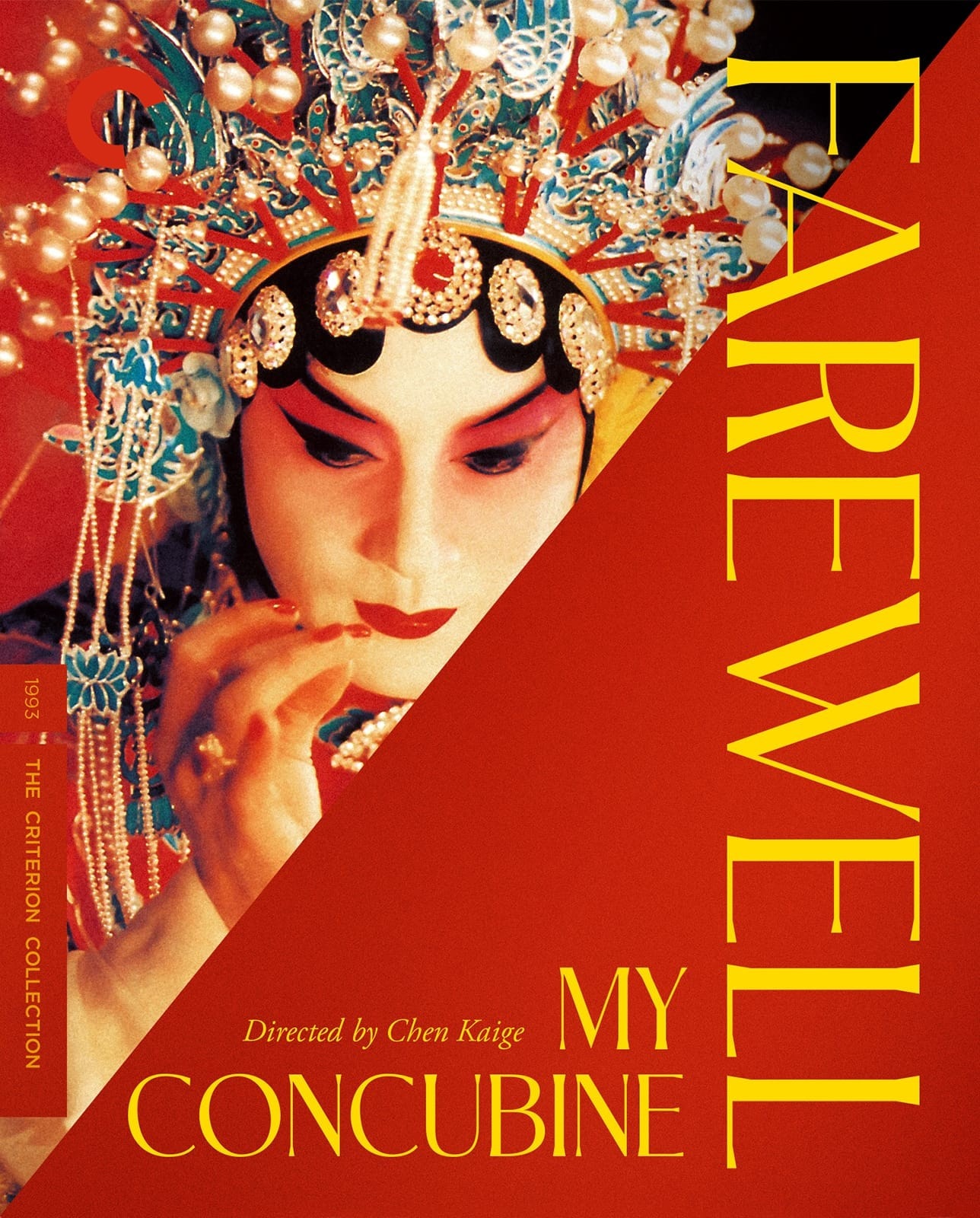
 Chen Kaige’s Farewell My Concubine is an epic melodrama about the Peking Opera set against the backdrop of 50 years of 20th-century Chinese history. As structured by screenwriters Lu Wei and Lilian Lee, adapting the latter’s 1985 novel, the film unfolds through a series of chapters that stitch together a sense of how physical discipline, unrequited love, and art comingled with broader political and revolutionary movements in China from 1924 to 1977. The film is a melancholic portrait of a nation and its people at a crossroads, relating as much to the conceptions of so-called Fifth Generation Chinese filmmakers in the present as to the country’s past.
Farewell My Concubine features a dizzying array of characters, but the story’s focus is essentially on the inevitably tragic love triangle between Cheng Dieyi (Leslie Chung), Duan Xiaolou (Zhang Fengyi), and Juxian (Gong Li). By 1937, both Cheng and Duan are Peking opera stars playing the leads in the traditional Chinese opera that gives the film its title. Cheng plays Concubine Yu, who kills herself after the King of Chu, played by Duan, is defeated in battle. Cheng’s love for Duan is unrequited, and it’s intensified once Duan marries Juxian, a courtesan. Gradually, the fiction of the opera bleeds into the characters’ lives, with Cheng in particular becoming increasingly incapable of separating his stage role with his love for Duan.
Much of these tensions are contextualized in a lengthy prologue, set from 1924 to 1932 against the backdrop of the so-called warlord era in Peking. When the men were boys, they didn’t yet have their stage names and were mercilessly disciplined by the elders of an opera troupe who berated them and spanked them with broad swords for even the slightest mistake.
It’s during these opening scenes that Farewell My Concubine introduces a homoerotic tension into the proceedings, with young Cheng watching with an ambiguous expression as young Duan is repeatedly spanked with a sword across his bare ass. Later, when young Duan forcibly shoves an object into young Cheng’s mouth for deliberately flubbing a line in front of Master Guan (Lü Qi), a cycle of sadistic abuse and masochistic desire is explicitly set in motion.
The film’s middle third thoroughly establishes how Cheng’s obsession with Duan entwines itself with performance, such that the character’s on-stage impulses toward sacrifice start bleeding into the real world. Some of this desire is precipitated by Master Yuan (Ge You), whose attention to detail extends to things like how many steps Duan takes in a particular moment of the opera. He’s an appreciative onlooker whose renown further speaks to how those with power tend to wield it in varied and, at times, suffocating ways within Chinese society during the period.

Farewell My Concubine settles into its most conventional storytelling mode during this stretch, as scenes are generally geared around dialogue and clear-cut character dynamics. But Chen’s style subtly pursues a more theatrical approach, visually echoing the entwined ontology between theater and life and Cheng’s ongoing confusion between being a man or a woman. Throughout, subtitles are used to announce the year and general epoch at the start of the chapters, from China being on the eve of war with Japan to the evacuation of the Nationalist Party of China to Taiwan. This dutiful rendering of various moments across so many years verges on turning the film into a straightforward admixture of passion play and history lesson.
Yet by the time the People’s Liberation Army arrives in Peking in 1949, the film transforms into a harrowing saga of betrayal and the loss of personal identity. And by the dawn of Cultural Revolution in 1966, the core trio are all accused of being class traitors, and a public humiliation session is held during which the Red Guards demand the truth about each of their pasts. This sequence consists of a magnificent range of shots, including wrenching close-ups of Cheng and Duan on one side of the public square staring through flames at Juxian on the other, bringing all of the established context, both personal and political, into one full, anguished vision.
In the end, Farewell My Concubine has become many things at once. It’s neither merely a historical rendering nor a work of revisionist history, but a blending of these elements into something that simultaneously accounts for Chen’s own memories and imagination. Having lived through the Cultural Revolution as a teenager, Chen offers a definitive vision of what it looks, sounds, and feels like to realize that the personal is always political.
Image/Sound
This 4K digital restoration of the original director’s cut looks outstanding. The image is remarkably rich and vibrant throughout. Film grain is intact and healthy, while contrast, depth, and color separation are consistently great. The 5.1 DTS-HD audio track is simply a stunner, with the drums that boom during the Cultural Revolution interrogation sequence resonating through the soundstage with startling precision. Dialogue comes across crisp and clean, and the opera sequences have a mellifluous range that sounds consistently dynamic.
Extras
The highlight of the disc’s extras is a lengthy conversation between Chinese cultural studies scholar Michael Berry and film producer Janet Yang on where to situate Farewell My Concubine within the broader scope of Fifth Generation filmmaking. The pair also discuss the differences between Lilian Lee’s novel and this adaptation, some of Chen Kaige’s other films, and Farewell My Concubine’s controversial reception in China following its Palme D’Or win.
A few archival materials are also included. The first is a documentary from 2003 on the film’s creation, which includes interviews with numerous cast and crew members. Another is an interview with Chen from 1993 conducted by journalist Charlie Rose. Rounding out the extras are the film’s trailer and a booklet featuring an essay by author and scholar Pauline Chen that further delves into the film’s themes of theatricality and performance.
Overall
The director’s cut of Chen Kaige’s Farewell My Concubine arrives on North American home video in a luminous restoration, along with an array of insightful extras.
Since 2001, we've brought you uncompromising, candid takes on the world of film, music, television, video games, theater, and more. Independently owned and operated publications like Slant have been hit hard in recent years, but we’re committed to keeping our content free and accessible—meaning no paywalls or fees.
If you like what we do, please consider subscribing to our Patreon or making a donation.