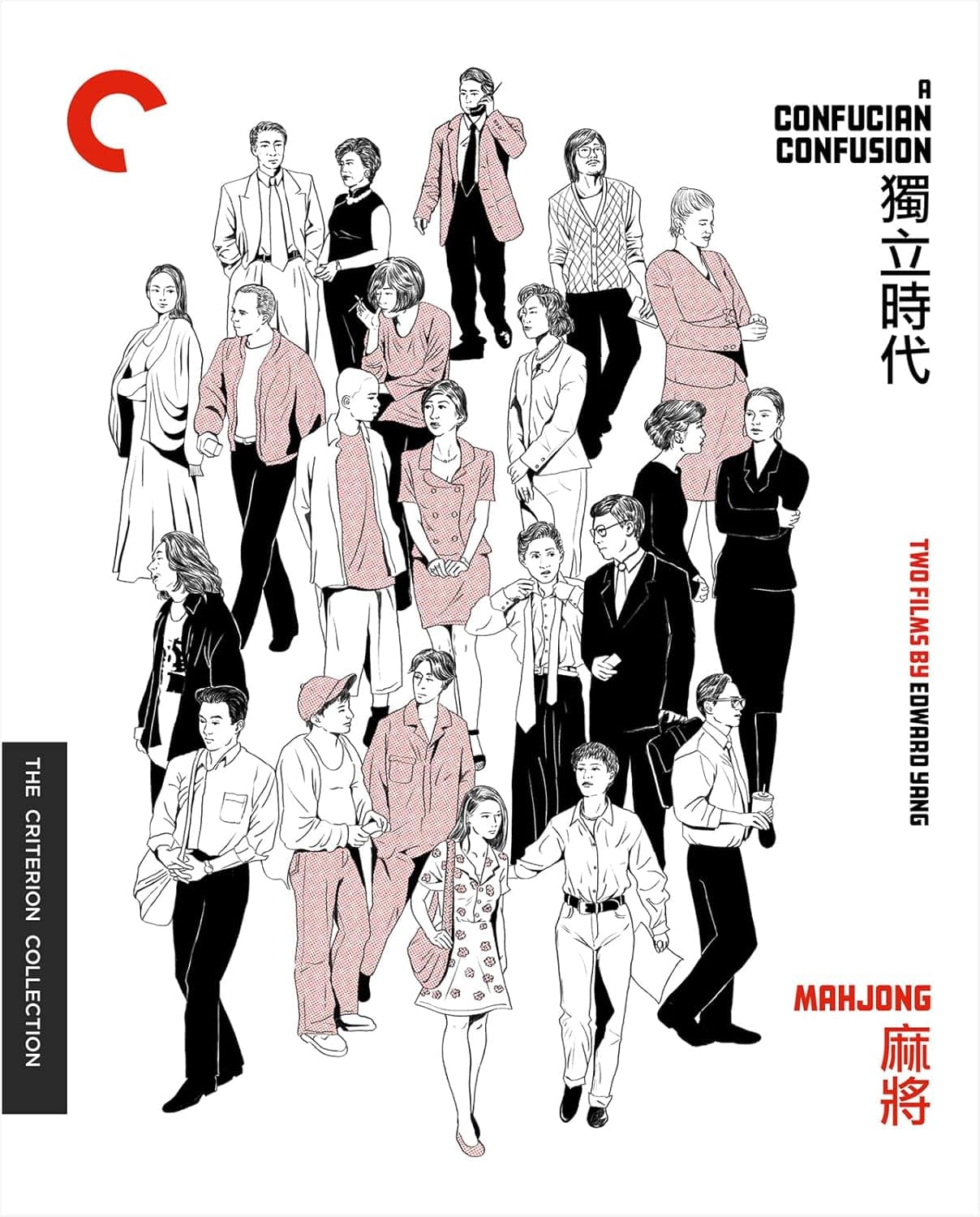
 The filmography of Edward Yang can be crudely divided into two main themes: the manner in which people in close physical proximity remain emotionally detached from one another, and the corrosive social impact of unchecked capitalism. Arguably, the two films which best balance these themes are 1994’s A Confucian Confusion and 1996’s Mahjong. Bitterly, sardonically cynical in tone about the impact of class aspirationalism on Taiwanese life, the films nonetheless strive to zero in on the humanity that its characters repress.
A Confucian Confusion expands on an approach that Yang took in his prior features: that of an anti-network narrative that hinges not on the coincidental intersections and near-misses of ostensibly unrelated characters, but on the ways that densely entwined people create artificial barriers between themselves. Centered on a TV station run by frazzled executive Molly (Suk Kwan Ni) and funded by her rich-kid fiancé, Akeem (Bosen Wang), the film quickly establishes an almost incestuous web of affairs that arise between colleagues and relatives linked to these characters.
The closest analog to this film’s depiction of frantic workaholism and messy workplace hookups of the entertainment company is François Truffaut’s Day for Night. But where that film romanticizes the act of moviemaking amid all the personal drama, A Confucian Confusion satirizes the commercial pressures that usually stifle higher ambitions in mass-produced art.
In the first scene, we meet an erstwhile avant-garde playwright (Yeming Wang) who announces in a press conference that he’s turned over a new leaf and embraced populism, cynically linking an appeal to mass tastes to Taiwan’s recent shift from one-party rule to democracy. He even likens the box office to a form of “voting” and suggests that the conformity of taste of the lowest common denominator is positive proof of democracy in action. The centerpiece show on Molly’s TV station is a fluffy piece of toxic optimism hosted by her sister (Chen Limei), who encourages viewers to put the ills of the world out of mind and embrace the distraction of consumerism.
With its crisscrossing romantic entanglements and fast pace, A Confucian Confusion could pass for a screwball comedy were it not for the angst that Yang injects into the film by focusing on the dissatisfaction that results from the characters’ sexual escapades over the frenzied rush of the antics themselves. Yang strategically places pauses throughout the film to take stock of the mounting malaise affecting all of the characters. Rather than play up the humor of these colleagues’ wandering ways, Yang highlights the way in which their romantic dissatisfactions are an outgrowth of a consumer mindset that programs them to focus on acquiring the next fleeting distraction—that is, against being grateful for what they have.
In one revealing scene, co-workers Ming (Weiming Wang) and Feng (Richie Li), who are each dating someone else, walk home from a bar. Along the way, Ming confesses that he’s grown bored with his girlfriend precisely because comfort and familiarity have become alien to him, a statement that triggers Feng’s doubts over her own relationship. Such melancholic interludes undercut the film’s frothy comedic register with a wider view of a culture that’s been thrown into the rapid churn of global capitalism and struggles to reconcile preexisting values with the emerging pressures of material gain. In the end, even the film’s most hopeful views of the future fall back on “love the one you’re with” compromise and resignation.
If A Confucian Confusion is a comedy constantly interrupted by somber misgivings, Mahjong is a vicious social commentary intermittently leavened by unexpected comedy which prevents it from sinking into pure nihilism. The film opens as an ostensible noir in which gangsters seek to flush out an indebted billionaire Winston Chen (Chang Kuo-chu) by kidnapping his son (Tang Tsung-sheng). But it soon expands its scope to Taipei at large, where the lines between legitimate business and criminal enterprise are vanishingly thin, where hustlers of all strata and countries of origin meet in a mad scramble for personal gain, and where all transactions are personal. In the world of the film, men used to nightclubs and dens of iniquity speak to women as if they’re sex workers, and the women themselves are either already in the trade or consider it for reasons ranging from quick money to petty revenge against partners.
In A Confucian Confusion, Yang called frequent attention to American cultural imperialism’s effect on the face of Taipei, with tacky chains like TGI Friday’s becoming frequent meeting spots and local broadcasts carrying updates about the Chicago Bulls. But the Taipei of Mahjong seems to have no culture at all. A British ex-pat (Nick Erickson) is the city’s most renowned interior designer, though this seems less a testament to his skill than to the fact that almost every interior shown, whether in a public or domestic setting, sports walls painted in bland off-whites befitting a corporate office and lacks any sense of personality.
The menagerie of locals and foreigners who populate the city doesn’t result in a bohemian scene of blended cultures but a constant struggle for the biggest slice of the monetary pie. This is a city as giant casino, an invitingly bright but sinister entity designed to distract its occupants with dreams of wealth just long enough to leave them penniless.
Focused solely on themselves, the characters often go to arduous lengths to deny forming emotional attachments that could compromise their profit-driven worldviews. One hoodlum (Wang Chi-tsan) refuses to kiss women on the lips lest he become too infatuated and soft-hearted, and sex becomes a weapon by which some women can assert their independence over men they would otherwise debase themselves for out of one-sided love. Even the hiding billionaire proves to be indifferent to his family, unconcerned about the manner in which his failing schemes have put his wife (Elaine Jin) and son in financial jeopardy.
Physical and emotional violence abounds throughout Mahjong, and not even the most turbulent moments of Yang’s 1991 opus A Brighter Summer Day plumb the same depths of inchoate fury as the final act. In many ways, the film recapitulates the mired romantic entanglements of A Confucian Confusion, but this time as tragedy instead of farce. Even so, Yang approaches Mahjong’s characters with the same observational frankness as he did in the previous film, regularly spotting the cracks in the characters’ emotional dams.
Despite the conscious effort that everyone in Mahjong makes to avoid forming emotional attachments or anything that could compromise their overriding drive for personal gain, relationships still form. And it’s only through being strong enough to recognize the need for human connection that anyone can break out of their dead-end life paths.
Image/Sound
The transfers of both films are sourced from recent 4K restorations of damaged negatives, though you’d never be able to tell given the strong, issue-free presentations. The image remains sharp in both exterior and location shots, balancing the dominant palette of neutral tones with the occasional splash of color in street signs or in the tinted lighting of nightclubs. Moments of stylized shadow, particularly in Mahjong, show no visible loss of definition or texture. The 5.1 audio tracks are immaculate, cleanly separating individual sources of street noise in the background from the overlapping dialogue that’s easy to discern at the front of the mix.
Extras
The Criterion Collection’s release includes excerpts of Edward Yang speaking at a 1994 screening of A Confucian Confusion, a new interview with editor Chen Po-Wen, and a conversation between scholar Michael Berry and film critic Justin Chang in which they break down Yang’s place in the Taiwanese New Wave. Most compelling, the package also includes a filmed performance of Yang’s 1992 play Likely Consequence, which contains elements that would be developed further, and in a less crude and farcical context, in A Confucian Confusion. A booklet essay by critic Dennis Lim examines how the two films in the set both perpetuate and upend stylistic and thematic tropes that Yang had explored to that point in his career.
Overall
Long unavailable in the West, two of Edward Yang’s most vital features arrive on Blu-ray with gorgeous A/V transfers from the Criterion Collection.
Since 2001, we've brought you uncompromising, candid takes on the world of film, music, television, video games, theater, and more. Independently owned and operated publications like Slant have been hit hard in recent years, but we’re committed to keeping our content free and accessible—meaning no paywalls or fees.
If you like what we do, please consider subscribing to our Patreon or making a donation.