Considering the popular perception of the French as culturally high-minded and intellectual, it’s not surprising that the country’s film industry has produced comparably few horror movies. Such an elemental genre, it stands to reason, simply held little intrigue for filmmakers working in the wake of artistic luminaries like, say, Jean Renoir, Robert Bresson, Jacques Tati, and Jean Grémillon.
And yet the handful of such films, particularly from French cinema’s fertile mid-century period—Henri-Georges Clouzot’s Diabolique, certainly, and, despite its fantastical elements, Jean Cocteau’s Beauty and the Beast as well—are indelible entries in the canon. Perhaps the most singular work to emerge during the era was Cinémathèque Française co-founder Georges Franju’s Eyes Without a Face, from 1960, a work of a wizened cinephile playfully exploiting the genre’s most primal strategies while employing outlying techniques familiar to fans of American film noir and the then-burgeoning nouvelle vague.
What Franju spun from Jean Redon’s pulp novel was something several times more unique and unsettling than what had come before in French genre cinema. Written by Pierre Boileau, Thomas Narcejac, Claude Sautet, and Redon—the former two equally well versed in thriller archetypes, having penned the source material for Diabolique, as well as Vertigo—the film is a seemingly simple and possibly even heartfelt tale of a doctor attempting to rehabilitate his daughter after an unfortunate accident that reveals itself as something far more sinister.
Génessier (Pierre Brasseur) may be accurately described as a mad scientist seeking to reconstruct the maimed visage of his daughter, Christiane (Édith Scob), after an auto accident has left her disfigured—and an accident that the obsessive doctor is responsible for at that. Even Génessier’s perceived attempts to atone for his actions are soon reveled to be self-serving.
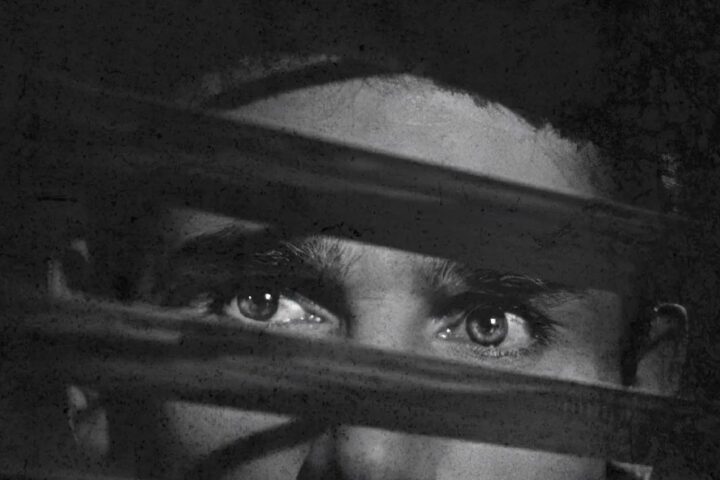
Eyes Without a Face is less about story or plot mechanics and more about atmosphere, and the mood that Franju creates from little besides a blank white mask, some deep shadows, and the sterile surface space of Génessier’s operating chamber is impressive. A centerpiece surgical sequence wherein Génessier rather realistically removes the flesh off a kidnapped girl’s face in order to graft the skin from victim to patient incited both nausea and censorship battles. But it’s in Franju’s patient setup and quietly devastating denouement where the accumulated power of Eyes Without a Face is most deeply felt. The film’s narrative is pregnant with unease, and Franju’s austere compositional sense grips even as it unsettles.
As is often the case with genre films, the stature of Eyes Without a Face has grown as the years have passed—as has the standing of both Franju and Scob. Despite a number of noteworthy films, including Thérèse Desqueyroux and the supremely underrated Judex, Franju never quite parlayed the notoriety that such a controversial breakthrough might suggest, while Scob was left to mostly collaborate on future Franju projects before being effectively rediscovered by such acolyte auteurs as Raúl Ruiz, Pedro Costa, and Leos Carax later in life.
Eyes Without a Face’s reputation is thus somewhat appropriate, as not only did its innovations and idiosyncrasies have an effect on all involved, but so, too, did it influence contemporary genre filmmaking, continuing as it does to represent a pivot point between classic and modern horror idioms. The obsessive doctor played by Brasseur in the film may have tried to harness nature’s course via mortal means, but as we see on a daily basis, history will forever write itself.
Image/Sound
Criterion’s new 4K digital restoration is beautiful, with the even grain distribution and level of detail sure to ameliorate any concerns anyone may have about digital noise reduction. Audio, meanwhile, is authentically preserved in a monaural mix. The sound design of the film is subtle but important to the viewing experience, and the soundtrack appropriately handles both the intricate effects and Maurice Jarre’s anachronistic yet evocative score.
Extras
All of the extras have been ported over from Criterion’s prior releases of the film. Alongside archival interviews with Georges Franju, Pierre Boileau, and Thomas Narcejac that appeared on Criterion’s 2004 DVD, and the restored presentation of the director’s 22-minute short film from 1949, “Blood of the Beasts,” we get the nice interview segment from the 2013 Blu-ray with Édith Scob, who talks about her experience working on the film and her subsequent projects with Franju. Finally, the accompanying booklet contains essays by novelist Patrick McGrath and film historian David Kalat, familiar to those who may have purchased Criterion’s initial DVD release.
Overall
The Criterion Collection gives Georges Franju’s 1960 horror classic a remarkable facelift.
Since 2001, we've brought you uncompromising, candid takes on the world of film, music, television, video games, theater, and more. Independently owned and operated publications like Slant have been hit hard in recent years, but we’re committed to keeping our content free and accessible—meaning no paywalls or fees.
If you like what we do, please consider subscribing to our Patreon or making a donation.