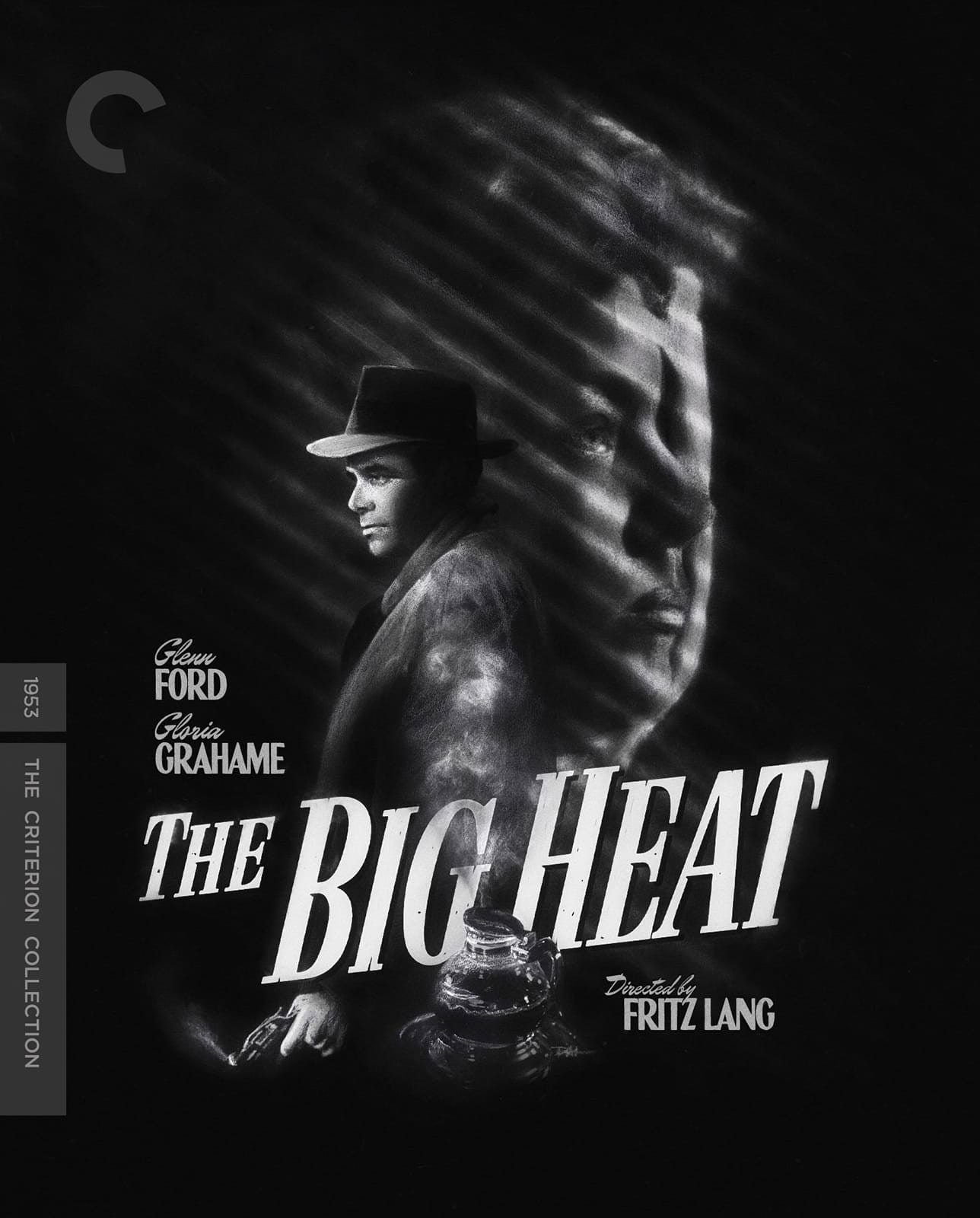
 Fritz Lang’s The Big Heat opens on an image of a gun on a desk. A man standing behind the desk grasps the weapon and raises it to his head, pulling the trigger. Throughout this curt sequence, we only see the desk, the gun, the man’s hand, the back of his head, and a stuffed envelope that’s intended to explain his actions, and which will promptly be confiscated and hidden by another character.
This death sets forth a scuttling of human insects across The Big Heat. And it illuminates the already pitifully obvious collusion existing between an unnamed city’s government and the closest its criminal empire has to “old” money, which are the prosperous businessmen who made their wealth a few decades prior, selling booze and killing rivals during Prohibition, laundering their blue-collar viciousness into white-collar “respectability.”
Much has been made of Lang, who was of Jewish heritage, fleeing Nazi Germany, which has been offered as an explanation for the obsession his films have with the sometimes insidious relationship between micro societies and the larger society that contains them. This coalition of personal biography and artistic preoccupation is logical as far as it goes. But the effectiveness of this theme in the director’s American work resides in Lang’s masterful paring down of the expressionism with which he made his name to embody the caged passions of his characters.
A less observant admirer of, say, Lang’s haunting and more outwardly visually extravagant M might find The Big Heat formally routine by comparison, direct and concerned mostly with the nuts and bolts of Sydney Boehm’s script. But this directness is where Lang’s formalism blooms.
Much of The Big Heat is composed of close-ups of the faces of the primary characters, which alternate with rhythmic exactitude. There are also tight medium shots, often of collections of people within small rooms, in which the camera is perched somewhat at an angle, emphasizing a diagonal sharpness across the image, intensifying an impression of constriction, tension, and aggression. All these images are clothed in gorgeously virtuosic shadow.

The Big Heat is a feast of resonant, unsentimental terseness, and its subject is ultimately what’s pointedly missing from it until the heartbreaking ending: sullied, qualified compassion, in a prosperous world with a foundation deeply eaten up by hypocrisy and corruption. Sergeant Dave Bannion (Glenn Ford) is so intent on bringing his wife’s inadvertent killers to justice that he overlooks the needs of a woman who will soon die for him: Debbie Marsh (Gloria Grahame), the moll of gangster Vince Stone (Lee Marvin), who’s the henchman of the film’s big bad, Mike Lagana (Alexander Scourby). When Debbie is brutally assaulted, Bannion initially, chillingly, only sees how her damage will influence his campaign of vengeance.
Lang doesn’t make a pretense of decrying vengeance, and he doesn’t valorize it either, seeing it as something that just happens. Every character in the film shares Lang’s bracing frankness, refusing to apologize for human will. This might also be linked to the artist’s real experience with fascism, as he accepts chaos as inherent to existence. The Big Heat is truly a hard-boiled film, and its nastiness cleanses the noir of the masculine self-pity that often lards the genre. These men aren’t victims or patsies, particularly of women, who are endlessly destroyed in this film; they’re vicious movers and shakers who go to war purposefully, for their own reasons.
Lang’s mercilessness, which is a neurotic, unresolved form of humanism, coaxes our guard down ahead of an ending in which Debbie’s needs and disappointments are briefly, truly seen, by both Lang and Bannion. Dying on a fur coat, her instrument of living—her sexiness—cruelly tarnished by abuse, Debbie asks Bannion about his wife, wishing to die with an image of a woman who made it into the sort of “mainstream” society that eluded her. Bannion yearns for his wife himself, of course, and this masterpiece’s one true moment of human communion is achieved when two characters from opposing castes realize that they’re both chasing the same dream of belonging, which they both understand to have blown irrevocably away.
Image/Sound
The new 4K digital restoration of the film is breathtakingly filmic, boasting lustrous whites and velvety, nuanced blacks. The cleanness of the image bolsters the sense of interplay between the foreground and background of the shots, which is always intensely important to Fritz Lang’s films, as they’re often parables of community at war with itself. (Put broadly, the various planes of the imagery could be said to embody respective, conflicting factions of society.) The monaural soundtrack swiftly, gracefully balances the important background noises—the simmering of coffee, the humming of a crowd in a bar—with the foreground of the score and the dialogue. In other words, all elements are in harmony in this attractive restoration.
Extras
This package is an ideal example of offering a few astutely produced and selected supplements that manage to say more about the film in question than any number of arbitrarily assembled puff pieces ever could. First and most importantly, there’s the new audio commentary with noir experts Alain Silver and James Ursini, co-authors of From the Moment They Met It Was Murder: Double Indemnity and the Rise of Film Noir. It’s a scholarly yet engaging track, especially notable for the duo’s deep dive into The Big Heat’s theme of vengeance.
The short archival interviews with Michael Mann and Martin Scorsese allow them to communicate the ways in which the film influenced their work. Mann observes that the women, while abused and the only ones to die, also have an agency that’s unusual for an American film. (The new video essay by critic Farran Smith Nehm provides a more in-depth look at the relationship between men and women in The Big Heat.) Scorsese, unsurprisingly given his own obsessions, homes in on how the hero’s quest warps him, and acknowledges the film’s formalism to be both “flat” and expressionist at once, which is probably the key to its power.
Rounding out the package are audio interviews with Lang, conducted by film historian Gideon Bachmann and filmmaker Peter Bogdanovich, the original theatrical trailer, and an essay by Jonathan Lethem in which the author draws astute comparisons between The Big Heat and some of Lang’s other masterpieces, most notably Fury, and even draws a fascinating line between a scene in the film and one from Paul Verhoeven’s RoboCop.
Overall
The Criterion Collection honors this lean and hard American classic the right way: with a pristine 4K preservation and correspondingly rich and efficient supplements.
Since 2001, we've brought you uncompromising, candid takes on the world of film, music, television, video games, theater, and more. Independently owned and operated publications like Slant have been hit hard in recent years, but we’re committed to keeping our content free and accessible—meaning no paywalls or fees.
If you like what we do, please consider subscribing to our Patreon or making a donation.