 Allan Dwan was one of Hollywood’s most prolific directors, working from the silent era through the golden age of the studio system. The Toronto-born filmmaker made somewhere north of 400 films—many of them woefully obscure, unavailable, or lost—during his career, and in a variety of genres and registers. As a proverbial gun-for-hire, he could have turned his productions around with anonymous influence, with little or no authorial voice to distinguish his work from the myriad other filmmakers tasked with nominally similar projects.
And yet, the best of Dwan’s films—among them Frontier Marshall, Brewster’s Millions, Silver Lode, and Slightly Scarlet—evince a psychological complexity and stylistic self-sufficiency rare for such genre-oriented fare. If Dwan’s films can be categorized by their conventions, they likewise refuse to be reduced to caricature, often recalibrating symbols of American mythology—the cowboy, the criminal, the solider, the entertainer—as vessels for vocational, historical, and ideological reconsideration.
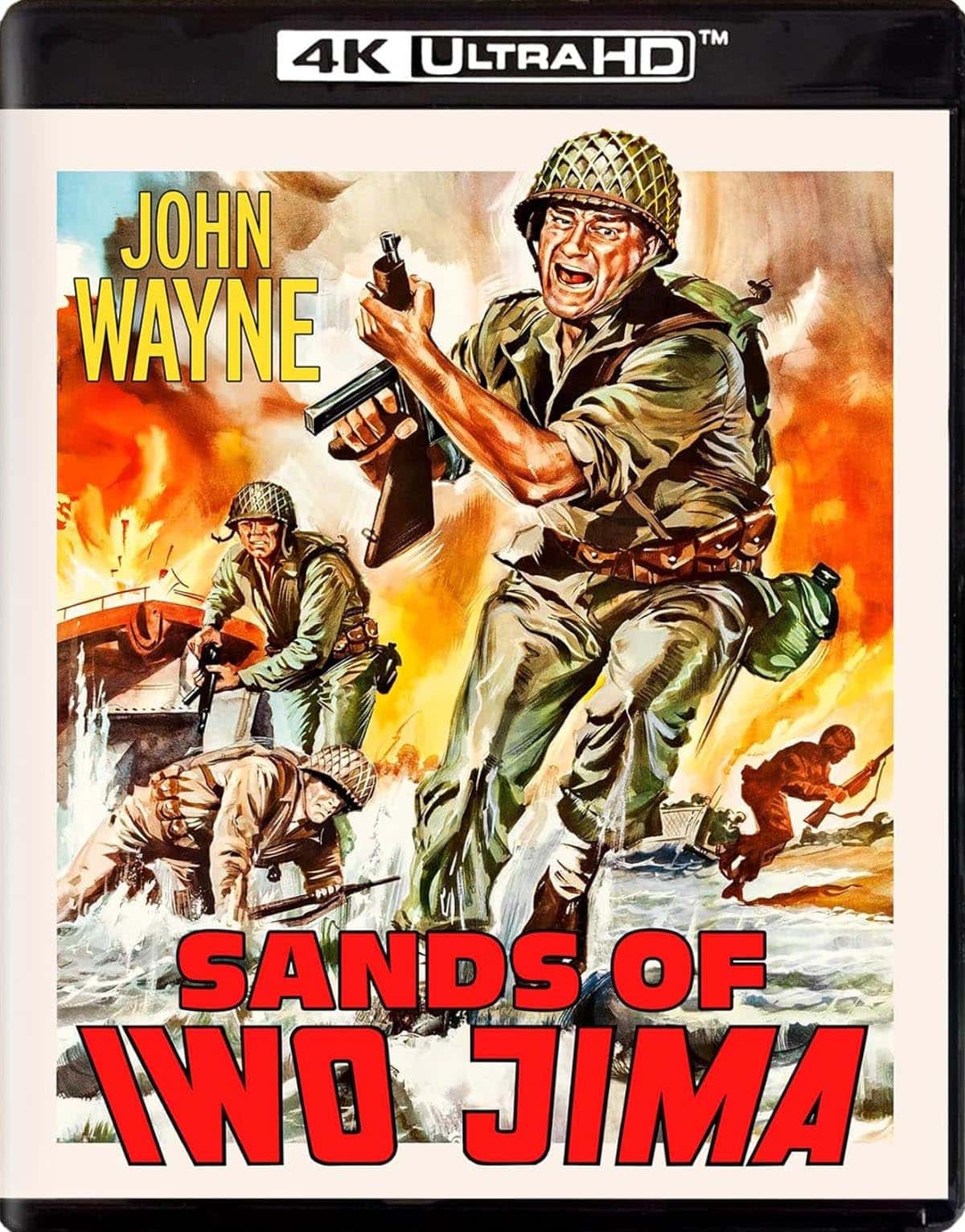
At a glance, Dwan’s relationship with the war film doesn’t appear as involved as some of the other genres he worked in at a more consistent rate. In fact, save for some early-century silents, he wouldn’t betray an outright interest in such matters until after World War II, and specifically with the 1949 film Sands of Iwo Jima. From there he’d go on to make a few more wartime period pictures, but Sands of Iwo Jima stands as not only a kind of working model, but also as one of the filmmaker’s most popular successes with both audiences and the industry at large.
From a script by Harry Brown and James Edward Grant, and starring John Wayne in one of his most emotionally complex roles, the film follows a company of fresh-faced marines from the dog days of training through multiple battles of the Pacific War. Under the strict tutelage of Wayne’s Sergeant John Stryker, the troupe, whose feelings about their leader range from guarded respect to outright distaste for his merciless methodology, tentatively adopt a similarly cold-blooded approach to combat, resulting in the simultaneous strengthening of the regiment and the weakening of their resolve. The gravity of Sands of Iwo Jima therefore lies less in the cinematic record of events than in the characters’ nuanced negotiation between the ingrained and the irresolute—a divide Dwan bridges in subtly diagrammatic fashion.
Sands of Iwo Jima covers quite a bit of geographic distance, from early scenes set at a remote training outpost, to a pre-battle wedding ceremony, to a selection of apartment and barroom interiors—not to mention a pair of impressively mounted combat sequences. Dwan, however, employs a consistent visual syntax throughout, no matter the chosen locale. War scenes tend to proceed in a manner not unlike the moments of camaraderie and confrontation set in saloons—where much of the interpersonal drama unfolds anyway—with Reggie Lanning’s camera initially observing from a distance, before focusing in on pairs of characters framed in tight two shots.

In nearly every instance we eventually end in close up, with Dwan cross-cutting between verbal exchanges, allowing the actors’ expressions to advance the narrative as much as the dialogue. And indeed, what lingers in the mind most when seeing the film is the faces, the subtle emotional tremors writ painfully across each characters’ cultivated visage. One moment in particular stands out, as Sergeant Stryker orders Private Conway (John Agar) to refrain from rescuing a wounded comrade as heavy artillery is being unleashed from all directions. What at first seems sadistic on the part of Stryker turns tragic as Dwan holds on a close-up of Wayne, anguish flooding his face as we hear the doomed solider cry out in agony.
The film ends with the eponymous battle, complete with a stirring recreation of the hilltop flag-raising. But like the majority of what’s preceded, the episodic backdrop remains just that, as Stryker and his men look on as the flag in planted in the distance. Wayne’s final speech to his troupe is one of reconciliation, and accordingly, the film doesn’t end in triumph, but in tragedy.
Dwan constructs this final sequence once again as a series of close-ups, with a succession of shots of the soldiers’ shell-shocked façades playing like a procession for a man they’ve reluctantly come to respect. This intimate rendering of a momentous epoch is in keeping with Dwan’s devotion to a kind of democratic cinema where small-scale conflicts leave devastation of a different yet equally appreciable influence. There are internal wars and interpersonal battles waged between many of his characters across many of his films. Sands of Iwo Jima happens to locate these in one of the decisive events in world history, and is all the more affecting for it.
Image/Sound
The unrestored high-def transfer of Sands of Iwo Jima that Olive Films released in 2015 was nothing to sneeze at, but Kino’s transfer, from a 4K scan of the 35mm original camera negative, blows it out of the water, thanks to the Dolby Vision boost. Gone are the instances of wear and damage that were visible in the earlier transfer. The image here is a textural marvel, evident in everything from the soldiers’ clothes and faces to the rough terrain of the island-set climax.
The DTS-HD mono track, meanwhile, handles the battle sequences quite well. Action effects come through demonstratively, with only little hints of distortion clouding the mix. Dialogue is consistently clear and upfront, never feeling as if it’s competing with the surround sounds.
Extras
In a new commentary track, filmmaker and historian Steve Mitchell and Combat Films: American Realism author Steven Jay Rubin take a deep dive into the making of Sands of Iwo Jima, placing it in the context of both Allan Dwan’s and John Wayne’s careers. Mitchell and Rubin also don’t skimp on the historical context, which will surely please fans of war films and aficionados of war in general. Rounding out the extras is the 1993 Leonard Maltin-hosted featurette “The Making of Sands of Iwo Jima,” which features interviews with the film’s cast (most notably John Agar) and Wayne’s son, and a theatrical trailer.
Overall
A pivotal film in the careers of director Allan Dwan and actor John Wayne gets a marvelous visual upgrade and an informative commentary track courtesy of Kino Lorber.
Since 2001, we've brought you uncompromising, candid takes on the world of film, music, television, video games, theater, and more. Independently owned and operated publications like Slant have been hit hard in recent years, but we’re committed to keeping our content free and accessible—meaning no paywalls or fees.
If you like what we do, please consider subscribing to our Patreon or making a donation.