The cultural moment in which Splitsville, the latest relationship-centric comedy from writer-director Michael Angelo Covino and co-writer Kyle Marvin, arrives is one where non-monogamy has reached such prominence that New York magazine devoted an entire 2024 cover story to offering a “practical guide” to polyamory. But in style and substance alike, the film feels more like a reinvigorated throwback rather than a missive from the trenches of modern love. The filmmakers contemporize the screwball comedy by focusing on characters who get really loose with their screwing around—and all have a ball in the process.
Following their 2020 breakout The Climb, real-life buddies Covino and Marvin once again lean into their off-screen camaraderie to bring specificity and spunk to their on-screen counterparts. Buddies Paul (Covino) and Carey (Marvin) share many experiences, including, as the title Splitsville indicates, their respective marriages each encountering some major turbulence.
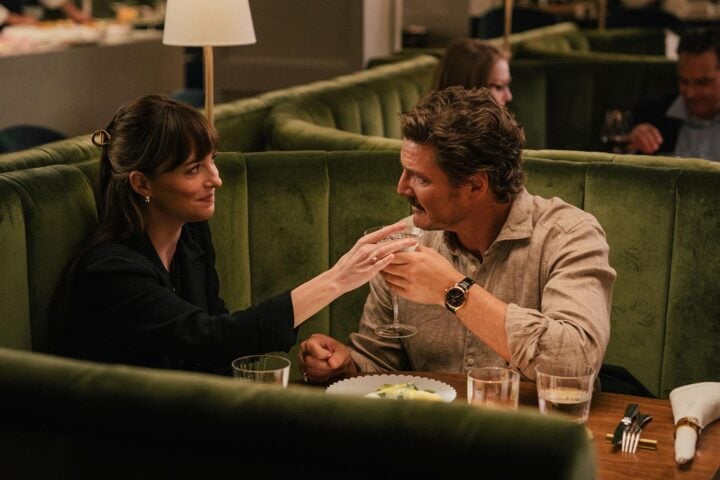
Carey begins Splitsville at the receiving end of a break-up with his wife, Ashley (Adria Arjona), on a road trip to Paul’s beach house. And shortly after the dissolution of his marital bond, Carey inadvertently instigates another divorce when he sleeps with Paul’s wife, Julie (Dakota Johnson). Despite his and Julie’s admission that their marriage is open, Paul reacts to this development as if he’s been cuckolded. His is a surprising display of jealousy that prompts an expertly choreographed comedic brawl for the ages between the two men—an extended centerpiece that sets the rest of Splitsville’s plot in motion.
This original sin between the best buds reveals the film’s core concern with delineating the different dimensions of relationships. Paul and Julie may believe their union can nourish their emotional and spiritual connection without satisfying their physical needs, but they neglect the glaring reality that marriage also contains other components that determine its durability. Any official partnership carries both social and legal weight, the latter of which Splitsville ironically underscores with chapter headings bearing the names of common divorce clauses.
The film spins out from the fight’s fallout, with the four central characters taking assorted lovers. The filmmakers render each development by channeling a wide variety of comedic approaches, which range from the visual virtuosity of mid-century French and Italian comedies to the verbal zest of American masters like Nichols and May. Behind the camera, Covino possesses an equal dexterity with composing a joke in the frame as he does in guiding a performer to deliver humor through a hilarious one-liner.

Splitsville proves that The Climb was no fluke. Covino pushes his directorial verve even further here without relying on his debut feature’s built-in single-shot gambit. His discipline and patience are still readily apparent in this sophomore outing, even though the film relies less on adhering to an aesthetic asceticism. Instead, Covino more naturally integrates gags into the scenes and lets their unfolding joys guide the editing toward a looser rhythm.
Splitsville thrives on the unpredictability of this formal freedom before settling back into a familiar Hollywood narrative formula: the comedy of remarriage. The adventure that each of the characters seeks outside their marriage ultimately becomes something they’re only able to find in the pursuit of their jilted former lover. Because Covino and Marvin’s screenplay gives the most airtime to their hapless male characters bungling their way back toward their ex-wives, Johnson and Arjona must keep the film grounded in the more serious stakes of spouse-swapping. It’s doubly impressive that they must do so while also making their character arcs cohesive despite many emotional pivot points occurring off screen.
Even though they live in the present, where attitudes toward fidelity are more lax, the characters here all find themselves circling the same tensions that powered many of the Golden Age studio rom-coms. Hopeless romantics like Carey and Julie try to reconcile the social and the sexual within the bounds of their marriages. Meanwhile, the more free-wheeling Paul and Ashley discover that the strictures of a relationship need not inhibit the spontaneity of romance.
Mostly steering clear of judgment calls or grand statements in favor of observational comedy, Covino and Marvin offer an instructive lesson on the force of (human) nature that is marriage. The institution represents an attempt to harness equal and opposite reactions, corralling the unruliness of the heart and the messiness of the libido into something resembling order. Maintaining a balance of different perspectives and proclivities is the key to functional coupling. It’s something that Covino and Marvin sharply show through Splitsville, itself a marriage of influences and inclinations that dissolves what might otherwise present as internal divisions.
Since 2001, we've brought you uncompromising, candid takes on the world of film, music, television, video games, theater, and more. Independently owned and operated publications like Slant have been hit hard in recent years, but we’re committed to keeping our content free and accessible—meaning no paywalls or fees.
If you like what we do, please consider subscribing to our Patreon or making a donation.