
“I know people speak of me as the typical American: trustworthy, loyal, full of integrity,” says the screen icon at the center of Henry Fonda for President in the film’s opening moments. “I read it, but it doesn’t mean anything to me.” The perception that the frail-voiced Fonda, in his final recorded interview, is referencing was mostly a flattering one for American moviegoers: The unassuming moral rectitude they saw in the actor was a reflection of the better angels of their nature, of a nation not yet disabused of its supposed founding ideals. As Fonda’s ambivalence suggests, though, the truth was more complicated.
The debut film by Austrian film historian and curator Alexander Horwath, Henry Fonda for President rigorously unpacks the implications of Fonda’s screen image over the course of the next three hours. The film charts a more-or-less chronological course through American history and Fonda’s own life through the prism of his screen roles, which offer a remarkable litany of historically resonant figures. In his films with John Ford alone, Fonda portrayed a fictionalized version of his own ancestor Douw Fonda (Drums Along the Mohawk), Abraham Lincoln (Young Mr. Lincoln), Tom Joad (The Grapes of Wrath), Wyatt Earp (My Darling Clementine), and the cruel, racist Apache hunter Lt. Col. Owen Thursday (Fort Apache).
Beginning in the Upstate New York village of Fonda—founded by Douw Fonda and depicted in Drums Along the Mohawk—Horwath introduces his formal device of cutting between clips of Fonda’s films and present-day footage of their settings. The distance between what the filmmaker’s voiceover refers to as “popular history,” written by the victors and cast into myth by the popular arts, and the historical realities it distorts is at the core of Horwath’s investigation.
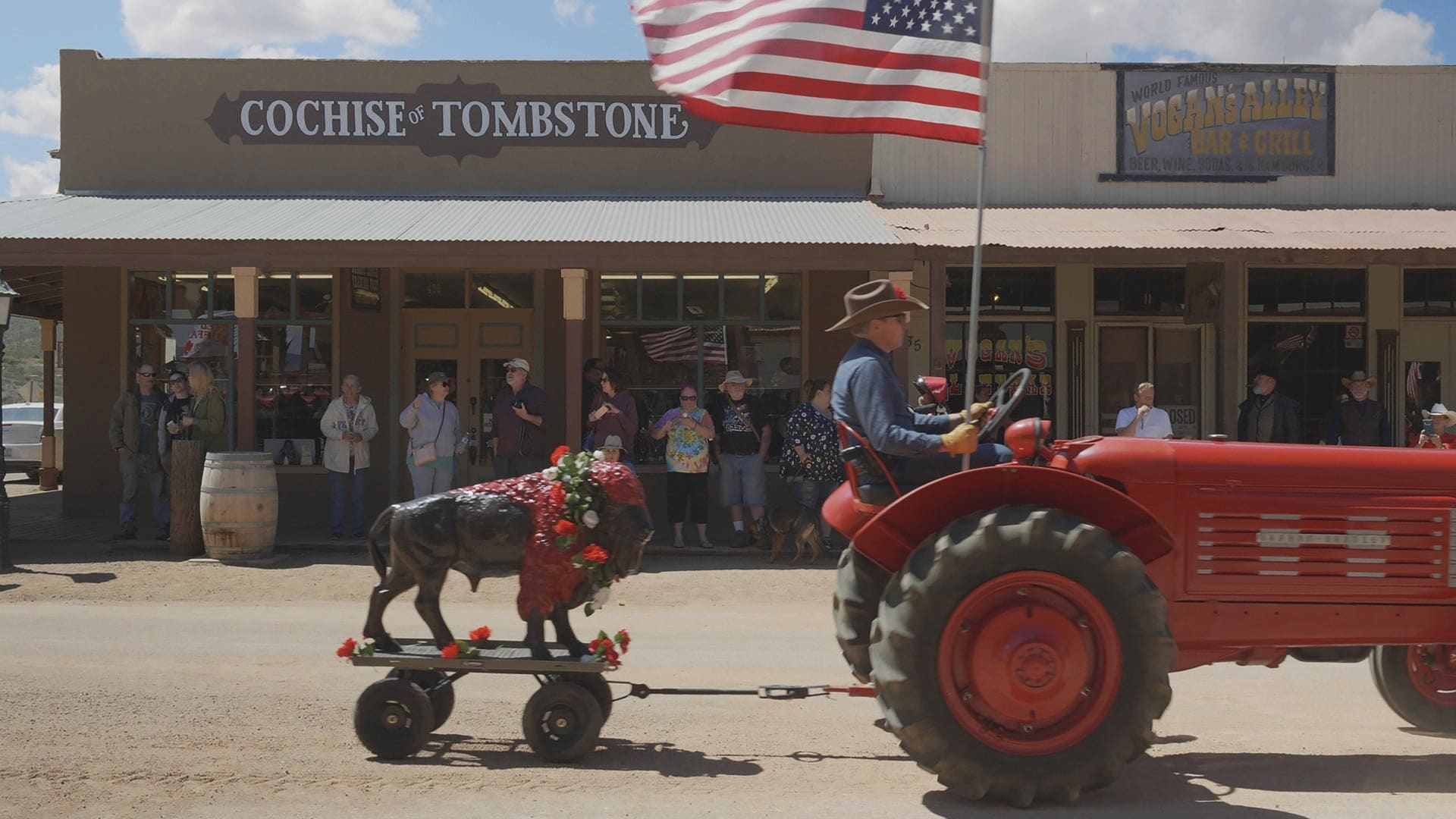
Despite the mournful anti-war tone of Drums Along the Mohawk, its depiction of a Dutch settler community could still work as a “manual to genocide”; the Tombstone that Wyatt Earp cleaned up now exists as a tourist trap squeezing the last few dollars to be made out of the myths of the West; the exploitation that Tom Joad fought against in the migrant camps of the Salinas Valley is now more brutally visited upon Mexican workers. If Fonda was an avatar of American liberalism’s tolerance and self-scrutiny, the film suggests, so, too, does he represent its complicity in the nation’s sins and its failure to change its course in the direction of justice.
Of course, far from being just an on-screen affectation, Fonda’s liberalism was a key element of his public persona. Born in Grand Island, Nebraska, in 1905, the film tracks how his childhood experiences—growing up as a Christian Scientist, witnessing the lynching of a Black man during the 1919 Omaha race riots—informed his outspoken political perspective. Horwath makes a convincing argument for Fonda as the author of his body of work along these lines, crafting his lifelong depiction of an American history marked by noble failures and bitter triumphs.

Following the thread of the lynching episode, Horwath identifies the central figure of Fonda’s filmography as the “wrong man,” falsely accused and prematurely judged guilty of a crime he didn’t commit. Sometimes Fonda plays the wrong man (The Wrong Man, You Only Live Once, Let Us Live), sometimes he’s in the position of defending him (Young Mr. Lincoln, The Ox-Bow Incident, 12 Angry Men), but always the wrong man is the scapegoat for the neuroses and prejudices of the American character. If the device of the wrong man lends itself to criticisms of the American justice system, it also explores the more existential loss of a fixed identity in a society that increasingly defines itself through images and fictions.
Fonda seemed to have thought himself something of a “wrong man,” anointed as a leading light of American progressivism by a public unable to view him apart from his screen image. As his career progressed, he began to play roles even more draped in moral authority: the upstanding Juror 8 in 12 Angry Men (the character is described by Horwath as a stand-in for Adlai Stevenson, Fonda’s favorite politician), and politicians trying to steer the country away from fascism (The Best Man) or nuclear disaster (Fail Safe) in the 1960s.
At home, though, Fonda was known as a distant father and husband, frequently given to bursts of anger and relentlessly self-critical. Vera Miles’s psychological breakdown in The Wrong Man closely follows the institutionalization and suicide of Frances Seymour, Fonda’s first wife and the mother of his children Peter and Jane, which Peter would later draw on during his emotional breakdown in the LSD trip sequence of Easy Rider.
Among Horwath’s achievements is the unity of thought he maintains despite his expansive, kaleidoscopic approach. Far from a trivial cataloging of coincidences, the myriad echoes between art and history are used to build a deeply considered critique of the Hollywood machine’s ideological underpinnings, of the real forces behind the images that machine produces. Horwath not only examines everything in the frames he shows us—paying close attention to Fonda’s physical gestures—he constantly reminds us of the history they leave out.
One of the film’s most deftly edited sequences focuses on the Old Trails Bridge that the Joad family crosses into Southern California, the same one that Peter crossed going the other direction into the heartland in Easy Rider. During the Depression, the bridge was closely monitored for potential socialist agitators—today it’s owned by Pacific Gas & Electric, who have contaminated the surrounding area with toxic chemicals for decades.
The film takes its title from a 1976 episode of Maude, in which Bea Arthur’s title character proposed the actor’s run for office to a guest-starring Fonda himself. Horwath notes that Maude was correct in her belief that the American people, eager to merge the dream life of the movies with real life, was ready for an actor president. Unfortunately, Fonda is the wrong man once again, as Ronald Reagan’s reactionary homilies sold that fantasy far better than Fonda’s sincere grappling ever could. Maude asserts that Fonda is the “quintessential American,” owing to his “spiritual honesty.” Henry Fonda for President shows us that she’s right, but for the wrong reasons. America saw in Fonda not a moral pillar, but, as Hitchcock captures in the shot of Fonda in a broken mirror The Wrong Man, a cracked reflection of their own contradictions.
Since 2001, we've brought you uncompromising, candid takes on the world of film, music, television, video games, theater, and more. Independently owned and operated publications like Slant have been hit hard in recent years, but we’re committed to keeping our content free and accessible—meaning no paywalls or fees.
If you like what we do, please consider subscribing to our Patreon or making a donation.


An interesting premise. What’s the conclusion? It ought to be that liberalism has no backbone and will always bend in the face of capitalism’s demands on us, with catastrophic consequences we are only now starting to see clearly.