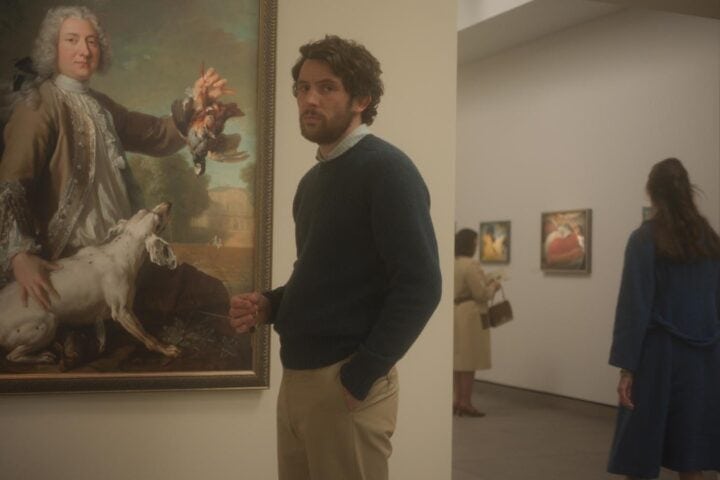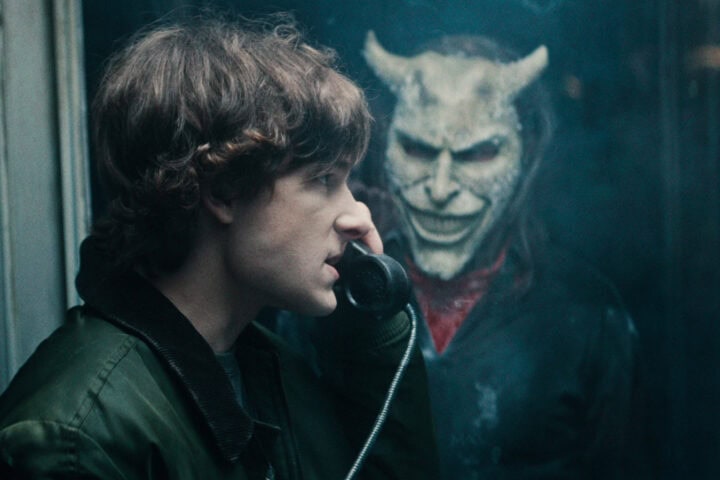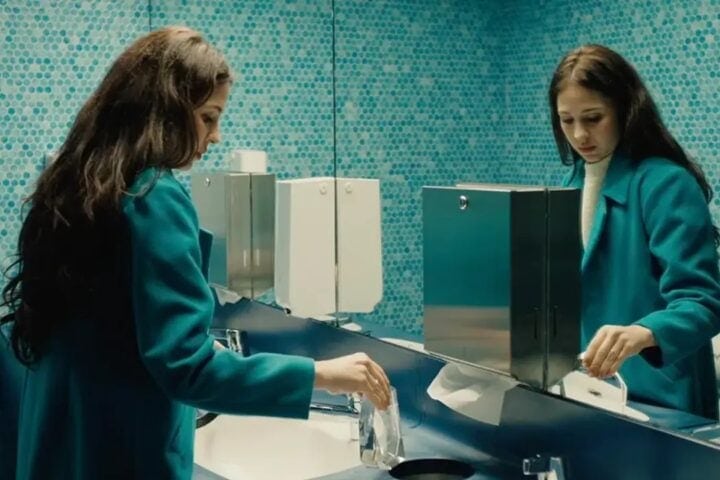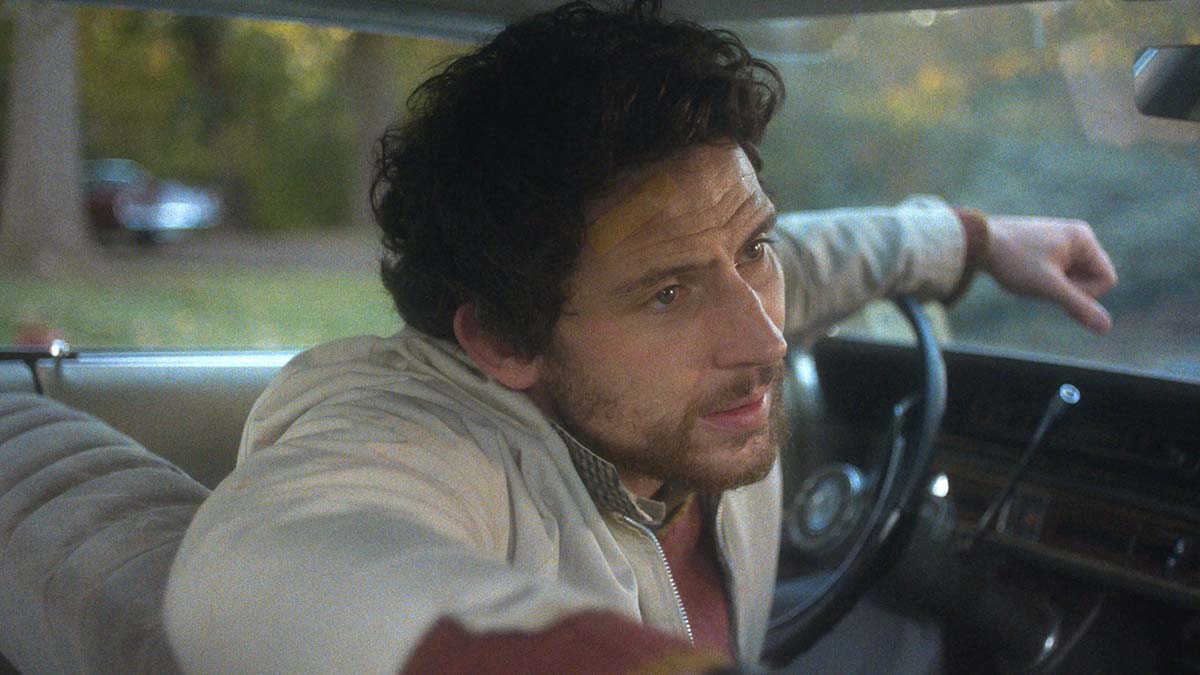
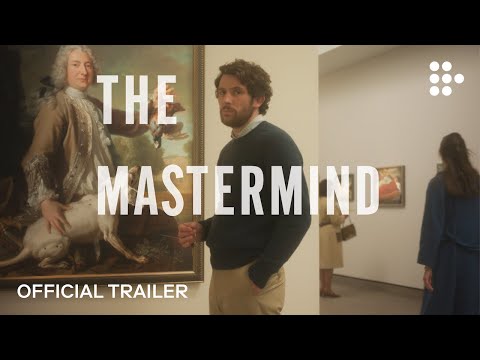
J.B. Mooney (Josh O’Connor) doesn’t move like a thief. Perpetually shambling along with his shoulders hunched and brow furrowed, he treats any task—from robbing a museum to looking after his two kids for an afternoon—with the same disdainful reluctance. Hardly a likely center for a heist film, but writer-director Kelly Reichardt’s early-1970s-set The Mastermind is less concerned with the mechanics of stealing than with teasing out what, if anything, makes O’Connor’s hapless, mostly unemployed ne’er-do-well tick.
J.B. lives an apparently stable existence with his wife, Terri (Alana Haim), and two sons, Carl (Jasper Thompson) and Tommy (Sterling Thompson), in the Boston suburbs. Not long after testing out the local art museum’s security by swiping a figurine in the film’s opening, we find him appealing to his college professor mother (Hope Davis) for a loan, claiming to need some capital for a carpentry project he’s been commissioned for. Its real use, of course, is as payment for the small-time crooks he’s recruited to steal four abstract paintings by the real-life artist Arthur Dove from the same museum. J.B.’s plan, which offloads the financial and physical risk of the heist to those around him, is our first clue to the void at the core of his scruffy exterior.
The Mastermind marks a new chapter in Reichardt’s ongoing tapestry of American life through the eyes of its eccentric outsiders, specifically capping off a trilogy about the intersection of art and commerce at differing stages of American capitalism. But where First Cow and Showing Up offer sympathetic portraits of artists striving for personal expression despite adverse material conditions, Reichardt’s script here focuses on the (attempted) exploitation of others’ expression for material gain. J.B.’s slackerdom seems to exist in the hangover of the ’60s, when—as we find out from two of his longtime friends, Fred (John Magaro) and Maude (Gaby Hoffmann)—he himself was an art student, admiring the Dove painting above his thesis adviser’s desk.
There’s more than a hint of envy to J.B.’s plan, with his desire to possess and profit from art without doing the work of an artist representing another of his characteristic shortcuts. For Reichardt, who struggled to finance a follow-up to her feature debut, 1994’s River of Grass, for a 12-year period that nearly drove her out of filmmaking, the subject feels personal.
Suffice it to say that the heist doesn’t go well, and the low-keyness of the entire affair extends beyond O’Connor’s performance. The Mastermind realizes its period setting in drab earth tones and gray, hazy skies, its texture provided largely by details like unappetizing food (steamed peas and carrots, fast food that tests the definition of “food”) and the ubiquitous hum of televisions tuned to coverage of the Vietnam War and its accompanying protests.
Vietnam is everywhere in the film, moving from what appears to be period window dressing to a central role in the film’s structure. The closest thing Reichardt offers to a stylistic flourish is a 360-degree pan around a boarding house room that locates, among other things, Walter Cronkite reporting on the bombing of Cambodia before landing back on the oblivious J.B.
The solipsism embodied in that shot is in many ways the film’s true subject, whether on a global scale or in J.B.’s conduct as a husband and father, as he saddles his wife and even children with covering for his misdeeds. There’s no mention of a political past among Fred and Maude, but J.B. isn’t above making a flirtatious pass at Maude while Fred sleeps. Reichardt’s intentions don’t fully reveal themselves until the film’s brilliant final shot, both a joke at J.B.’s expense and a bitter commentary on a nation increasingly operating by his own blinkered logic.
The ending casts everything prior in a different light—one that justifies Reichardt’s preference for comedy of embarrassment over the taut suspense thriller suggested by the film’s logline. Effective as it is, there’s a schematic element to The Mastermind’s construction that limits the scope of its perception. Reichardt’s greatest strength has always been a certain sort of portraiture, an immersion in character and environment that suggests rich personal histories and negotiations of social orders with minimal explanation. J.B., though, feels locked into the filmmaker’s larger design, set up from the beginning for his (deserved) comeuppance.
Where her greatest works ground themselves in specificity and in so doing illuminate universal ideas and emotions, Reichardt here seems to have started with a thesis and worked backwards. That extends to the direction as well. Where the images in films like Wendy and Lucy and Meek’s Cutoff teem with the possibility of what lies just off screen or under the surface, here they more narrowly illustrate the progression of the script. The Mastermind closes its loop with an effectively wicked sense of humor, but it comes at the cost of the openness that has made Reichardt one of the great American filmmakers of her era.
Since 2001, we've brought you uncompromising, candid takes on the world of film, music, television, video games, theater, and more. Independently owned and operated publications like Slant have been hit hard in recent years, but we’re committed to keeping our content free and accessible—meaning no paywalls or fees.
If you like what we do, please consider subscribing to our Patreon or making a donation.