
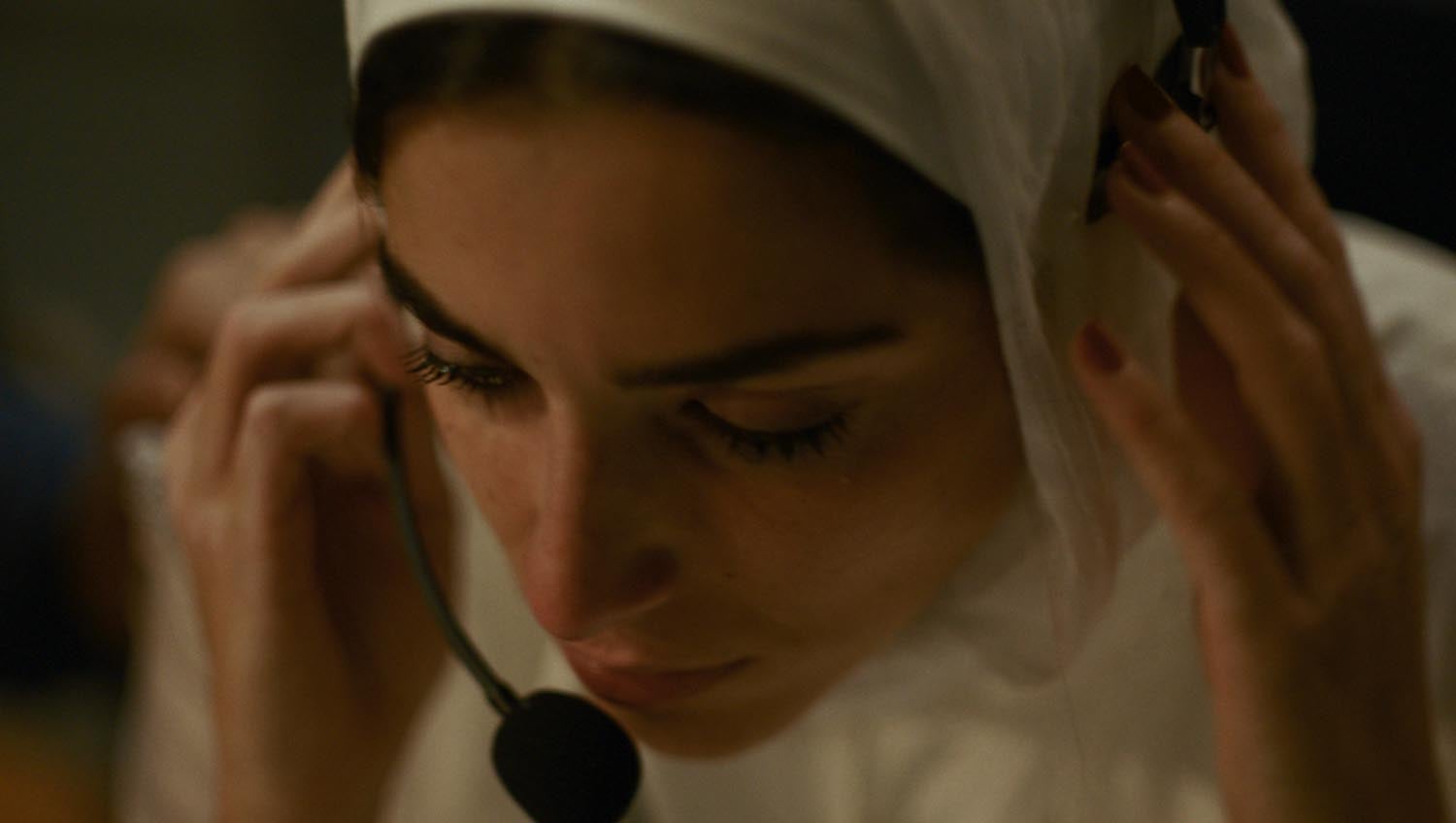
On January 29, 2024, employees at the Palestine Red Crescent Society in the relatively quiet West Bank city of Ramallah fielded an emergency call from a five-year-old child named Hind Rajab, who was pleading for help from inside car under fire in war-torn Gaza. Unfolding in the guise of a thriller, writer-director Kaouther Ben Hania’s The Voice of Hind Rajab recreates the events of this single day and from the perspective of the call-center employees who were on the phone trying to coordinate the rescue of the child.
Central to the film is the actual audio recording of Rajab’s calls to the Palestine Red Crescent Society, and they’re as wrenching and agonizing as you can imagine. But in the context of a film that’s almost hell-bent on ratcheting up a sense of tension and unease around its recreation of the scene inside the call center, the usage of the recording becomes more than a little dubious. Indeed, watching actors, namely Saja Kilani as Rana and Motaz Malhees as Omar, interact with an authentic recording of a child on the brink of death is less an invitation to audiences to wrestle with the horrors of war and more with the ethics of the film’s creative choices.
Between so much of the film unfolding in near real time and its use of jittery handheld camerawork and tight close-ups, the comparisons to Paul Greengrass’s queasily forensic docudramas make themselves. Some sequences, such as a climactic one where Omar lashes out at his supervisor, Mahdi (Amer Hlehel), for a perceived lack of commitment to Rajab’s rescue, are pitched to such melodramatic heights as to seem gratuitous, since the real phone calls themselves already emphatically convey a sense of the situation’s severity.
Despite scene after scene being beholden to highly expositional dialogue, the film gives us a very clear sense of the emotional toll that the work inside the call center takes on its employees. But the jarring contrast between the histrionic reenactments and the very real terror felt in the audio recordings only underlines how uneasy The Voice of Hind Rajab’s combination of dramatization and reality is. The film wants to be seen as a galvanizing force to assert Palestinian dignity, but its questionable artistic approach, lamentably, overshadows that goal.
Since 2001, we've brought you uncompromising, candid takes on the world of film, music, television, video games, theater, and more. Independently owned and operated publications like Slant have been hit hard in recent years, but we’re committed to keeping our content free and accessible—meaning no paywalls or fees.
If you like what we do, please consider subscribing to our Patreon or making a donation.



This review is an outlier. Most reviews are effusive in their praise for excellent filmaking that highlights the horrors of Israel’s genocide of the Palestinian people.
It is interesting that the review avoids any explanation of what happened to Hind Rajab, her family and the two Red Crescent medics travelling to her assistance. “pleading for help from inside car under fire” could have been published in the ever-evasive New York Times. They were all murdered by Israel’s military forces. Five-year-old Hind Rajab, whose identity and youth were certainly known to those forces, was machine-gunned to death by killers in a tank using 335 bullets. Her relatives in the car had already been murdered by Israel; the Red Crescent medics were shortly afterwards murdered in their ambulance. Shame on the writer of this review for not mentioning any of these salient facts.
This review misses the point. The film is INTENDED to be “uneasy” via the combination of reality and dramatization, but not via the reviewer’s characterization of “histrionic reenactments.” If one has heard the 911 and cellphone calls from Uvalde or any number of mass shootings in the U.S., it is easy to recognize the intense pressure faced by would-be rescuers. The atrocity here is virtually universal – Ukraine, Africa, the Hamas attack on Israel, etc.