Known for its relentless pace, high difficulty, and over-the-top machismo, the Contra series has been unapologetic about its action identity for more than 30 years, to the point where the manual for 2007’s Contra 4 mocked the very notion of save points. Contra: Rogue Corps, by contrast, features a save system, gear upgrading, level gaining, and a hub in which players can access various game modes and features, including upcoming DLC. In short, it offers the whole industrialized shebang. And so, this latest Contra feels as if it lacks an identity altogether—other than the sense that it’s obviously, tediously modern.
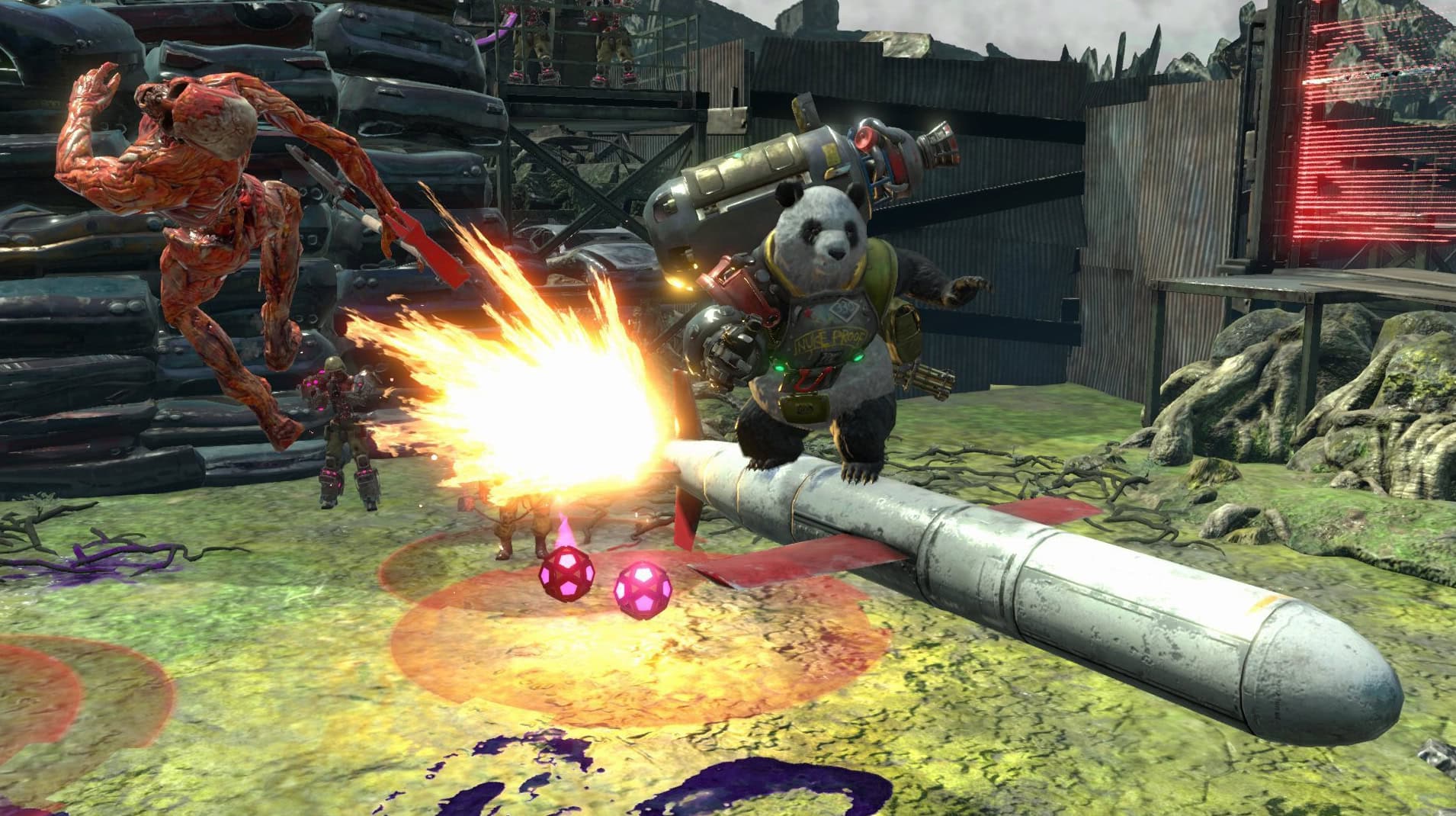
Set years after the events of Contra III: The Alien Wars, Rogue Corps allows you to select from one of four characters, including a giant minigun-wielding panda. As always, the goal is to blast a plethora of enemies throughout, with a more significant opponent waiting for you at the end of each mission. Unlike Contra III and the other mainline entries in the series, the camera’s main position here is a top-down angle, though the perspective will shift to over-the-shoulder from time to time, and the game utilizes a twin-stick shooter control scheme. Also different is the general stage design. While Contra built its reputation on aggressive run-and-gun action, Rogue Corps is more akin to 2016’s Doom, where a level tends to funnel the player toward individual arena battles that, once completed, unlock new paths.
This type of structuring isn’t inherently bad, but Rogue Corps doesn’t do anything particularly noteworthy with it. The environments aren’t very dynamic; the occasional destructible fuel barrels and sudden door openings are more than expected at this point. And the way the game leans on familiar mechanics makes the proceedings feel predictable. For one, there’s a dodge maneuver, one of the most timeworn of gaming conventions, that you’re supposed to spam in order to escape enemy crowds, maintain distance, and stun individual threats. And like several of the “stronger” foes in Sekiro: Shadows Die Twice, many of the bosses here can’t overcome that tried-and-true diagonal dodge that places the hero right behind the baddie, the soon-to-be recipient of much, much damage. Your adversaries’ limited attack patterns can also be recognized and memorized quickly, which leads to monotonous bouts of attrition.
Rogue Corps desperately wants to appear hip to its target audience. The audio more than confirms this pandering approach, with plenty of glibly voice-acted, profanity-littered dialogue, an odd turn for a franchise that up to this point has preferred to let the action do most of the talking. Although you’ll hear a classic Contra melody here and there, the music usually becomes tense in a Metal Gear Solid sort of way during pivotal battles, and the lightly jazzy track that plays at the game’s main hub sounds like it came straight out of Persona 5. That’s a pity, as the scores to the best Contra titles are intent on keeping your blood pumping with a masculine fury, and without reminding you of other games’ musical compositions.
Perhaps Rogue Corps’s efforts to fit in with the big dogs of the gaming world would be more tolerable if there were more variety to its challenges. Judging by the content of this release, the bosses are as recyclable as plastic water bottles. One level’s map is practically a carbon copy of a prior one, only with more (of the usual) threats to extinguish. And be prepared to constantly switch between two weapons, whose tendency to overheat means that being conservative with firepower is often the best way to win out. Rogue Corps hopes that everyone likes it, and wishes to achieve this by implementing ideas that can be easily tested and approved by modern fans. Which is to say that the uncompromising design that made the original Contra a formative touchstone is missing in action.
Since 2001, we've brought you uncompromising, candid takes on the world of film, music, television, video games, theater, and more. Independently owned and operated publications like Slant have been hit hard in recent years, but we’re committed to keeping our content free and accessible—meaning no paywalls or fees.
If you like what we do, please consider subscribing to our Patreon or making a donation.