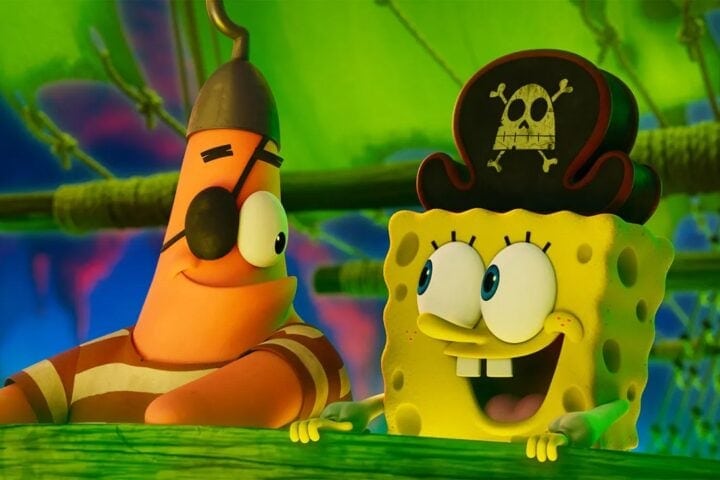
In 2018, Sony’s Spider-Man: Into the Spider-Verse pioneered an animation approach that rejected conventional 3D modeling in favor of something closer to hand-drawn art, turning the film into a megahit and kickstarting the current multiverse craze. Predictably, other studios have taken note of the association in our minds between that style and the promise of artistic innovation. But unlike, say, DreamWorks breathing new life into Puss in Boots with The Last Wish, Chris Miller’s Smurfs marks a shift in this trend where the style, once synonymous with boundless creativity, has become nothing more than a marketing ploy.
Smurfs, at every turn, is a film that only half-commits to its promotional promises. Advertised as a pop musical featuring new Rihanna music (currently a scarce commodity), the film contains a whopping three musical numbers. (Judging by the needle drop of 2007’s “Don’t Stop the Music,” one imagines that even the studio felt they were delivering insufficient Rihanna originals.) While ostensibly a star-studded ensemble piece, the film relegates its supporting cast to a handful of quips that could have been delivered by anybody.
The film is also advertised as a multiverse movie (the plot is kicked into motion by John Goodman’s Papa Smurf being pulled into a portal, transporting him to the human world), though you wouldn’t know it, as the bulk of the running time is spent in Smurf Village or on Earth, with Paris, Munich, and the Australian Outback rendered with all the warmth and character of a Windows screensaver. Only in a two-minute montage during the film’s climax do the characters actually travel across dimensions, with shifting art styles to go along with it.
It seems as of late that simply boasting a refreshing art style has become catnip for piquing fans’ interest in bottom-of-the-barrel IP movies (one is reminded of 2020’s Scoob!). With its references to Zoom calls and LinkedIn, Smurfs reveals its Spider-Verse pastiche to be nothing but window dressing for low-hanging, pop culture-centric humor.
We, as a society, haven’t quite stooped so low as to attempt critical reappraisal of Raja Gosnell’s The Smurfs, from 2011, but at least that film, with its grotesque three-dimensional Smurfs uncannily composited into a live-action New York City, didn’t try to trick you into thinking it was a tasteful reinvention of an animated property. While this Smurfs has evolved away from the era in which every live-action adaptation of such properties needed a human protagonist, the fact that what we get instead is a lead character named No Name (James Corden) says everything you need to know about the film’s contribution to the cartoon’s legacy.
Since 2001, we've brought you uncompromising, candid takes on the world of film, music, television, video games, theater, and more. Independently owned and operated publications like Slant have been hit hard in recent years, but we’re committed to keeping our content free and accessible—meaning no paywalls or fees.
If you like what we do, please consider subscribing to our Patreon or making a donation.