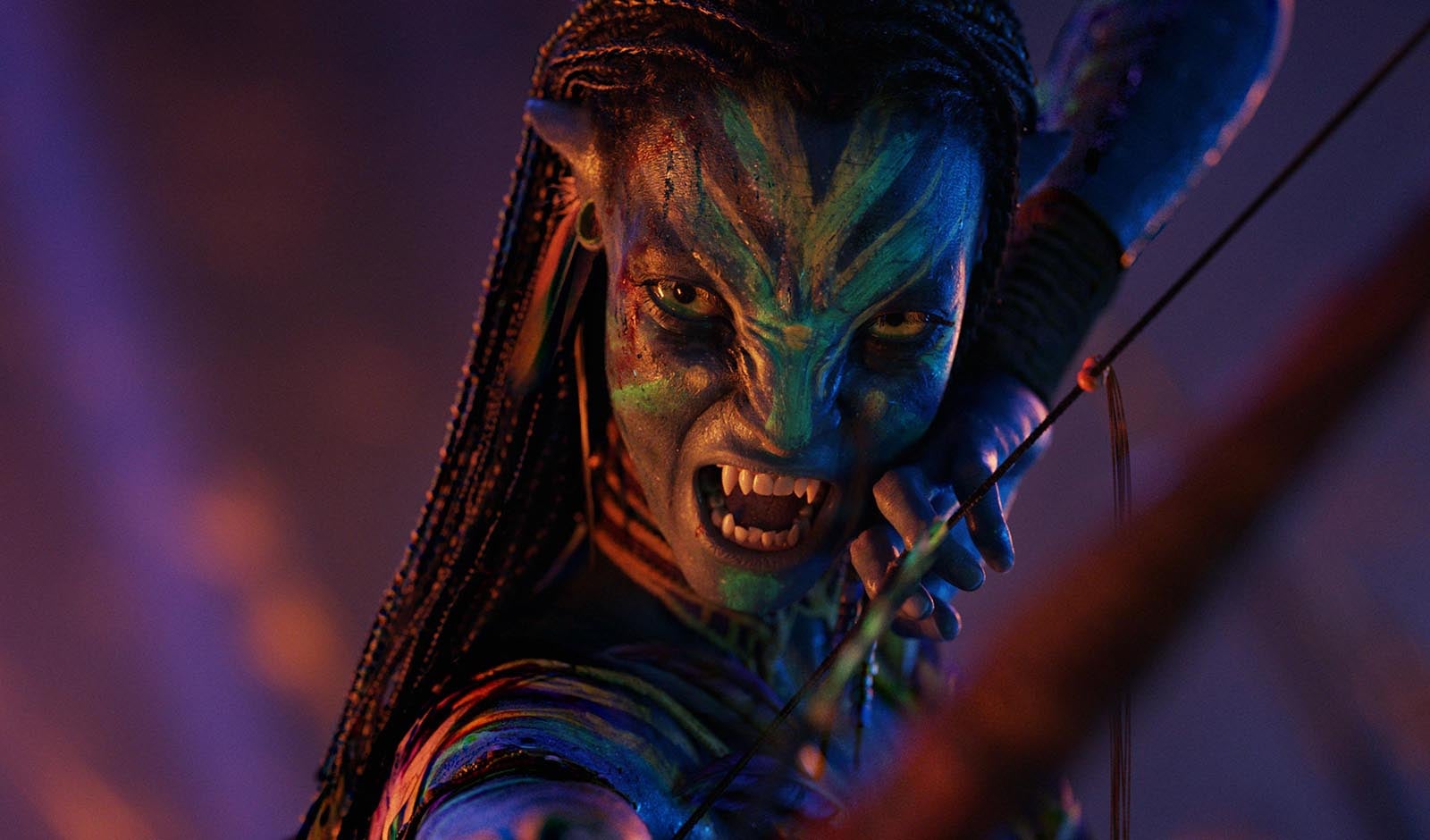
James Cameron’s Avatar: Fire and Ash, the third installment in his ongoing blockbuster sci-fi saga, is effectively a three-hour-plus series of climaxes. The boundless sense of finality proves unsurprisingly wearisome. And it’s also the first time one of these behemoths feels clouded by doubt, almost as if Cameron and his army of technicians are worried that the double-billion-dollar roll of the dice that paid out with both 2009’s Avatar and 2023’s Avatar: The Way of Water might finally come up snake eyes. There’s little doubt Fire and Ash will make money, but will it be enough to justify continuing a tale (two additional entries are planned) that more than a few have dismissively likened to FernGully: The Last Rainforest in space?
But enough talk of green. Once again, we find ourselves on the searingly blue planet of Pandora among its Na’vi inhabitants. It’s a few weeks since the towering, azure-skinned Sully clan, led by human-alien hybrid Jake (Sam Worthington) and his actual extraterrestrial spouse, Neytiri (Zoe Saldaña), did battle alongside the aquatic Metkayina tribe. They’ve driven back the “sky people,” a.k.a. Earthlings, working for the colonialist-minded R.D.A. but have lost multiple Na’vi in the process, most tragically eldest Sully child Neteyam (Jamie Flatters).
The early scenes are all about the family’s grief: Jake is red-bloodedly sullen; Neytiri is maternalistically enraged; the remaining kids—among them a motion-captured Sigourney Weaver as teenage oracle-in-training Kiri—are in varying stages of shock. If there’s a focal character, it’s Spider (Jack Champion). He’s the Sully clan’s adopted human son who’s also the biological offspring of the series’s seemingly unkillable main antagonist Miles Quaritch (Stephen Lang), still wreaking havoc from within a resurrected and ill-treated Na’vi body.
Trapped between two literally otherworldly sets of parents—the oft-scolding and skeptical Sullys and the devoted if still psychopathic Quaritch—Spider must hack his own path toward both self- and communal acceptance. Multiple action sequences later (all well-staged but tediously similar in their narrative beats), catharsis arrives in the form of a cringingly sentimental we-are-all-family finale, one so trivial and tossed-off it makes the much-maligned conclusion to another part-three space opera, Return of the Jedi, seem like August Strindberg by comparison.
Everything in Fire and Ash tends to the simplistic and palatable in ways that anyone familiar with Cameron’s oeuvre can clock immediately. He certainly has a talent for glib grandiosity, as exemplified by 1997’s Titanic, with which he turned a horrific real-life historical tragedy into the roller-coaster backdrop for a fatuous harlequin romance.

There’s of course nothing here that qualitatively differentiates the third Avatar from its predecessors. The movie moves at a clip and looks like hundreds of millions of bucks have been spent, which isn’t the same thing as saying that its 3D visuals, a mix of standard- and High Frame Rate sources, are particularly beautiful. As with many massively budgeted digital experiments (of which Robert Zemeckis and Peter Jackson are Cameron’s obsessive fellow practitioners) it feels like your vision is expanding while your eyes are being slowly gouged out.
The crystal clarity of Russell Carpenter’s cinematography is often unnerving, as is the uncanny nature of Pandora’s computer-generated flora and fauna, which never truly seem alive and vital—quite a feat when your alien species include multi-eyed telepathic whales with their own character arcs. This same walking-deadness is evident in the many mo-capped performances, which rarely show a pulse. The one exception is Oona Chaplin as Varang, the leader of the bloodthirsty Mangkwan clan, a.k.a. the Ash People, whose memorably villainous turn (spouting extraterrestrial invective in and around her volcanic lair) transcends all the tech-heavy shellac.
Cameron has gone out of his way to promote his mo-cap techniques as actor-friendly, even concocting a behind-the-scenes short that plays before the movie proper in which he and several of the cast note the many imaginative freedoms afforded by the production as well as the non-use of generative A.I. at every stage. Though, since the two Avatar sequels were primarily shot in 2017 and 2018, the no-A.I. mantra in particular comes off as a disingenuous sop that allows Cameron to appear like an unimpeachable good guy amid the entertainment world’s many villains of the moment. All the creativity-first performativeness also matters little when the on-screen talent barely registers, be they under CG-augmented pancake like David Thewlis as kindly Na’vi trader Peylak or are fully flesh and blood like Edie Falco as General Ardmore, a non-entity of a militaristic thug who proves a constant thorn in the Sully clan’s side.
Cameron has never been especially good at writing characters beyond the broadest of strokes, which isn’t much of a detriment when, as in Aliens and the two Terminator films, the narrative stakes are high and the technological innovations augment rather than overwhelm the comic-book fervor of his vision. The Avatar movies, by contrast, are empty vessels of pro-forma spectacle that, true to the very disposable era of entertainment in which we’re living, make bank primarily because of how quickly they can be memory-holed.
Since 2001, we've brought you uncompromising, candid takes on the world of film, music, television, video games, theater, and more. Independently owned and operated publications like Slant have been hit hard in recent years, but we’re committed to keeping our content free and accessible—meaning no paywalls or fees.
If you like what we do, please consider subscribing to our Patreon or making a donation.