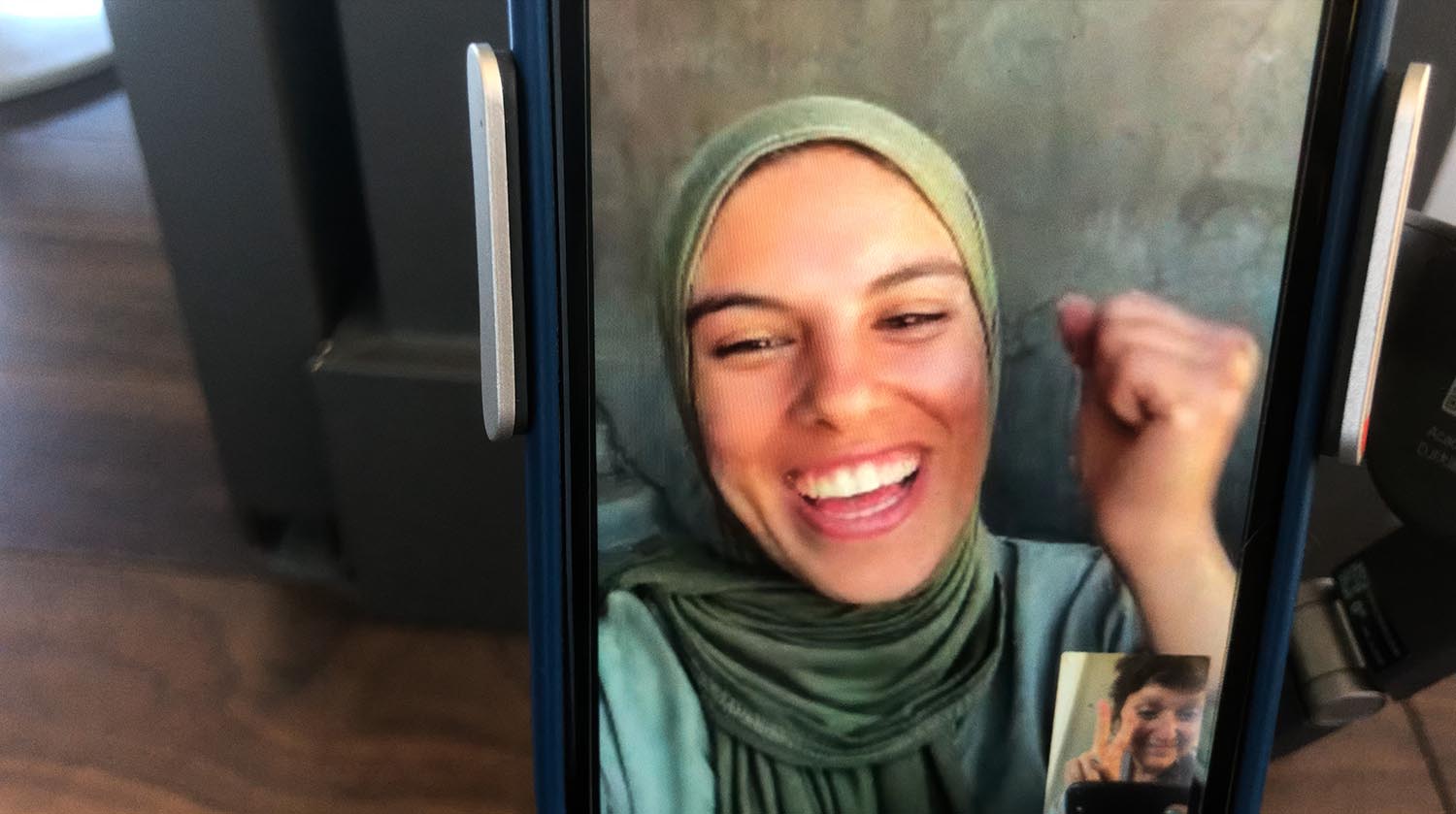
“Everything happens for a reason!” beams Fatma Hassona during one of her early conversations with exiled Iranian filmmaker Sepideh Farsi. It’s April 2024 and the rosy-cheeked Palestinian photojournalist is explaining the infrastructural and human devastation inflicted by Israel’s bombardment of her native enclave of Gaza. Months later, Hassona’s face has shrunk, her skin paled and coarsened from lack of fresh water and nutrition, and in between her characteristic smiles and laughter her expression goes blank as she contemplates the still-ongoing bombardment: “There is no reason for anything they do.”
Throughout Farsi’s Put Your Soul on Your Hand and Walk, handheld smartphone footage captures monitors displaying Hassona, who was killed in a targeted strike by Israel just prior to the film’s Cannes premiere, conversing with the filmmaker. These conversations are juxtaposed with woozy close-ups on television sets broadcasting news about the Gaza war—namely Hamas and Israel’s repeat failures to broker a ceasefire, each holding out on demands that their leaders deem politically unacceptable, and Western allies’ shocking complacency as Israel defies international humanitarian law under the banner of counterinsurgency.
Hassona’s spectral, hijab-clad visage contrasts with these nauseating volleys of information, so often smiling as she discusses the compounding suffering on the ground. She evinces only generalized awareness of the larger political struggles shaping and threatening her life, focusing instead on her family and community as she wages her own struggle against despair—a struggle in which smiles, laughter, art, and faith are her chosen weapons of resistance.
The film’s title comes from a description by Hassona, also a gifted poet, of the existential terror felt by citizens in the streets of Gaza, where bombs seem to fall at random, taking friends, family, and neighbors with them. Her photographs and poems, exhibited in haunting montages throughout—and the film’s only lucid, high-definition images—document vast landscapes of urban ruin presided over by drones, snipers, and other faceless bringers of death. Yet they also contain a playfulness that defies the looming pall of despair, emphasizing children’s games and imagination even as they attempt to make peace with the abyss: “I lied when I said that death was hideous; death is delicious, yet none of us has ever tasted its flavor.”
Farsi, a secular feminist living in the West, is acutely aware of the physical and cultural separation between herself and her subject as well as the layers of mediation required for her access. In parts, she lightly presses Hassona on sensitive topics: hijab enforcement and conservative Islam, October 7, Hamas, and more. Hassona’s statements on each aren’t quite endorsements and not quite condemnations; Farsi, though she occasionally notes her own skepticism, doesn’t judge but presents them honestly as part of a full human portrait.
Put Your Soul on Your Hand and Walk was intended by Farsi as a reflection on barriers and bridges in the age of screen omnipresence. But in the wake of Hassona’s death, it also stands as a moving monument to this young woman and countless others like her—lovers of life who refused to be quiet as they were swept into the dehumanizing machinery of war.
Since 2001, we've brought you uncompromising, candid takes on the world of film, music, television, video games, theater, and more. Independently owned and operated publications like Slant have been hit hard in recent years, but we’re committed to keeping our content free and accessible—meaning no paywalls or fees.
If you like what we do, please consider subscribing to our Patreon or making a donation.