In both Sidney Lumet’s Fail-Safe and Stanley Kubrick’s Dr. Strangelove, an American nuclear strike on Russia is ordered against the intentions of the White House. One is a hyperrealist parable with dedicated and rational men at its center that treats the threat of nuclear war with teeth-gritted seriousness, while the other paints military men as buffoons, cowards, and lunatics whose sexual neuroses and grandiose delusions render them congenitally incapable of controlling their potentially world-destroying power.
Kathryn Bigelow’s nerve-shredding A House of Dynamite, written by former NBC executive Noah Oppenheim, has echoes of both films, and it arrives at a time when global tensions are approaching a boiling point unseen since the Cold War’s end. Clearly inspired by Russia’s 2022 invasion of Ukraine—the only present-day conflict explicitly referenced here, albeit in passing—it revolves around an intercontinental ballistic missile launched from somewhere in the Pacific and toward American soil without warning. There’s also no clear aggressor.
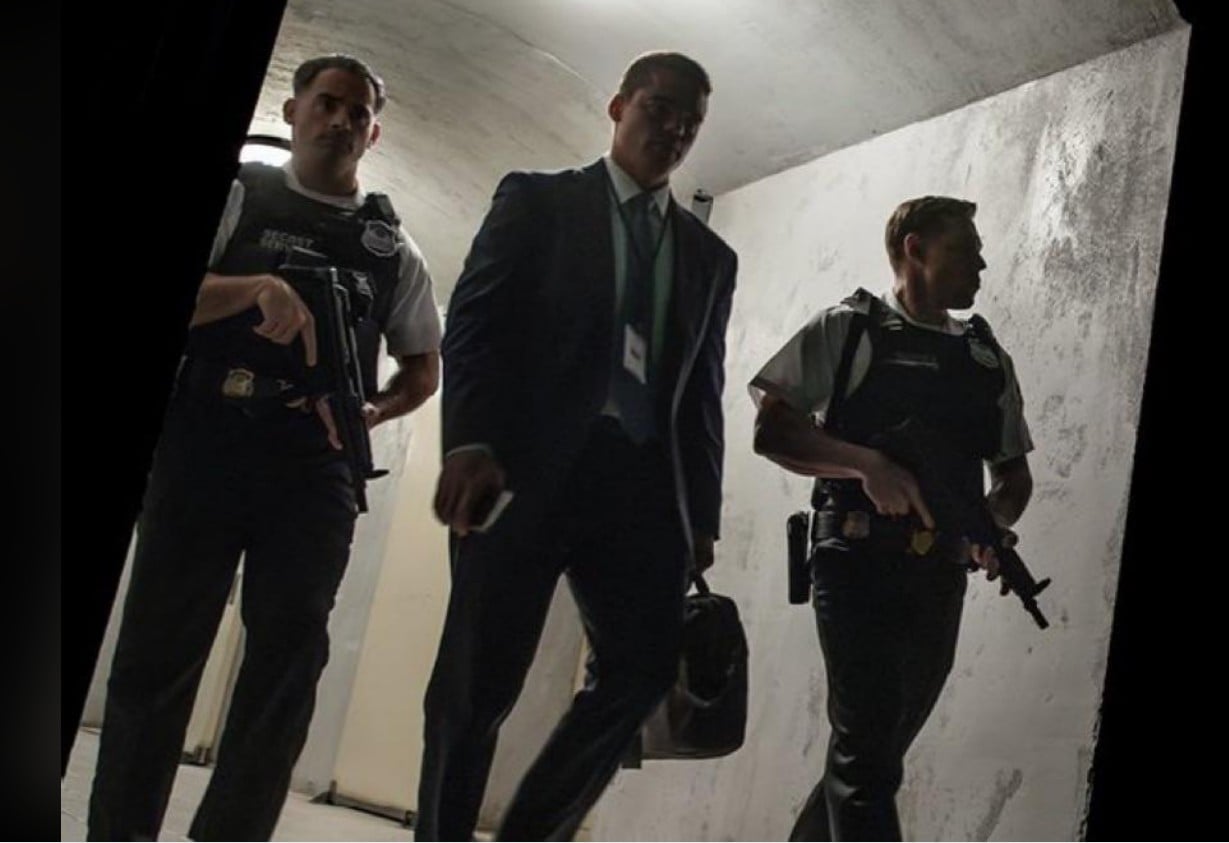
The film plays like a D.C.-insider procedural as we’re shuffled between departments and the perspectives of different personnel within them, the different units of government and technology relevant to every step of America’s nuclear response protocols explained in slick animated title cards fit for a network news special. Through a series of close-ups and zooms on consternated faces inside brightly lit meeting rooms, bunkers, and vehicle interiors, we watch as individuals screen reams of information, snapping at one another trying to avert a nightmare, all set to the strains of Volker Bertelmann’s relentless decibel-shredding score.
Once everyone settles in for what will be the most terrifying workday of their lives, A House of Dynamite begins a roughly 30-minute ticking-clock scenario played out in full not once but three times. The film moves at a whirring pace as it latches on to characters mulling seemingly endless possibilities. Was the missile launched by North Korea, or is that what the Russians want the Americans to think? Would foregoing retaliation prevent escalation or invite it?
The replay of the story, from different perspectives, allows us to grasp the scope of government action needed to defuse an international crisis as the once-mightiest nation in the world tumbles into confusion and terror in the span of a single morning. It also introduces us to characters who are defined primarily by their job title, secondarily by the fragmentary domestic dramas haunting their confrontations with national disaster, and tertiarily by the bad jokes they crack.
Every top-level U.S. government employee here is competent and conscientious, struggling against their human limitations of cognition and emotion to take the most responsible course of action on behalf of their nation and family. The film can be riveting to watch as norms break down as the missile approaches. And its not-so-subtle warning is a queasy one: that even were our nuclear capabilities in the most responsible hands, one rogue launch and a few failed coin flips could be all that’s required to shatter the world as we know it.
Like Fail-Safe, A House of Dynamite stares down impossible questions about an unthinkable scenario. But for all of its affectations of ripped-from-the-headlines realism, the film envisions a hyper-competent, ethically concerned American government that feels wildly out of date in 2025, to the point that it may as well have been beamed in from another dimension.
Today, Dr. Strangelove’s rendering of geopolitics as deadly buffoonery is more profound than Fail-Safe’s sweaty humanism, specifically its crystallization of our deepest intuitive suspicions about the real forces behind the ever-shifting fortunes of state and empire. In 2025, we live in Strangelove’s universe of chaos and myopia, and some in Bigelow’s generation, it seems, are still playing catch-up to the breakdown of liberal institutions once taken to be the hard spine of the nation. The rest of us still await the Kubrick of our troubled time to aestheticize the true, horrifying reality show behind the world’s great waning military superpower.
Since 2001, we've brought you uncompromising, candid takes on the world of film, music, television, video games, theater, and more. Independently owned and operated publications like Slant have been hit hard in recent years, but we’re committed to keeping our content free and accessible—meaning no paywalls or fees.
If you like what we do, please consider subscribing to our Patreon or making a donation.