
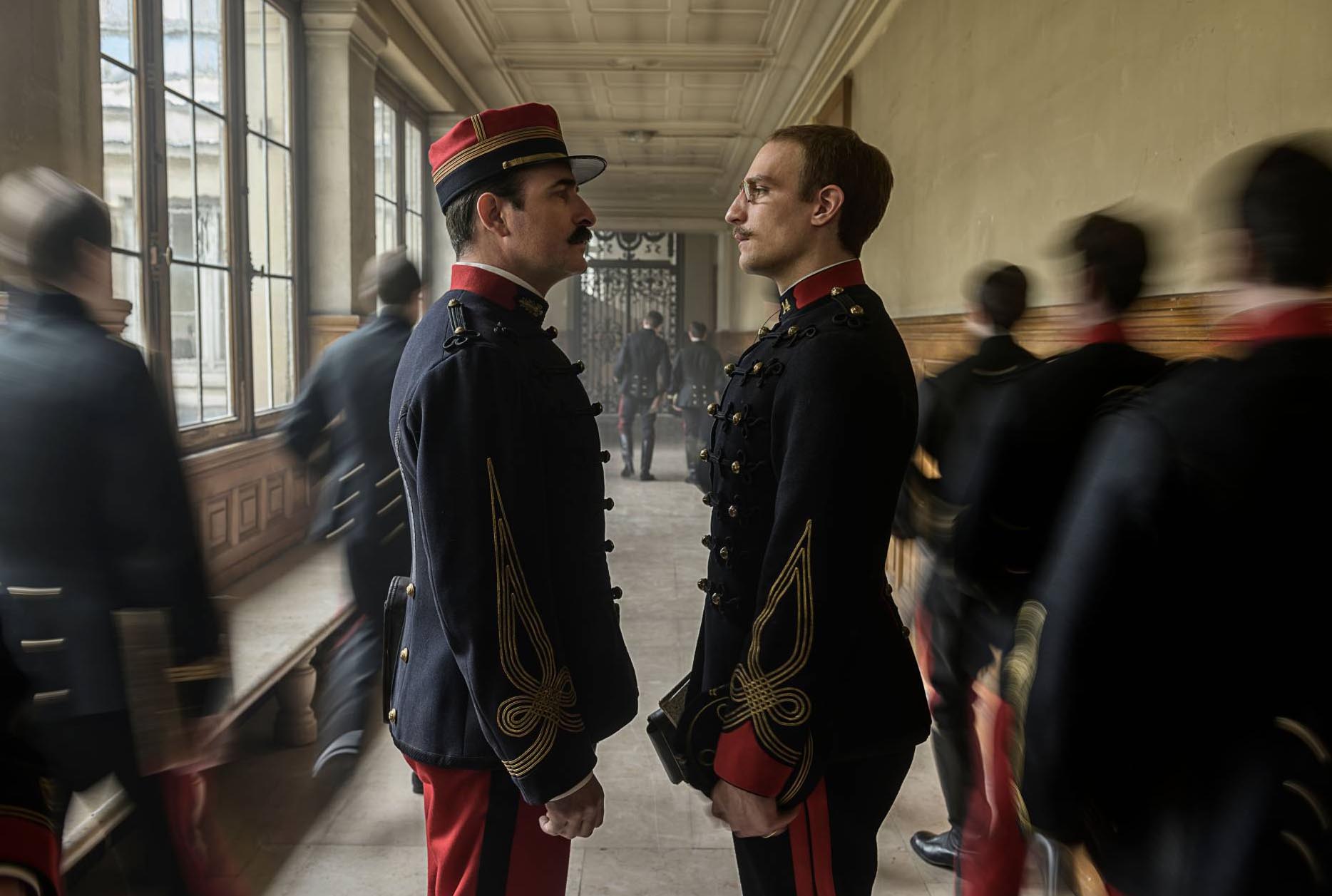
The Dreyfus Affair, a viper’s nest of cover-ups and deception, was triggered in 1894 by one real-life conspiracy: that of a lone French army major selling secrets to the German Empire. As Roman Polanski tells it in the painstakingly researched historical drama An Officer and a Spy, this was far less notable than the conspiracies that followed.
The second was a coordinated effort by the army, through doctored evidence and manufactured testimony, to frame Jewish officer Alfred Dreyfus (Louis Garrel), leading to his conviction and imprisonment. The third, which existed in the minds of the public and government factions who slaked their nationalist passions with Dreyfus’s shaming, was that of international Jewish interests working to undermine the French body politic and steer the course of world events. The fourth revolved around the government trying to preserve its image by concealing the existence of the second. And the fifth, forming around army officer and future Minister of War Marie-Georges Picquart (Jean Dujardin), involved gathering a crew of sympathetic politicians, publishers, and public intellectuals to expose all of the other conspiracies.
With An Officer and a Spy, Polanski returns to themes of conspiracy, xenophobia, and antisemitism. This film’s conspirators are petty and thuggish authoritarians, their secrecy and scapegoating both covers for their own frailty. But the narrative isn’t about a hero’s gnostic awakening to a malevolent grand design. Rather, it’s about a professional stickler trekking painstakingly over a deepening minefield of weaponized incompetence.
The film opens on the icy spectacle of Dreyfus’s public degradation before a crowd of statesmen and hissing spectators. Garrel’s Dreyfus trembles in the Parisian winter air, wincing back tears as he proclaims his innocence. But as a character, Dreyfus remains tantalizingly out of focus. Garrel’s quiet performance poignantly suggests the trials of a man clinging desperately to dignity in the face of absurd torments, but across An Officer and a Spy’s decade-spanning narrative, it’s Picquart’s perspective that the filmmakers privilege.
Picquart is a man who describes the sight of Dreyfus’s humiliation as a “Jewish tailor crying over the gold he lost.” A stone-faced soldier married to his job, Picquart isn’t an especially empathetic or likable hero. In fact, he’s humorless, myopic, rigid, a self-professed bigot, and engaged in an adulterous affair with another man’s wife (Emmanuelle Seigner). But Picquart is also, at times to his own frustration, a fervent patriot whose very rigidity and commitment to the codes of his institution make him unable to let any falsehood or act of professional misconduct in his sight go unchallenged. As he follows a dense—and, in the script’s flashback-filled rendering, at times convoluted—trail of evidence, fakery, and intuition, he becomes increasingly certain of Dreyfus’s innocence and aware that the state’s priority isn’t justice, but public relations.

The conspirators behind Dreyfus’s suffering include hardened antisemites, statesmen who intuit the political usefulness of antisemitism, statesmen who will tell any lie to avoid discrediting their administration, and toadies who will do anything to protect their bosses. The film understands that, beyond a certain point, the differences between them hardly matter.
The scapegoating of Dreyfus, based on the circular logic of conspiracism, is cathartic spectacle for a fearful nation. As escalating public passions weigh on the choices of the government, Picquart’s unflagging loyalty to the state leads him to clash with its representatives, bringing in forces from outside the state in order to preserve its integrity. But An Officer and a Spy has the appropriate cynicism to end on a note of ambivalence, asking if merely putting a “good man” in a seat of power is enough, if exposing the truth really defeats human irrationality, if the state or the public truly deserve forgiveness from the people they’ve failed.
Embodying the general shape of a post-Watergate procedural, Polanski and Robert Harris’s script (based on Harris’s own novel, which Polanski urged him to write) takes obsessive interest in the empirical facts of the Dreyfus case, in many ways at the cost of drama. The film creeps clinically through every step of the investigations and trials to which Picquart might have personally been witness, with cuts eliding years of time between important events, toward a staggered anticlimax that students of history will know is coming.
Evocative details suggest thematic approaches not taken: flashes of personal guilt on Picquart’s part and a key scene in a church reference the real Picquart’s ardent Catholicism, a faith he lost over the course of his life. But the film prefers to orient his crisis of faith solely around the processes of the nation-state, with Picquart’s scant personal life relegated to the depiction of his less-than-electrifying love affair. A final meeting between Picquart and Dreyfus is hauntingly inconclusive, merely hinting at deeper, unbridgeable schisms between the two men.
Visually, at least, Polanski’s balance of empiricism and poetry finds a sweet spot. Pawel Edelman’s spacious, darkened frames evoke with their high-contrast color and naturalistic lighting the paintings of the late 19th-century in a similar manner as Stanley Kubrick’s Barry Lyndon did the century prior, while the overwhelming density of detail in sets, locations, and costuming draws exhaustively from the photographic record. Rigid, elegant structures—buildings, army formations, baroque interior decor—are visually imposing and inescapably flawed, smudged with grit and filth highlighted by the camera’s lens.
The sum of these aesthetics, as in The Pianist, Polanski and Edelman’s first collaboration, feels at once like a gritty window into history as it was and a haunting amber-trapped essence of the feeling of an age. An Officer and a Spy’s darkened skies, always bearing down on the characters, practically portend great storms on the 20th-century horizon, much as the similarly overcast skies of The Ghost Writer did for the 21st. Polanski and Harris don’t approach the past as pure allegory for the present, but they remind us of where we’ve been for a reason.
Since 2001, we've brought you uncompromising, candid takes on the world of film, music, television, video games, theater, and more. Independently owned and operated publications like Slant have been hit hard in recent years, but we’re committed to keeping our content free and accessible—meaning no paywalls or fees.
If you like what we do, please consider subscribing to our Patreon or making a donation.


Strange that the review doesn’t mention that this film, finished in 2019, has never been released theatrically or on home video in the US, the UK, Australia or New Zealand. As detailed on WSWS: “Polanski pleaded guilty in 1977 to unlawful sexual acts with a minor. When a corrupt judge threatened to renege on the plea bargain, and planned instead to sentence Polanski to years in prison, the filmmaker fled the US.
As a 2020 open letter signed by 100 female French lawyers observed, the victim in the case, Samantha Geimer (then Gailey), “has appealed countless times for an end to the exploitation of her story.” In an interview with the French-language Slate in 2020, opposing the campaign against Polanski, Geimer insisted that a victim “has the right to leave the past behind her, and an aggressor also has the right to rehabilitate and redeem himself, above all when he has admitted his mistakes and apologized.””
It has been released in the US (well, NYC, but that’s all that matters). NZ? Really? Reviews of Polanski films should be of the film, not his life. Thanks.