
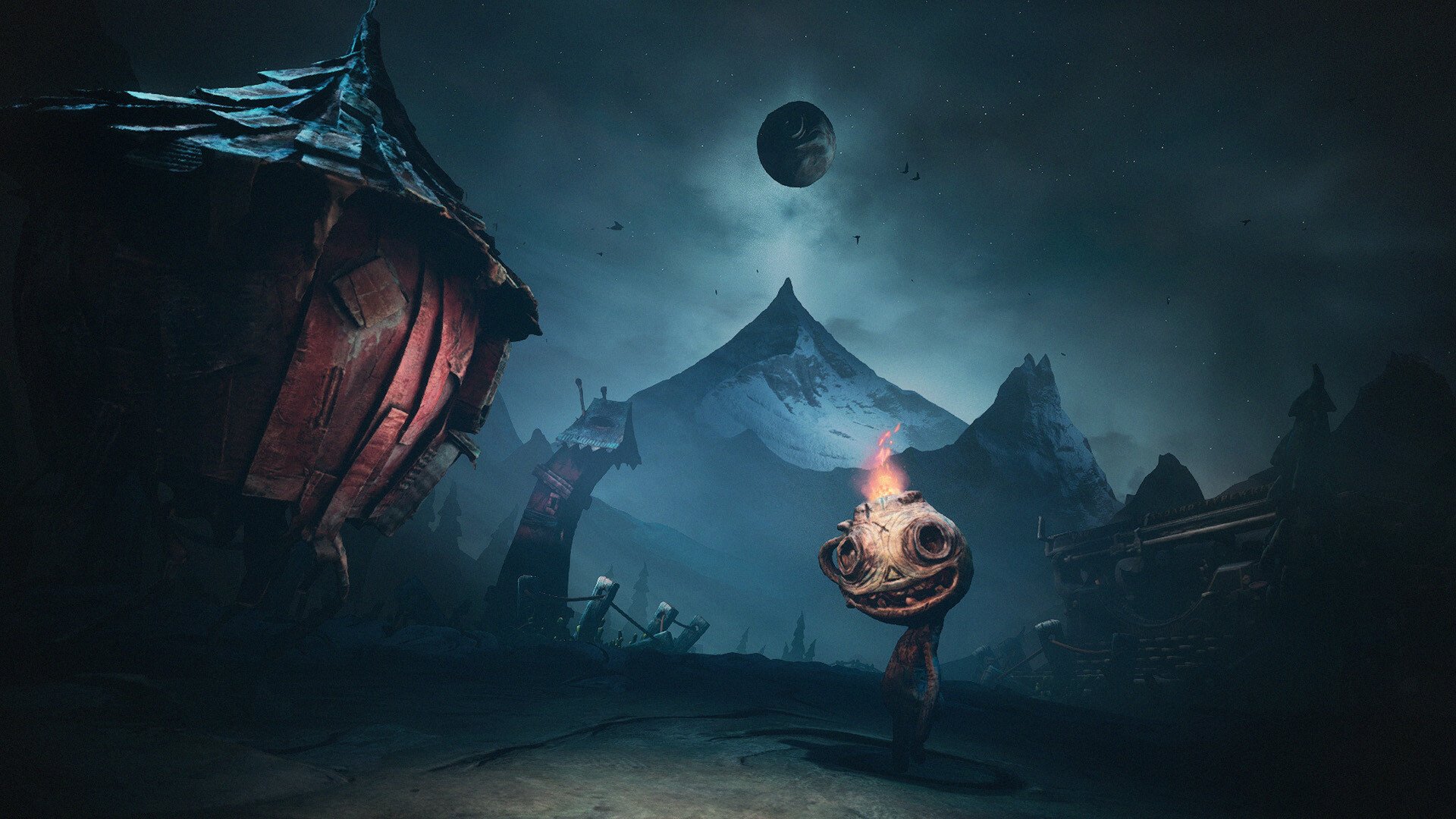
Pure aesthetics are the main selling point of The Midnight Walk, a first-person “narrative adventure” horror game from developer MoonHood. And if those aesthetics are decidedly familiar, they’re an effusive tribute to the well-loved gothic stylings of Henry Selick and Phil Tippett, with every in-game object scanned from handcrafted sculptures to emulate the spindly, spooky character designs and expressionist dioramas of the stop-motion masters.
The results are visually striking, as in the wrinkles that bulge and sag off of pallid cartoon skin in the game’s whimsically morbid cast of hollow-eyed skeletal puppets and mummy-faced arachnoid ghouls. Rustic wooden villages flicker in candlelight, bordered by warped triangular evergreens and silhouetted hills, while found objects (books, matchboxes, papier-mâché structures) sport faded colors beneath layers of dust. Canned animations have a frame stutter emulating the jerky handmade movements of stop-motion film.
In the game, players assume the role of the Burnt One, a nameless, faceless being who awakens in a post-apocalyptic fairy-tale world of endless night. Alongside a goofy little companion named Potboy—a childlike dancing clay gremlin with a burning brazier for a head—you proceed through a series of highly scripted levels in segmented and often narrow linear environments, solving fire-based puzzles and hiding from jump-scary boogeymen at fixed moments.
Across an episodic series of quests and encounters in quirky, haunted locales, players engage with whispery NPCs and audio logs to piece together cryptic clues about the history of this ruined world. At times, there’s a playfully perverse, Roald Dahlian wit to the narrative—as in a village of babbling severed heads who scorn the Burnt One for having limbs—though just as often its dour secondhand pseudo-surrealism and vague moralizing about human folly read as MoonHood clawing at the gravitas of their inspirations rather than letting it arise organically. (The game’s approach to tutorials and guidance is didactic, often bombarding the player with on-screen text, icons, and voiceover narration explaining the same mechanical basics.)
Throughout The Midnight Walk, MoonHood gives you only a few simple actions and points of environmental interaction, around which the game design revolves. Fire is the game’s key mechanic, with you having to light carefully placed torches using giant matches, cannon fire, or Potboy’s ember-spewing powers. Avoiding the monstrous, rigidly placed enemies prowling patrol routes, and who can kill you in one hit, also occupy brief action sequences.
The most unique mechanic is how, with the press of a button, the Burnt One closes its eyes, directing you toward objectives purely by sound. (The game is releasing with PlayStation VR2 and SteamVR support, and MoonHood encourages players to use headphones.) This could be a fascinating mechanic in a more expansive game, but The Midnight Walk’s ultra-linear nature is such that you’re typically prompted to use it at designated puzzle-solving moments, quickly find the object in the environment that you need to interact with, and move on. Sometimes it’s simply used to activate switches. The game is too worried about you losing your way during the just-shy-of-10-hour campaign to leave progression up to ingenuity or subtle cues.
MoonHood’s level designers come up with an imaginative variety of applications for their small stable of mechanics and rarely repeat the same challenges too often. But interaction points are too lock-and-key narrow for the puzzle set pieces to approach the greatness of those from, say, Portal or Braid, which let the player unleash the ingenious environment-manipulation puzzle mechanics. Midnight Walk primarily has the player find and hit a series of designated interaction points to trigger carefully rendered animations. It’s a constraint of the ambitious graphical approach that makes the game a sumptuous but brief shot of bedtime-story vibes.
This game was reviewed with a code provided by TriplePoint PR.
Since 2001, we've brought you uncompromising, candid takes on the world of film, music, television, video games, theater, and more. Independently owned and operated publications like Slant have been hit hard in recent years, but we’re committed to keeping our content free and accessible—meaning no paywalls or fees.
If you like what we do, please consider subscribing to our Patreon or making a donation.


Beautifully written, as always.