Often regarded as the odd duck of the Xeno series, Xenoblade Chronicles X, newly remastered from its 2015 release in a Definitive Edition for the Switch, may be the purest expression of Takahashi Tetsuya’s thematic fixations through game design. Like every Xeno game, it spins a gnostic sci-fi yarn about humanity overcoming a hostile world and combating cyclical forces of backwardness and bigotry through cooperation, progress, and transcendent will. But where some titles in the cutscene-heavy series have struggled to square away their anime-inspired storytelling with gameplay, nearly every aspect of Xenoblade Chronicles X’s expansive and at times overwrought design leads back to this thematic core.
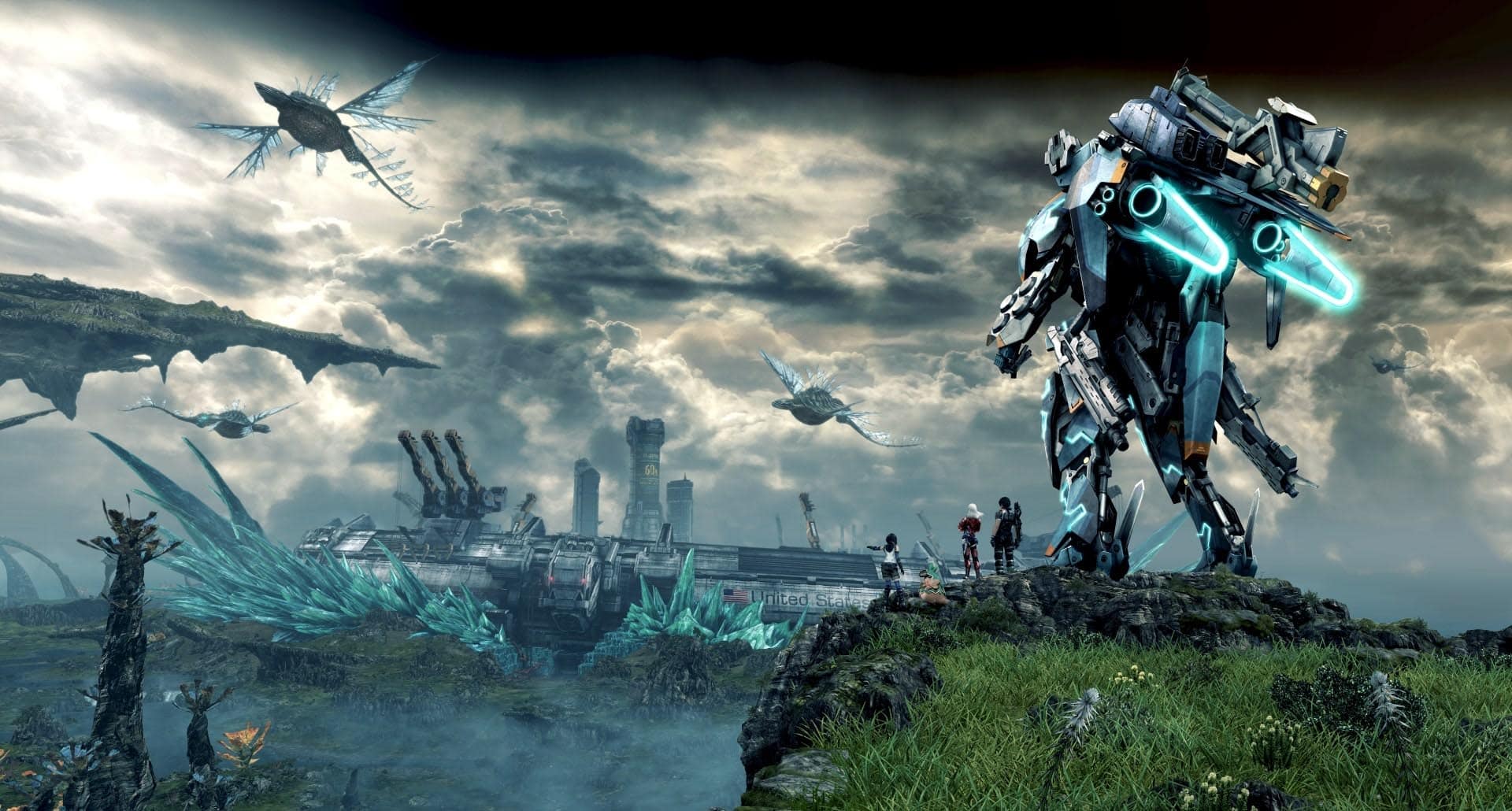
The game’s scenario posits an ark ship of beleaguered refugees expelled from their ancient homeland of Los Angeles on Earth to claim a new home in the far reaches of the universe. Fleeing an apocalyptically destructive clash between fanatical alien empires, this militarized, mech-toting colony of doll-eyed survivors finds themselves forced to cultivate a new civilization on the untamed frontier of Mira—a mysterious, distant planet teeming with natural resources and alien “xenoforms” and “indigens” both docile and dangerous.
To this end, Xenoblade Chronicles X tasks players with creating a custom avatar (a break from the series norm of defined protagonists), forming a party from up to 17 recruitable characters throughout the city. From there, you embark on an ever-expanding checklist of missions into a sprawling 3D play space ingeniously crafted to read as an organic alien environment.
Monolith Soft’s developers, who assisted in the groundbreaking map designs of The Legend of Zelda: Breath of the Wild and Tears of the Kingdom, are unparalleled at balancing the aesthetic and the functional. Mira, a series of pseudo-natural landscapes and futuristic facilities stylized after the covers of psychedelic sci-fi novels, may be their finest work of craftsmanship. One continuous map encompasses the bustling technological hub city of NLA and six topographically distinct continents of breathtaking scale, from the winding megaflora jungle of Noctilum to the uncanny spherical motifs of the Sylvalum badlands—and players can navigate it all freely.
Within these environments is a densely latticed network of landmarks, pathways, treasures, objectives, chatty NPCs, and creatures of wildly varying size, strength, and aggression. This network sprawls out in every direction—not just horizontally but vertically as well. Exploration is so central to the gaming experience here that players can earn nearly as much EXP and loot from discovering new locations (and crucial fast travel points) as from battling and questing.

Which isn’t to say that any of it is easy. The player’s time is split between thousands of tiny interactions and lengthy sprints across various terrain, and at every level the game seeks to overwhelm with possibility and pushback. From the opening minutes, players will be led to many navigational or combat obstacles well beyond their current capabilities. Many more can be bypassed with a little ingenuity, either by circumnavigating tricky terrain or exploiting the bewildering rat’s nest of adjustable knobs in the game’s battle and resource systems.
Battles use a class-based, MMO-inspired real-time combat system with free character movement and menu-based selections. These play out as cooperative affairs, with AI comrades combining player positioning, cooldown juggling, buff coordinating, and combo assembling with synergistic commands. And every move, skill bonus, and piece of equipment involved can be customized and upgraded with various currencies. Tens of hours into the experience, players will also be given the opportunity to pilot giant mechs similar to those in Takahashi’s operatic debut Xenogears, radically transforming their vantage point on Mira and their relationships with both navigation and combat in one of Monolith’s finest feats of delayed gratification.
Skeptical players may note, not entirely incorrectly, that the game’s grindy progression and frantic errand-running can come to feel, especially in its early hours, an awful lot like a job. If that’s true, Takahashi and Monolith at least put unusual contemplation into this facet of RPG design by framing it all with a narrative that’s literally about a job. What most distinguishes Xenoblade Chronicles X from its sister games, and much of the JRPG genre whose narratives tend to follow Campbellian arcs of young chosen heroes and their fellowships, is the sense of its narrative, and by extension its gameplay, being less a dramatic bildungsroman than a process of labor by professional laborers for the sake of a collective national project.
Each surveying, resource-gathering, hunting, and mediating mission taken on by the player’s party for the city guilds and government bends the wild land you explore to humanity’s will, directly contributing to the growth of the colony’s knowledge base, economic production, infrastructure, communications network, and diplomatic relations with other nations on their new planet. As in Kojima Productions’s Death Stranding, the player’s painstaking progression in steady gameplay loops through the game’s complex systems and hostile environments is framed as an allegory for the progression of human civilization from the primordial, and progress produces visible changes in the landscape and makeup of the open world.
Video game storytelling is ill-equipped to challenge literature and cinema’s best explorations of individual human psychology but uniquely well-positioned to tell stories about places, processes, systems, and worlds. More than any one character in Xenoblade Chronicles X, New Los Angeles evolves tremendously over the course of the game. Racking up successful missions in the wilds of Mira first yields profits for the player, then more and better goods at city vendors, more facilities, more housing, and more people in the streets.
Resolving political conflicts and making contact with sentient alien species establishes mutually beneficial networks of trade, immigration, and cultural exchange that transform the sights and sounds of NLA. When genocidal alien imperialists steeped in religious dogma track down Earth’s survivors to finish the job, they increasingly face not a beleaguered people but a technologically augmented force of progress united against the dictates of fate—all thanks to the player’s self-directed curiosity and persistence. Epic, unwieldy, and utterly sincere, the game is nothing if not an optimistic, transcendental vision of a mythical America from a distant admirer.
This game was reviewed with a code provided by Golin.
Since 2001, we've brought you uncompromising, candid takes on the world of film, music, television, video games, theater, and more. Independently owned and operated publications like Slant have been hit hard in recent years, but we’re committed to keeping our content free and accessible—meaning no paywalls or fees.
If you like what we do, please consider subscribing to our Patreon or making a donation.