
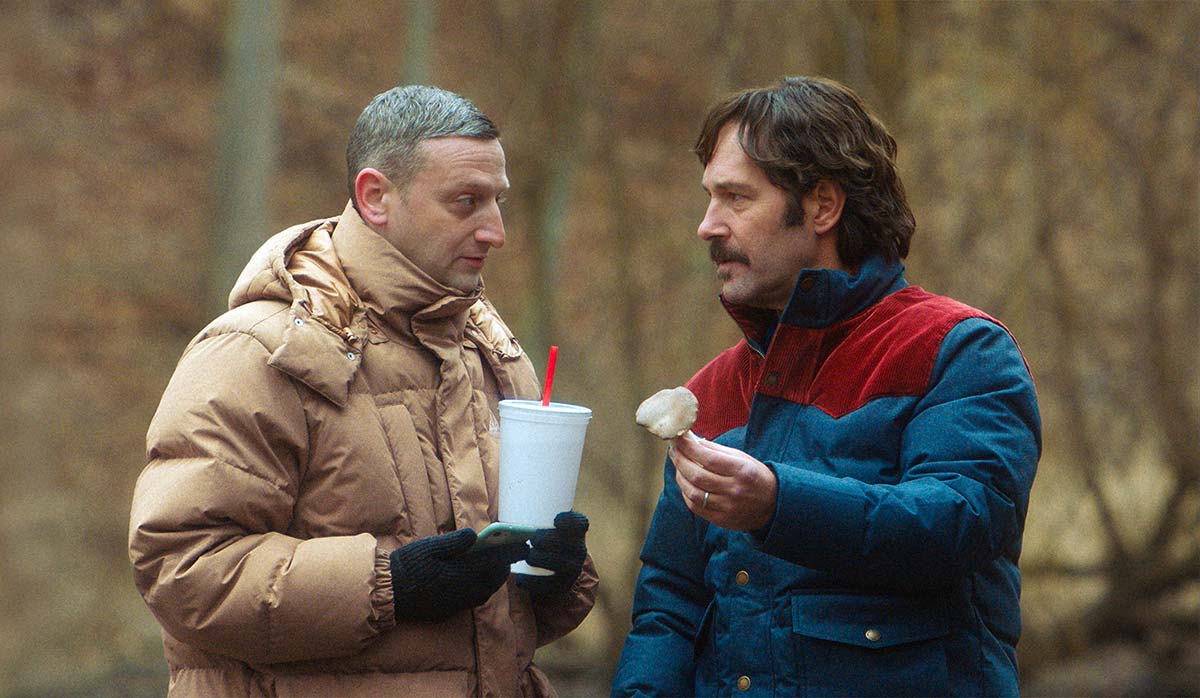
“There’s no rules for male friendship!” exclaims Paul Rudd’s Peter Klaven in John Hamburg’s 2009 film I Love You, Man as he agonizes over the intricacies of platonic etiquette. Over a decade and a half later, the actor returns to find humor and insight across the same thematic terrain in writer-director Andrew DeYoung’s Friendship. This time, however, his character is the object of anxious affection rather than its originator.
Society, too, has shifted since 2009. Today, the epidemic of male loneliness is taken seriously as an “issue” to debate rather than merely a topic of discussion, though it’s also prone to being skewered by meme culture. Friendship lands somewhere in the middle of that spectrum, offering little in the way of answers or cures yet providing plenty of gut-busting laughs. While not necessarily a response to the times, it’s undeniably a product of them.
DeYoung pitches his feature debut directly into Tim Robinson’s sweet spot of surrealistic and satirical comedy. While the rhythms of Friendship often resemble those of its star’s sketch-based Netflix show, I Think You Should Leave, the film’s episodic beats coalesce around a larger aim. This is a comedy of manners for a world that largely lacks them.
Throughout, Robinson’s Craig Waterman, a simple suburban father, attempts to buddy up with his new neighbor, Rudd’s studly local newscaster Austin Carmichael. It’s a journey that begins in the terrain of Andy Kaufman, with Robinson wringing pained laughs from his character’s repeated humiliations and mortifications during mundane hangouts. Yet as his unrequited gestures of amicability assume a greater air of desperation and depravity, Craig begins to feel more like a figure being put through the wringer of mortification by Charlie Kaufman.

The comic construction of Friendship is such that every cinematic beat ends with the equivalent of a question mark rather than an exclamation point. The tactic makes viewers lean in and actively participate in decoding the film’s intentions. DeYoung deliberately leaves unclear whether Friendship is ultimately either ironic in its earnestness or earnest in its irony, and this moment-to-moment volatility is alternately engaging and delightful, if at times exhausting.
The appeal of Robinson’s zany comic persona lies in his ability to disorient. The characters around Craig, including his wife, Tami (Kate Mara), and son, Steven (Jack Dylan Grazer), often vary widely in how they react to an absurd gesture or comment from him. Some act as if he’s behaving entirely logically, while others respond with utter confusion. It’s a relief when Conner O’Malley, the great burlesquer of the modern manosphere, makes an appearance late in the film…and everyone recognizes his bizarre, buffoonish behavior for exactly what it is.
But even for those in the audience whose mileage only goes so far with Robinson’s schtick, Friendship has more to offer than cringe-inducing, often bawdy humor. He and DeYoung expertly skewer the rituals that trap men in prisons of consumption and estrange them from their emotions. The film is deeply attuned to male malaise, though it steers away from offering anything resembling an overly academic thesis about its roots. More than anything, Friendship makes the conditions of modern masculinity feel as weird to watch as they are to understand.
Craig is devoted to his idea of a monoculture, as he thinks it offers him the greatest opportunity to participate in something with others. From his job furthering smartphone addiction and his repeatedly expressed interest in the next Marvel movie, he’s lowest-common-denominator thinking incarnate. He even talks as if he’s outsourced his brain to a large language model that will generate the most milquetoast and median response to whatever prompts him to speak. That no one seems alarmed by the stiltedness of his words throughout Friendship raises the disquieting possibility that banality is the new baseline for American life.
Since 2001, we've brought you uncompromising, candid takes on the world of film, music, television, video games, theater, and more. Independently owned and operated publications like Slant have been hit hard in recent years, but we’re committed to keeping our content free and accessible—meaning no paywalls or fees.
If you like what we do, please consider subscribing to our Patreon or making a donation.




Can’t wait to see this without friends.