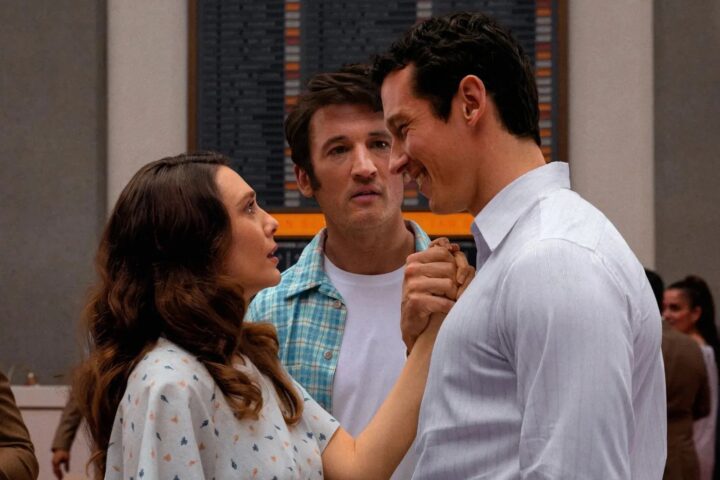
With their tactile 16mm photography and post-sync sound, Mark Jenkin’s films Bait and Enys Men plunged us into worlds that felt simultaneously naturalistic and otherworldly. The Cornish filmmaker’s latest, Rose of Nevada, combines the seaside community melodrama of Bait with the supernatural overtones of Enys Men to trace the metaphysical fallout from a long-lost fishing boat’s return to the harbor of a village in Cornwall.
Nick (George MacKay), a struggling young family man in need of repairing a gaping hole in his roof, and Liam (Callum Turner), an aimless drifter, are hard up for money. It’s at this stressful moment in time when the unmanned fishing vessel of the film’s title, missing for decades, appears at the harbor. Despite the puzzlement of the village and the lingering mystery about the fates of the original crewmembers (the words “GET OFF THE BOAT NOW” are ominously carved on the wall of one of their bunks), the boat’s owner (Edward Rowe) decides to put it back to work, and Nick and Liam quickly sign on for a chance to make some quick cash.
Like Jenkin’s prior films, Rose of Nevada is lensed with a wind-up Bolex camera that allows for limited shot durations of up to 30 seconds, and there’s an appropriately ghostly quality to the way each carefully composed, richly textural image gives way to the next in quick, fluid succession. Throughout, Jenkin places primacy on close-ups—of hands, feet, faces, objects, the pesky hole in Nick’s roof—that come to suggest puzzle pieces locking together to reveal larger portraits of the film’s working-class setting. Combined with the vintage look of Rose of Nevada, the eerie soundscape adds to the impression that the setting is unstuck in time.
That feeling will eventually be literalized, and it’s portended early on when Nick’s elderly next-door neighbor, Mrs. Richards (Mary Woodvine), seems to mistake him for her long-vanished son, one of the ship’s two original crew members. After a stormy night out on the boat that effectively shakes something loose in the cosmos, the two men return to port to discover that they’re now in the year 1993. What’s more, Nick and Liam are the boat’s original crewmembers in the eyes of the village, despite still physically appearing as themselves.
From here, the two men’s differing responses to this situation causes tension to rise between them. Nick, who has a loving wife and young child at home, is desperate to return to the present, while Liam, who has nothing to come back to, takes things in stride.
A sly sense of humor sneaks into the film as Liam nonchalantly steps into his predecessor’s shoes, “rekindling” a romance with the man’s long-suffering wife, Tina (Rosalind Eleazar), who’s overjoyed by her newly attentive partner. Liam’s behavior infuriates Nick, who’s now living with his “parents,” the Richards, while trying in vain to convince everyone that he’s not who they think he is. “You’re pretending to be someone else!” Nick admonishes Liam at one point for his growing involvement in Tina’s life. “I am someone else!” he blithely retorts.
Jenkin’s style become increasingly disorienting as Rose of Nevada proceeds, with previous shots in the film cutting in at parallel narrative moments to forcefully sync up the past and present. Moreover, ghostly appearances and unsettling nightmares hint at the possibility that our heroes may be trapped in some kind of purgatorial realm, or perhaps just within their own fading memories. All the while, the question of whether Nick or Liam will soon end up disappearing into the ether like their predecessors looms large, with Jenkin’s meditation on the slipperiness of time effectively emulating his main characters’ sense of dissociation.
Throughout the entirety of its ominous depiction of this physically and psychologically tumultuous experience, Rose of Nevada remains focused on the plight of its working-class characters and the uncontrollable situations they’re often forced into, whether fantastic or mundane. The film ends with a haunting moment of calm, perhaps before a storm not unlike the one that originally claimed the ship in the first place, that suggests that perhaps the only way to endure the perpetual instability of one’s life is to just go with the flow.
Since 2001, we've brought you uncompromising, candid takes on the world of film, music, television, video games, theater, and more. Independently owned and operated publications like Slant have been hit hard in recent years, but we’re committed to keeping our content free and accessible—meaning no paywalls or fees.
If you like what we do, please consider subscribing to our Patreon or making a donation.