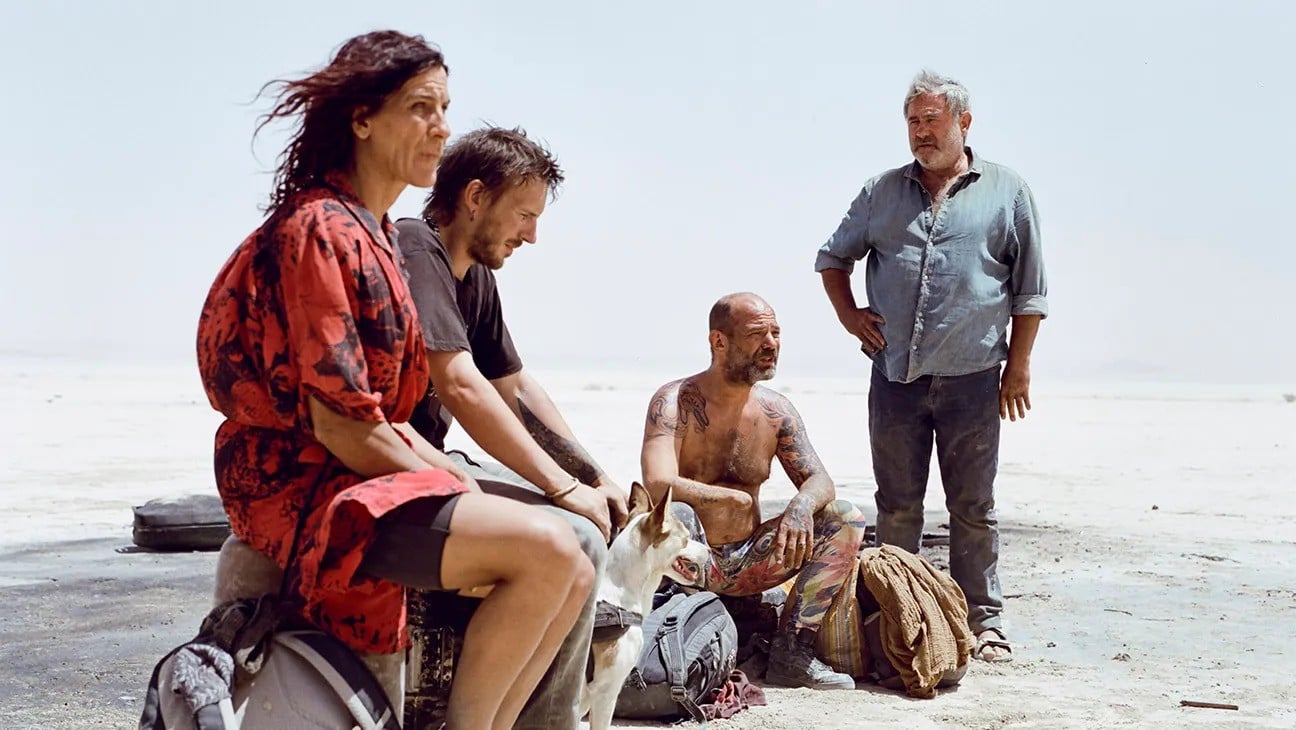
Óliver Laxe’s Sirât seeks to plug us into its setting, as cheekily signaled by an opening series of close-up shots of speakers being hooked up. The camera eventually pulls back to reveal a massive sound system that’s been set up within an alcove somewhere in the Moroccan desert. The next shot shows a large crowd of people in a blissed-out stupor, moving and swaying to the beats now emanating from the sound system. As Laxe casts his ethnographic eye over this rave, the camera weaving its way through the crowds, Sirât immediately mesmerizes as a sensorial paean to losing oneself in rhythm and music.
The depiction of transcendence through dance complements Sirât’s spiritual inspiration. The film is named after the mythic Islamic bridge between paradise and hell that an opening text card describes as “thin as a strand of hair and sharp as a sword.” Accordingly, Laxe’s film proceeds as a contemporary fable whose characters shuttle between extreme polarities, none more so than Luis (Sergi López), who arrives at the scene of this rave—his young son, Esteban (Bruno Núñez Arjona), and their dog Pipa in tow—looking to find his missing daughter.
Passing around photos with no luck, Luis and Esteban eventually meet a quintet of ravers—Stef (Stefania Gadda), Jade (Jade Oukid), Josh (Joshua Liam Henderson), Bigui (Richard Bellamy), and Tonin (Tonin Janvier)—who inform them that they’re headed to an upcoming rave at a different location where she could be found. So when a group of soldiers abruptly roll up and put an end to the party, to the vehement protestation of the crowd, Luis and Esteban end up following the group’s convoy trucks away from the melee and into the desert expanse.
From there, Sirât proceeds as an existential road movie, with Luis and Esteban eventually becoming part of this chosen family of ravers as they journey deeper into the vast unknown of the desert and encounter various obstacles. The film keeps a loose and warm atmosphere through much of its runtime, as in an amusing moment when Luis and Esteban bond with the others as they nurse Pipa back to health after the dog ingests some LSD-contaminated feces.
Like he did in Mimosas, Laxe puts the Moroccan desert landscapes on spectacular display, even giving them an out-of-time quality. The film has a post-apocalyptic air about it, but outside of a radio mention of World War III, contextual details are kept to a minimum. Throughout, Kangding Ray’s thumping electronic music remains a constant, suggesting the initial rave never ended and enhancing the hypnotic quality of images like the convoys speeding in the night through the barren landscape, barely made visible by headlights that hover like ghosts.
But just as Sirât’s vibe-heavy approach has successfully lulled us into a state of tranquility, the film pierces through the spell with a spate of riveting set pieces in which the characters are perched on the precipice of hell. When their route takes them along a narrow mountainside road, the precariousness of the convoys on the shifting gravel underneath instantly recalls the coiled intensity of Henri-Georges Clouzot’s The Wages of Fear and William Friedkin’s Sorcerer. That’s just a warmup, though, for a heart-stopping finale in which the group’s earnest belief in the serenity of the raving way of life is irrevocably and perversely shattered.
Sirât, which hauntingly echoes Gus Van Sant’s Gerry in its final stretch, is a vivid meditation on human possibility in the face of fate and nature’s tumultuous might, ending in a fog of ambiguity that mirrors the characters’ bewilderment. This is foremost a film about the power of feeling over understanding, which is sometimes the only antidote to a world that continues to grow more confusing and unstable. As Jade tells Luis at one point when he says that the audio quality from her refurbished speaker isn’t very good, “The music is not for hearing. It’s for dancing.”
Since 2001, we've brought you uncompromising, candid takes on the world of film, music, television, video games, theater, and more. Independently owned and operated publications like Slant have been hit hard in recent years, but we’re committed to keeping our content free and accessible—meaning no paywalls or fees.
If you like what we do, please consider subscribing to our Patreon or making a donation.