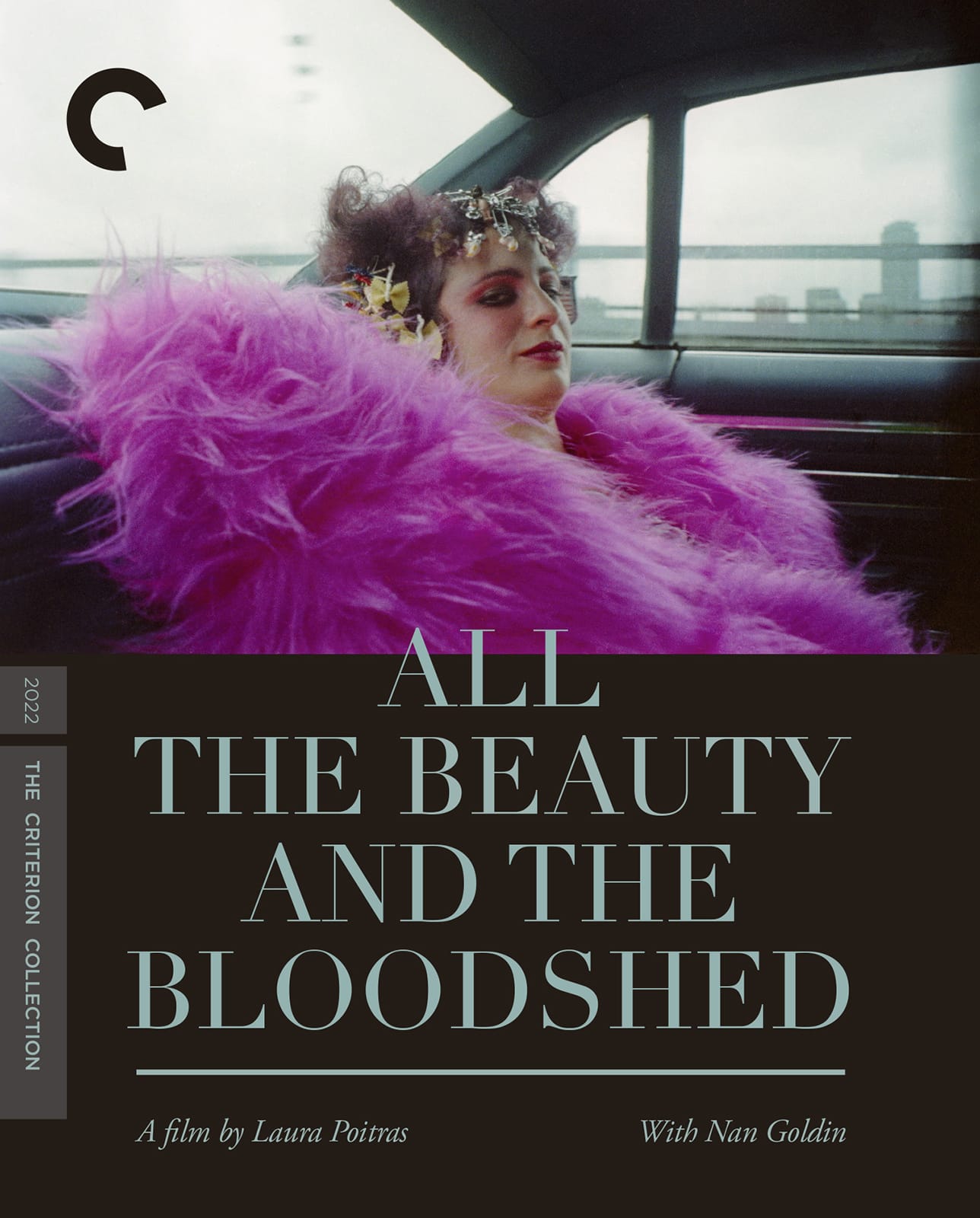
 For director Laura Poitras, All the Beauty and the Bloodshed represents a departure of sorts. After centering films around people ranging from a former bodyguard for Osama bin Laden in The Oath to Edward Snowden in Citizenfour and Julian Assange in Risk, her latest documentary focuses on an artist: legendary photographer Nan Goldin. But there’s still a strong political dimension to the film, since Goldin was a major force in bringing down the Sackler family, the owners of Purdue Pharma, one of the global pharmaceutical companies largely responsible for the opioid epidemic in the United States.
It’s a deeply personal mission for Goldin, as someone who found herself addicted to OxyContin for a period of time until she nearly died from an overdose. Goldin’s activism, though, is, the documentary suggests, born out of not just her brush with the opioid crisis, but from a lifetime of dealing with mental illness, drug abuse, and untimely death to varying degrees. All the Beauty and the Bloodshed turns out to be as bifurcated a film as its title: It’s half a biographical portrait of Goldin told in her own words, half a chronicle of her present-day activism in shining a light on the Sacklers’ ruthless pushing of these addictive drugs on an unsuspecting public.
Poitras has broken the film up into seven chapters, each devoting roughly half of each section to a period in Goldin’s life, the other half returning to contemporary times to depict an episode in her campaign against the Sacklers. The back-and-forth structure does make the film feel somewhat unwieldy, like two different movies coexisting uneasily in one. Poitras doesn’t quite fully convince us that every single biographical detail that Goldin offers to us about her life necessarily ties to her direct actions against the Sacklers and her advocacy for harm reduction.
And yet, relevant or not, the details themselves are compelling, especially as Goldin narrates it to us in a slideshow format reminiscent of her own public presentations of The Ballad of Sexual Dependency and other seminal photo series of hers. Goldin covers everything from her own hellish suburban upbringing, to the discovery of both a welcoming queer community in Provincetown and her own bisexuality, to her personal and professional difficulties while living in downtown NYC, to the ravages of the AIDS crisis to which she bore witness in the 1980s.

The warmth, ruefulness, and occasional anger with which Goldin recounts these experiences is moving in and of itself. In addition, hearing Goldin talk openly about not only her past but about how her experiences affected her frank, intimate, and vulnerable art offers an illuminating window into her photographic art, of which the film offers a generous on-screen sampling. As portraiture, All the Beauty and the Bloodshed accomplishes the goal of any documentary worthy of its genre by shining an insightful light onto what informs an artist’s vision.
It’s during the scenes in the film detailing the Sacklers’ injustices and Goldin’s crusade against them—from public demonstrations at art organizations still carrying the Sackler name to the formation of her organization P.A.I.N. (Prescription Addiction Intervention Now)—that the film feels most like Poitras’s previous work. Her firsthand access to the staging of, say, her group’s 2018 protest at the Metropolitan Museum of Art at what had previously been known as the Sackler Wing exudes the life-or-death immediacy that The Oath and Citizenfour had in spades. So does a shorter passage in which various P.A.I.N. members, as well as New Yorker reporter Patrick Radden Keefe, find themselves being stalked by a mysterious figure that they believe has been sent by Purdue Pharma to spy on them (a claim Purdue has firmly denied, naturally).
But All the Beauty and the Bloodshed shows the intrepid Poitras pushing into new emotional terrain. The film’s title comes from a report that a doctor filed about Goldin’s sister, Barbara, who committed suicide at the age of 18 after many years in and out of psychiatric hospitals. To some degree it speaks to the wide-ranging, inclusive way that the rebellious Barbara viewed the world, a perspective that was wrongly deemed mental illness during the more repressive ’60s, and one which Goldin has spent her whole life trying to honor. Based on this affectionate and powerful cinematic portrait, it’s a perspective to which Poitras feels a kinship, making this film arguably the closest to a personal manifesto that she’s offered in her filmography to date.
Image/Sound
Like many of Laura Poitras’s films before it, All the Beauty and the Bloodshed draws from a wide variety of video sources, so the variances in quality are understandable. The efforts of the new high-definition digital master are most evident during the footage shot for the film, which boasts stellar detail, sharpness, and a warm and inviting color depth. And given All the Beauty and the Bloodshed’s primacy on narration, the disc’s DTS-HD Master 5.1 surround track isn’t given much of a workout, but there’s generally a nice separation of the sound layers, especially in instances where the film leans into the music by Soundwalk Collective.
Extras
The highlight of this release are the two conversations from the 2022 New York Film Festival. The first, featuring Laura Poitras, Nan Goldin, co-producer and PAIN activist Megan Kapler, PAIN activist Harry Cullen, and lawyer and PAIN member Mike Quinn, covers everything form Goldin’s influence to the complexities of the film’s editing. In the more wide-ranging second, Goldin attests to her cinephilia, the pull of drugs, and the intertwining of art and activism throughout her work. Rounding out the extras is a new interview with Poitras and an impassioned, principled essay by novelist, author, and activist Sarah Schulman.
Overall
All the Beauty and the Bloodshed gets a sturdy release from Criterion that further attests to Nan Goldin’s commitment to the intertwining of the personal and political.
Since 2001, we've brought you uncompromising, candid takes on the world of film, music, television, video games, theater, and more. Independently owned and operated publications like Slant have been hit hard in recent years, but we’re committed to keeping our content free and accessible—meaning no paywalls or fees.
If you like what we do, please consider subscribing to our Patreon or making a donation.