Ronan Day-Lewis’s feature-length directorial debut, Anemone, is ostensibly about brotherhood, but in execution, the story plays out as one man’s unraveling from past traumas in self-imposed confinement. Though anchored by a mercurial performance from Ronan’s father, Daniel Day-Lewis, who also co-wrote it, the film is ultimately unable to tell a family story that lives up to its visual splendor and enigmatic atmosphere.
Anemone begins with long shots of Northern England’s woodlands as Jem (Sean Bean) sets out on his motorcycle to meet his brother, Ray (Daniel Day-Lewis), who’s been holed up in a cabin for reasons unknown. The siblings spend a few days together, foraging and cooking and avoiding the topic of Jem’s visit until that becomes untenable. Turns out, Ray has been living in seclusion for decades despite having a family. Meanwhile, we get glimpses of Ray’s son, Brian, (Samuel Bottomley) back in town, wrestling with his father’s absence from his life.
With shots of nature captured with a survivalist’s eye and an anxious synthwave score by Bobby Krlic that feels more fitting for the psychologically terrifying films that he’s scored for Ari Aster, it’s unclear at the start what type of story Anemone is meant to be. The film revels in a naturalistic silence as it shows extended montages of Ray and Jem eating stew and wandering through forests, but there’s little insight as to who they are as people and why they’ve convened.
Anemone takes an interesting family dynamic and hides it behind hazy storytelling. While we learn that Ray left his wife, Nessa (Samantha Morton), and Brian behind because of shame over his actions as a soldier, the film never explores how he feels about his abandonment of them. Everyone from the beleaguered Nessa to the resentful Brian feels like a cutout, and there’s no sense of how Jem’s life was impacted from having to step in and perform Ray’s parental duties.
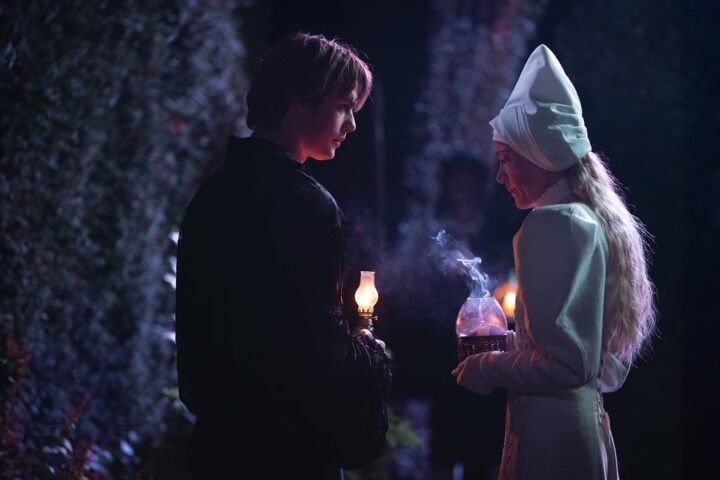
Ronan Day-Lewis, a trained painter, and cinematographer Ben Fordesman dot Anemone with expressionist flourishes; the film abounds in gorgeous and surreal imagery, and at one point Ray comes across a creature with a human face reminiscent of the Night Walker from Princess Mononoke. But as Anemone has all the trappings of a kitchen-sink drama, these fantastical touches feel like they’re trying to distract from the script’s lack of interiority or introspection.
It may gesture vaguely toward themes of family, but Anemone is very much certain of itself as a showcase for Daniel Day-Lewis. The high points of the film are two excruciating monologues by Ray, the first of which gives a glimpse into the trauma he experienced at the hands of an abusive priest and the second of which enlightens us about the guilt he feels for the possible war crimes he committed. But the memorable gravitas that the actor brings to those monologues just barely papers over the weakness of the script, especially its reliance on simplistic storytelling tropes.
More than familial redemption, Anemone is preoccupied with what religion giveth and taketh away. That’s clear from Ray’s displeasure with Jem’s praying, and his account of getting revenge on a priest that abused him. Even the thunderous hailstorm at the end of the film feels biblically outsized. But there’s a certain randomness to this fixation. We find out that part of Ray’s anger stems from being molested as a child, though this revelation, along with his journey toward some kind of salvation, is too tenuously connected to the glimpses we get of his family before he went into exile that it gives the film a vaporousness akin to its beautiful yet weightless images.
Since 2001, we've brought you uncompromising, candid takes on the world of film, music, television, video games, theater, and more. Independently owned and operated publications like Slant have been hit hard in recent years, but we’re committed to keeping our content free and accessible—meaning no paywalls or fees.
If you like what we do, please consider subscribing to our Patreon or making a donation.