“When I was a kid, I believed when you fall in love, you must sing and dance like in the movies,” recalls the mild-mannered Anand (Bhushaan Manoj) in Rohan Kanawade’s gently stirring Cactus Pears. The line seems to directly position both Anand’s temperament and tentative approach to love, as well as the film’s overall ethos, in opposition to the sweeping, emotive, fantastical nature of not just Hindi cinema but much of the dominant blockbuster modes of moviemaking in the Indian subcontinent.
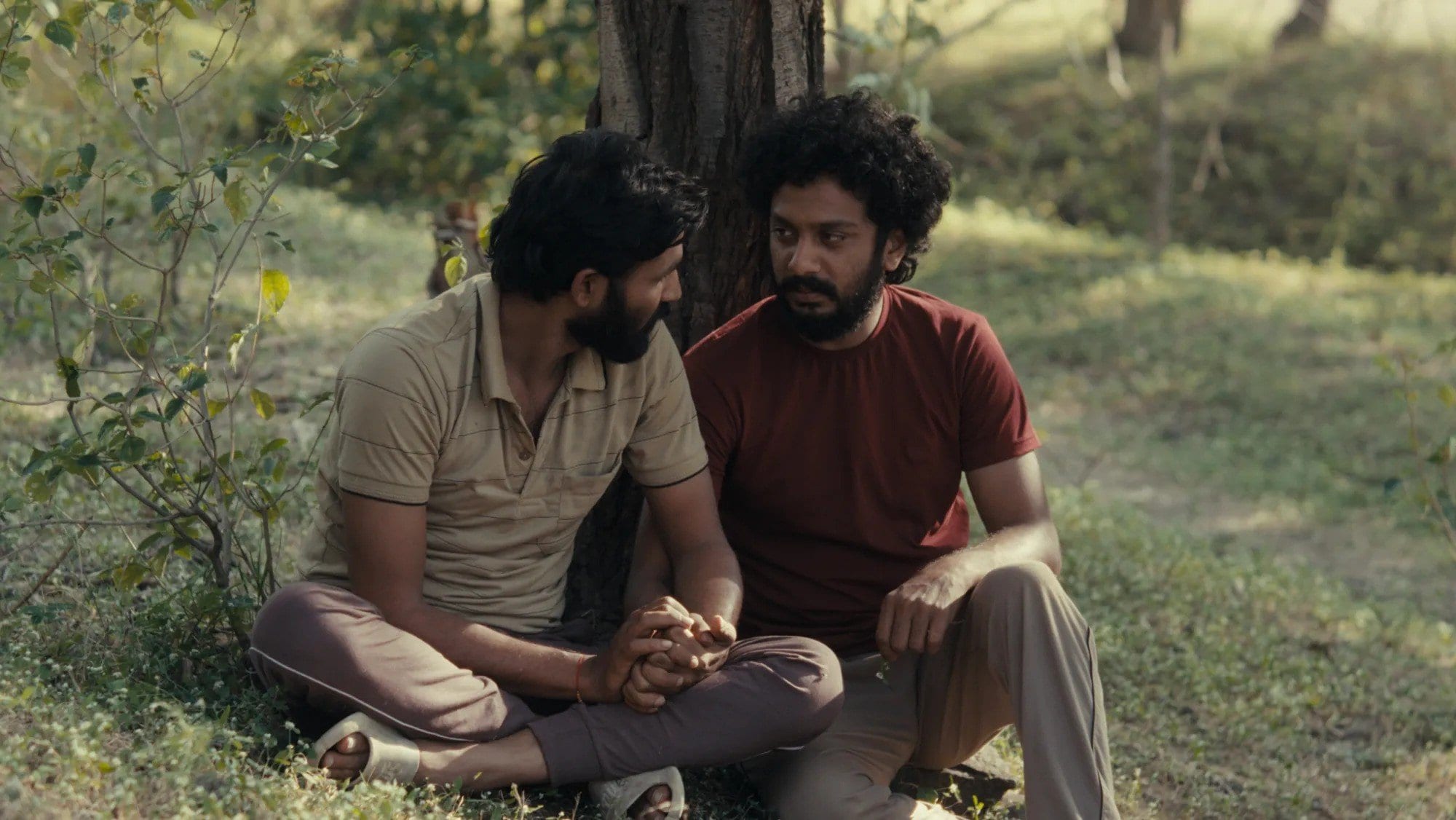
Cactus Pears is stylistically bare, and notably so. When Anand utters those aforementioned words, he’s sharing earbuds with Balya (Suraaj Suman) while listening to a song that the audience doesn’t get to hear. Think of that moment as a wink from a film that, in lieu of a score, generates a symphony on its soundtrack from the sounds of more than just nature.
Kanawade and cinematographer Vikas Urs shoot Cactus Pears with little flash. The film’s images are studied, at times beholden to a canny interplay between background and foreground. Throughout the film, the camera often appears perched just behind an out-of-focus Anand as something or someone goes about their business in the middle distance. (Only an over-reliance on fade-to-black ellipses occasionally disrupts the film’s unobtrusive rhythmic flow.)
It’s an aesthetic that’s neatly keyed to the weary and hesitant Anand, who’s returned to his small village to mourn the death of his father. Wracked with grief, he’s forced to contend with the near-constant needling of his relatives, who are all flummoxed that he’s 30 and unmarried. They suspect what’s true—that Anand is queer—and though no one outright addresses the matter, they use nearly every conversation as a way to subtextually prod him about his identity.

As a result of that needling, Anand is perpetually on guard, and appears a lot more reserved than he probably is. Anand’s mother, Suman (Jayshri Jagtap), is refreshingly sympathetic and supportive, but his other relatives’ prejudiced nosiness at first pushes him to decide to stay for only two of the 10 days that comprise the mourning ritual. That is, until he reconnects with Balya, a family friend and local farmer whose company provides much-needed sanctuary.
Balya’s presence and wisdom complicates a story that could have too simplistically demarcated the clash between tradition and progress. He surprises Anand in telling him that there’s a small community of gay men in and around the town and acclimates him to the leisurely pace of shepherding goats and milking cows. In a pasture, they experience an intimacy with each other that neither of them has before in their more transactional history with other “special friends,” and Kanawade fascinatingly, and movingly, parallels the men’s deepening bond with Balya gaining more respect for the ancient customs of the grieving process.
Anand and Balya’s burgeoning relationship also surfaces some compelling and provocative ideas about the fundamental relationship between economy and identity formation. The former raises the notion that once he began earning a salary at a certain level, he felt emboldened to come out to his parents. Balya likewise feels that if he can reach a comfortable income bracket, maybe he can be more decisive about the way he goes about his life. Cactus Pears speaks with rueful clarity about how financial success can be a model for self-realization.
The titular fruit, which the caring, if rash and controlling, Balya gifts Anand in a bit of not-overplayed symbolism, is significant because it no longer grows in the town anymore. Indeed, across Cactus Pears, Anand is fond of noting what’s changed in the intervening years since his childhood, and the film is at its best when it fashions itself as a kind of ouroboros where the future and the past, death and new love, circle back on one another.
Since 2001, we've brought you uncompromising, candid takes on the world of film, music, television, video games, theater, and more. Independently owned and operated publications like Slant have been hit hard in recent years, but we’re committed to keeping our content free and accessible—meaning no paywalls or fees.
If you like what we do, please consider subscribing to our Patreon or making a donation.