
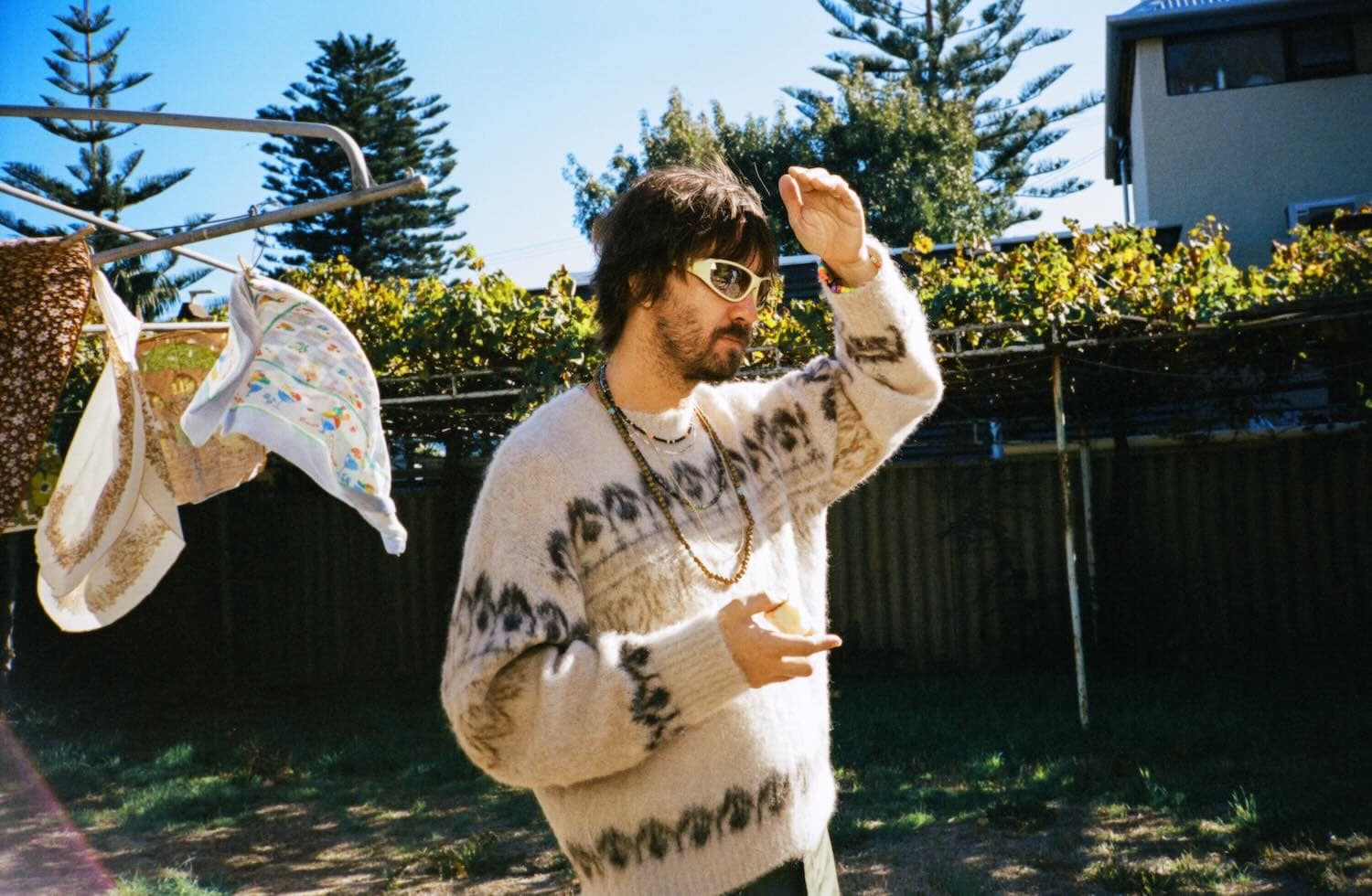
From the opening lines of 2010’s InnerSpeaker, Kevin Parker’s debut album as Tame Impala, the Aussie musician has bemoaned his self-inflicted prison of malaise. References to Groundhog Day, circuitous loopty-loops, and sentiments like “only [going] backwards” permeate his work. Despite multiple Grammy nods and high-profile collaborations with the likes of Dua Lipa and Travis Scott, not to mention the adulation of dorm-room stoners everywhere, Tame Impala’s fifth album, Deadbeat, finds Parker still selling himself as a something of an underachiever—or, as he puts it, a “loser.” This is burnout as branding.
If Parker were interested in being vulnerable, Deadbeat—which moves further away from the psych-rock of Parker’s early work and more toward dance-pop—might be more interesting. Instead, he begs us to see him as a glamorous fuck-up without demonstrating actual self-reflection on tracks like the midtempo “Loser”: “I’m a loser, babe/Do you wanna tear my heart out?/I’m a tragedy,” he bleats over an uninspired Ennio Morricone-esque guitar loop. Even worse, three different songs here—“No Reply,” “Piece of Heaven,” and “Ethereal Connection”—offer some variation on “I wish I could describe how I feel.”
The most intimate detail Parker exposes also comes on “No Reply,” where he addresses another woman who’s far too good for him by sharing, “You’re a cinephile, I watch Family Guy/On a Friday night, off a rogue website/When I should be out, with some friends of mine.” It’s kind of funny, but the way Parker’s voice reaches for emotional conviction suggests that this is an attempt at genuine introspection. The aw-shucks ordinariness might be more charming if it didn’t veer into chummy, self-conscious “I’m a piece of shit”-core.
Unlike on 2020’s The Slow Rush, whose songs were reworked several times out of reported obsession, the ones on Deadbeat could have used some more tinkering. Setting aside the fact that suddenly making a dance album is becoming a tired party trick for major pop stars of late, Parker doesn’t have the finesse required to mount a pounding house track like “Not My World.” The song goes limp long before it floats through a transition into a Four Tet-cribbing zone of spookiness awash in rubbery synths and gurgling bells. That mid-song shift is emblematic of the restlessness of much of Deadbeat, which is unable to sustain a groove.
Parker struggles to maintain the propulsion and charge of a truly epic club song. When the seven-minute-plus “Ethereal Connection,” for example, is clearly running out of gas, he pivots into a new mode entirely, with any momentum he’d accumulated falling away. On “Obsolete,” he stops mid-verse to take a literal breath in a moment of prepackaged candidness, murmuring “Wait…just wait…okay.” The messiness feels overdetermined and jarring.
Deadbeat’s nadir is a pair of deeply hollow tracks in its first half. For a song centered on the shopworn concept of a ne’er-do-well party animal who only goes out at night, “Dracula” packs all the bite of Count Chocula. And “Oblivion,” which adopts a prancing dembow beat for no discernible reason, is an utterly weightless stab at chillwave that delivers the peanut-butter-and-licorice combination no one was asking for: Bad Bunny meets Washed Out.
The album is bookended by its strongest cuts: “My Old Ways” has a nice build to it, layering piano and a muscular four-on-the-floor kick with gradually accumulating details, while “End of Summer,” with its memorable, unhurried synth progression, comes closest to the ecstatic highs of 2015’s Currents. Parker’s longing and the procrastinatory habits he describes on the latter—“I waited ‘til the end of summer and I ran out of time”—are reflected in the sense of indefiniteness conjured by the soundscape as the mechanical drum knocks away. These rare bright spots remind us of how intoxicating Parker’s music can be when he gets out of his own way; when he’s at free-flowing ease without loudly telling us how chill he is.
Since 2001, we've brought you uncompromising, candid takes on the world of film, music, television, video games, theater, and more. Independently owned and operated publications like Slant have been hit hard in recent years, but we’re committed to keeping our content free and accessible—meaning no paywalls or fees.
If you like what we do, please consider subscribing to our Patreon or making a donation.




this review was better than the album