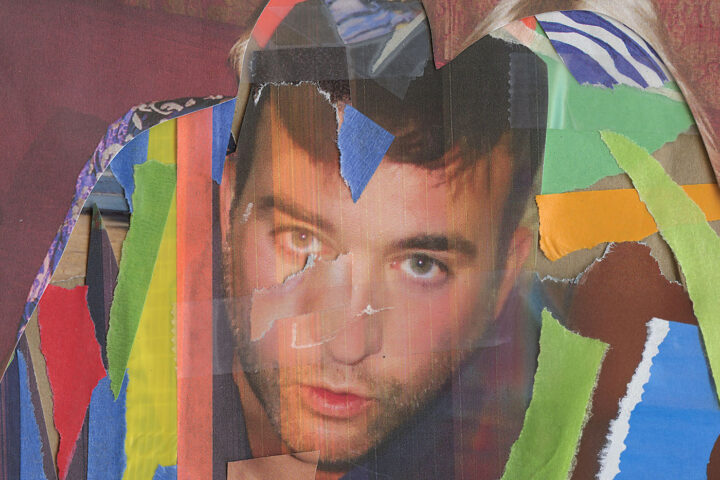
In a recent New Yorker interview, experimental electronic musician Daniel Lopatin noted that he finds most of the hand-wringing over A.I., specifically in the context of creating music, to be overblown. What’s more interesting, he added, is seeing how A.I. “creates these insinuated arrangements that don’t sound anything like any music I’ve ever heard.”
This tension between the organic and the synthetic—or, more specifically, between what sounds “natural” and what’s trying its hardest to be perceived as such—defines Again, Lopatin’s 10th album as Oneohtrix Point Never. It’s an album that, like much of Lopatin’s work, sounds as if every single MP3 file on a hard drive was corrupted beyond the point of recognition. But there’s still a wealth of grace and unearthly beauty to be found in these glitched-out compositions.
There’s an abundance of allusions to Lopatin’s past releases throughout Again, such as “World Outside,” whose mechanical buzzings and walloping elastic bassline would have felt right at home on 2015’s Garden of Delete, and the spectral “The Body Trail,” whose stuttering vocal samples recall 2011’s eerie Replica. But the album is most akin to 2013’s dense R Plus Seven, a project filled with alien tones and composed of a largely electronic sound palette.
Tracks like “Plastic Antique,” which takes on the characteristics of a traditional waltz, and the gothic “Nightmare Paint” sound like they could have been made using Virtual Studio Technology, which was employed heavily on R Plus Seven. And the album’s stunning closer, “A Barely Lit Path,” reprises the organ arpeggios originally found on R Plus Seven’s “Boring Angel.”

Both Again and R Plus Seven revel in the ersatz joys of blending unnatural noise with “real” instrumentation, though it should be noted that online AI tools OpenAI’s Jukebox, Adobe Enhanced Speech, and Riffusion are all credited on Again. “Krumville” starts off with a twinkling PC boot sequence effect but eventually, and surprisingly, switches gears and becomes a picturesque post-rock ballad—one with plenty of digitally produced distortion.
For Lopitan, nothing in our modern age can escape our encroaching technocratic hellscape, as even the album’s classical passages contain some form of robotic interference. The baroque strings on “Gray Subviolent” sound like they’ve been infected by a computer virus, while the title track kicks off with a series of childlike vocal drones that have been altered to rapidly pitch-shift, as if to imitate a genuine vibrato.
Throughout, Lopitan remains hopeful, locating some semblance of serenity first with the reassuring “Ubiquity Road” and then more cogently with “A Barely Lit Path.” “If I empty my mind/Do I scoop out my skull/What gifts would I find?” he openly ponders, his vocals mangled to the point of sounding weathered. He concludes with “Nothing’s inside/Just a slug that provides/A barely lit path/From your house to mine,” a humanist observation that suggests that, even in a highly automated world, a longing for human connection will never cease.
And with that, a harmonious medley of cellos, double basses, and some fluttering flutes emerge from the ashes, building to an ecstatic progression (the aforementioned nod to “Boring Angel”) that caps off the album on a blissful note. “A Barely Lit Path” effectively locates the humane within the machine, the ghost in the shell, and further affirms Again as one of Lopitan’s most sincere and spellbinding statements yet.
Since 2001, we've brought you uncompromising, candid takes on the world of film, music, television, video games, theater, and more. Independently owned and operated publications like Slant have been hit hard in recent years, but we’re committed to keeping our content free and accessible—meaning no paywalls or fees.
If you like what we do, please consider subscribing to our Patreon or making a donation.