
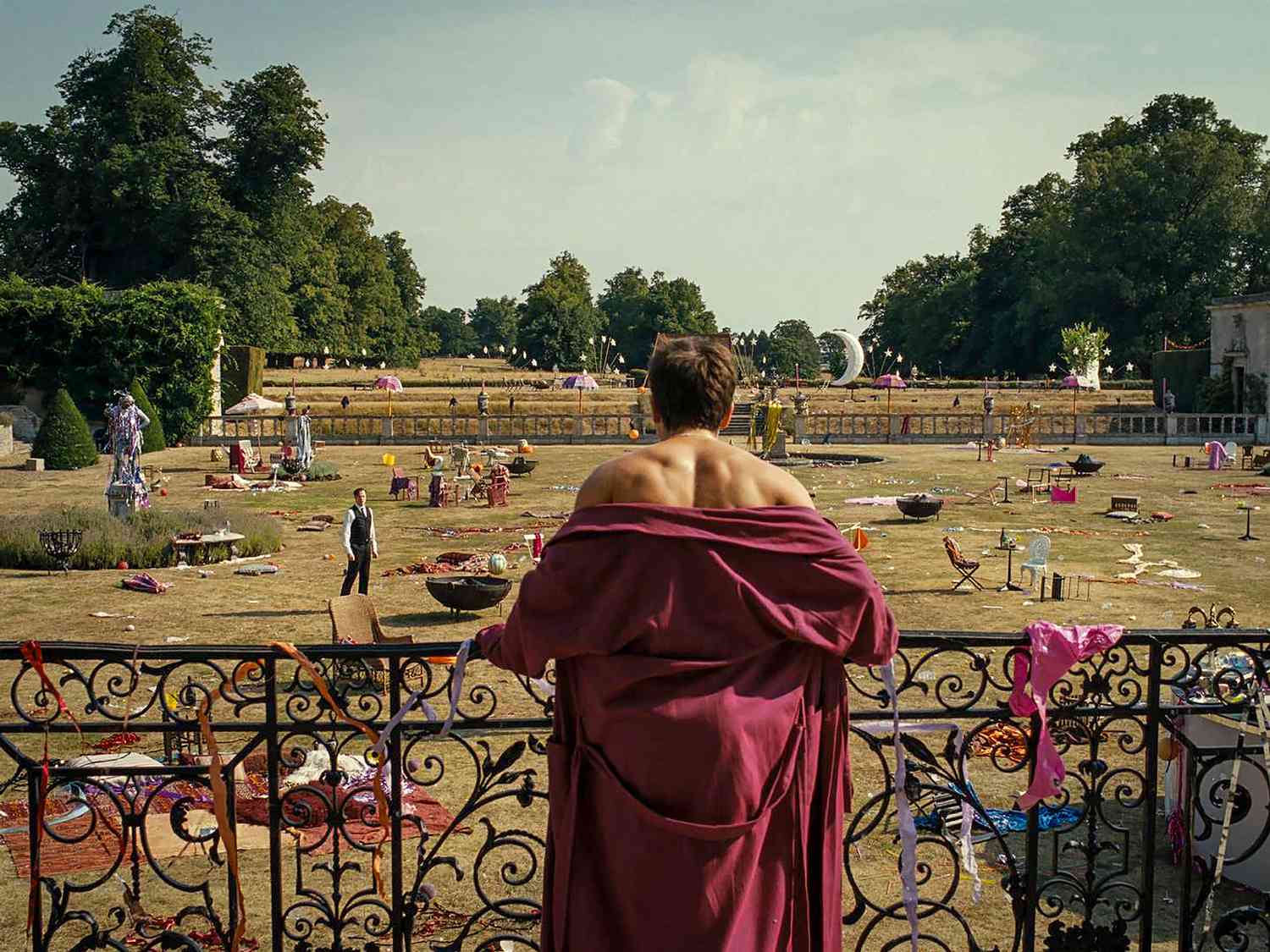
If there’s any group sure to find delight in Saltburn, it’s devotees of the IMDb goofs section. Emerald Fennell immediately dates the film with an Oxford University “class of 2006” banner, a year that overlaps with her own study there. From a lounging family watching Superbad to a cringeworthy karaoke rendition of Flo-Rida’s “Low,” both 2007 releases, Fennell abandons any sense of fidelity to chronology in her anachronism-ridden millennial time capsule.
But this tendency proves more than just mid-aughts miasma as Saltburn progresses. It’s not just that Fennell’s memory leads her to conflate or mistake details from the period. Her sophomore feature seems to outright ignore the larger forces guiding the masculinity and machinations of Oliver Quick (Barry Keoghan), a scholarship student who fixates on wealthy classmate Felix Catton (Jacob Elordi) as much as his studies. To sell their parasitic yet platonic relationship as they go back to the titular Catton countryside estate, Fennell has to unconvincingly retcon the 2000s as a time when homoeroticism rather than homophobia flourished in elite spaces.
The Dickensian name of Fennell’s protagonist seems to signal an ambition to use his extreme actions to examine social class anxieties or create an irresistibly repellant villain. But Saltburn only has value for Oliver as the doe-faced observer through which to experience her “yassified” spin on Tom Ripley lore. Patricia Highsmith’s conniving criminal has been the subject of frequent cinematic reinterpretation, but Keoghan’s take on the archetype falters. As he plunges headfirst into a world of posh privilege and brash bravado, Fennell undermines his inscrutability by elevating the queer subtext to the text of the film itself.
“I wasn’t in love with him,” Oliver confesses of Felix at the start of Saltburn, “I loved him, of course.” While couched in the era’s “no homo” vernacular, the uncommonly plainspoken admission feels inconsistent with the character’s—and the society’s—emotional repression. The quote also gives away the game of the film far too early, robbing interactions between the two men of any true sexual tension. Not unlike her script for Promising Young Woman, Fennell feels the need to explain everything—including elements that never required answers at all.
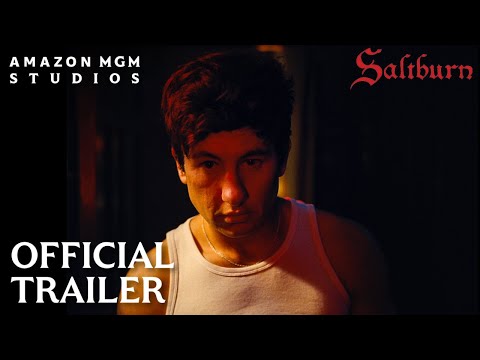
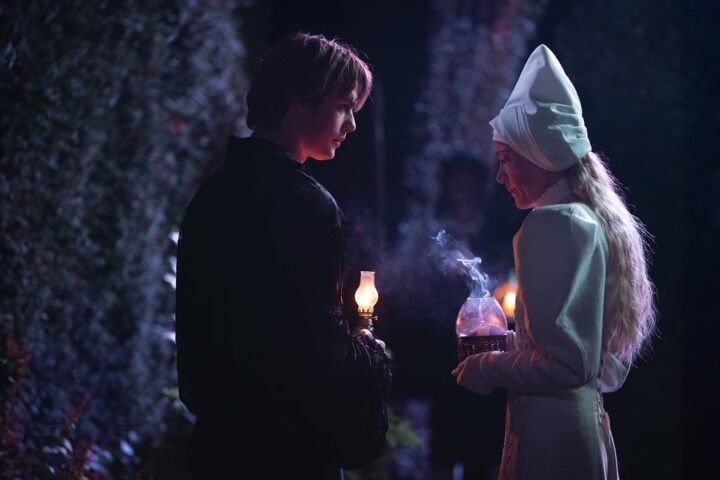
Be it sexuality, gender, class, age, or race, there’s scarcely a hot-button issue of identity that Fennell won’t invoke to amplify the stakes of an obvious metaphor. As the Catton clan slowly sours on the novelty of Oliver, Saltburn consistently tries to pass off these bombastic provocations as a substitute for interesting observations. The coterie of eccentric characters—ranging from Felix’s bemused mother, Elsbeth (Rosamund Pike), to his free-wheeling, mixed-race cousin, Farleigh (Archie Madekwe)—amount to little more than their affectations given how the film prioritizes aesthetics over analysis. Without more meat on the bones of these caricatures, Fennell’s grotesque burlesque of the upper crust cannot draw blood.
Only Felix escapes the torrid yet twee trappings that befall his family members. He’s the only character for whom Fennell doesn’t trade suspense for shock value, as there’s still some mystery behind why he takes in Oliver like a pet. Elordi’s guileless spin on Felix proves the secret weapon of Saltburn because he manages to embody the tensions of aristocratic power. The character’s very stature—physically and societally—feels irresistibly effortless and unnatural all at once.
In a film that loves to luxuriate in surface pleasures, at least the time the camera spends ogling Elordi’s towering frame tracks with Oliver’s point of view. If there’s one element of Saltburn where the period setting does make sense, it’s in the parasocial relationship that Oliver develops with Felix. None of the primitive forms of social media developing at the same time make an appearance here, but their ability to inspire envy feel refracted in Oliver’s voyeuristic yearning. Montages where Felix exists in his element resemble today’s Twitter fancams, linking an early age of internet-enabled obsession with a contemporary visual syntax in the digital realm.
Oliver, however, manages to be both overwritten and underplayed in the film. Keoghan’s performance renders the character’s self-deception primarily as simmering stillness, an expression on which the camera often lingers in slow motion. It’s an abnormally subdued turn from the normally restless and rambunctious young actor. And while it often works as a foil to the swaggering smolder of Elordi’s Felix, Keoghan’s brooding blankness doesn’t have enough substance to carry Saltburn on its own. By the time that Oliver gets to let it all hang out (literally) in the final scene, his strut confirms a sneaking suspicion from earlier in the film. That is, that this wannabe emperor of English high society has no clothes.
Since 2001, we've brought you uncompromising, candid takes on the world of film, music, television, video games, theater, and more. Independently owned and operated publications like Slant have been hit hard in recent years, but we’re committed to keeping our content free and accessible—meaning no paywalls or fees.
If you like what we do, please consider subscribing to our Patreon or making a donation.





this is the sort of posh fetishism that gets made when you fund an oxbridge graduate called “emerald fennell”. will be avoiding
Having watched the film and not simply made a sweeping assumption, I’d hardly say that the upper class are glorified, as they are almost uniformly made to look ridiculous.
This was a pretentious read. The reviewer is trying too hard and is coming across like the character Oliver himself. YUCK.
You have read every detail of this wrong. The 2000s was not a homophobic era, and even if it were, individual characters in a film are hardly expected to conform to the social norms of the time. I assume you’re American. I’d stick to reviewing only films about America, if I were you.
It’s always interesting reading American film reviewers that can only view a movie through the lens of their own experience. There is so much misinterpretation here by Marshall Shaffer. A lot of the English setting and experiences are completely missed here by this reviewer.
Go and see this film without thinking of this review, it has a fair amount of humour completely missed by Marshall Shaffer. The music is so apposite in every selection.
The karaoke rendition of Flo-Rida’s Low is meant to be cringeworthy but also hilarious and Joshua McGuire is perfectly cast in this cameo. This is one of my favourite moments of the whole film.
The point of the family watching SuperBad was to show that despite their immense wealth and privilege the family still do normal things that other people do.
And at the poster above called Keith – judging someone because of their name – get a life.
It’s really not that anachronistic, they would have started in October 2006 and the summer therefore would have ran from late June 2007 to October 2007 and Low and Superbad were both released in that pocket, but at the very tail end and so they are a few months premature (Superbad wouldn’t have hit home video until the end of the year). As someone that graduated university in 2005, no homo was on its way out starting in 2000, academia, especially private universities were certainly high on exploration and bisexuality was definitely a part of the upper class mystique – and homosexuality has always been a more protected feature of high society and Oliver certainly wasn’t out anyways.
Julian if it was on its way out in 2000, why did Cam’ron use it in songs in 2002 and 2006, and why did SNL do a sketch about it in 2011?