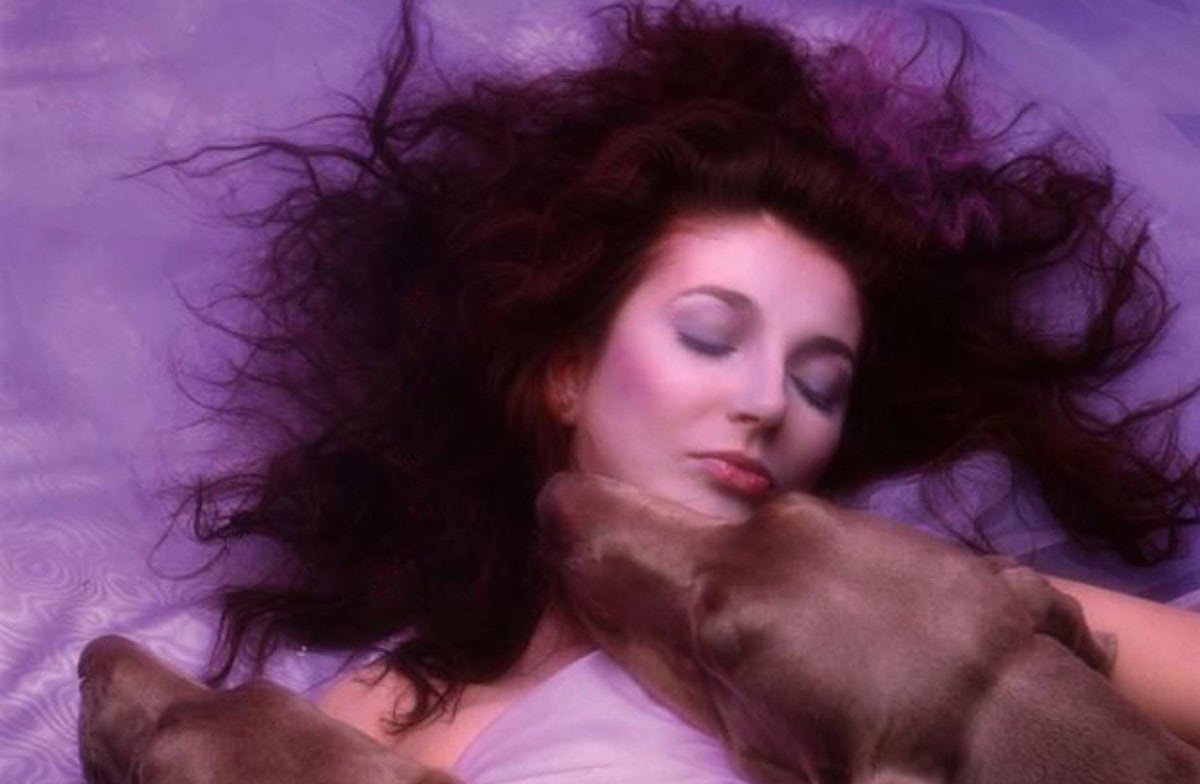
By 1983, Kate Bush was in retreat. The English singer-songwriter’s fourth studio album, the entirely self-produced The Dreaming, was her boldest act of self-determination to date, as well as her most unflinchingly experimental and most misunderstood. Critics called it dense, strange, even mad, and it proved to be a commercial disappointment.
Bush went away and built a farmhouse studio at her country home in the West Berkshire region of England, far from label deadlines and public scrutiny. There, she let her imagination run wild, terrified of where it might take her. She channeled her anxieties into a musical universe where pop could contain not just joy but terror. The result was 1985’s Hounds of Love.
Hounds of Love is really two separate albums. Side one is a collection of five perfect art-pop songs, each track haunted by an uneasy sense of dread. On “Running Up That Hill (A Deal with God),” her would-be signature song, Bush fantasizes about switching bodies with a lover in order to understand him more fully. Despite her attempts at genuine empathy, though, she seems to suspect that true understanding is, perhaps, impossible. The production embodies that tension, with driving drums and chilly synths pulling like a wire ready to snap.
On the title track, Bush makes clear that these aren’t the hounds of puppy love, but of something much more complicated. This love is feral, pursuing her like something out of a monster movie rather than a rom-com: “When I was a child, running in the night/Afraid of what might be/Hiding in the dark, hiding in the street/And of what was following me.”
If that song casts love as something terrifying, the rest of side one traces those feelings to childhood as a time of innocence. “The Big Sky” captures a sense of wonder that often fades with age, a fleeting moment of reprieve before heading into the darkest and most challenging song on the album, “Mother Stands for Comfort.” Here, Bush examines another type of love: the unconditional love of a parent and the unsettling implications that type of love can present. “Mother will hide the murderer,” Bush sings over ghostly synths and fretless bass, the track’s slippery gliding notes mirroring the murky morality of the lyrics.

Based on Peter Reich’s 1973 memoir A Book of Dreams, “Cloudbusting” turns childhood memory into myth as its narrator remembers days spent helping her father with fantastical weather machines, only to watch authorities drag him away. “I just know that something good is going to happen,” Bush sings, a refrain that hovers between hope and naïveté. The song captures the exact moment you realize your parents are fallible, and that the world won’t bend to your imagination. “Just saying it could even make it happen,” Bush sings. But while that faith may sustain you, she suggests, it can also strand you in a dreamworld, blind to life’s harsher truths.
That tension comes into full focus on side two, subtitled The Ninth Wave. While Hounds of Love’s first side grapples with the ambiguities of love, the second plunges us into isolation. This conceptual suite of songs, a masterpiece within a masterpiece, is a surreal survival journey that proves pop music can bear the emotional and conceptual weight of an opera.
On the surface, The Ninth Wave tells the story of a woman lost at sea. Across seven tracks, Bush’s character drifts in and out of consciousness. Life flashes before her eyes in a series of dreamlike vignettes: in the calm lullaby “And Dream of Sheep,” in the frozen synthscape that is “Under Ice,” in the frenetic Irish folk song “Jig of Life,” and, finally, in the bright and serene “The Morning Fog.” More than anything, The Ninth Wave is about the dark places that the mind can go when in crisis, and the resilience it takes to return to yourself.
Bush herself experienced such a cathartic return, as Hounds of Love became her most successful and critically acclaimed album. It was celebrated as much for its futuristic production as for Bush’s nuanced storytelling and vocal performances. Digital samples, complex lyrical themes, and howling, heavenly vocals are some of the ingredients of immersive soundscapes that still feel as otherworldly today as they did in 1985.
“Running Up That Hill” has proven especially enduring, its plea for empathy ever urgent in an era in which the gender divide is no less stark. More broadly, the album’s themes of fear, survival, and resilience echo our current age of anxiety, isolation, and uncertainty. Forty years later, Hounds of Love continues to shake and awaken the imagination.
Since 2001, we've brought you uncompromising, candid takes on the world of film, music, television, video games, theater, and more. Independently owned and operated publications like Slant have been hit hard in recent years, but we’re committed to keeping our content free and accessible—meaning no paywalls or fees.
If you like what we do, please consider subscribing to our Patreon or making a donation.