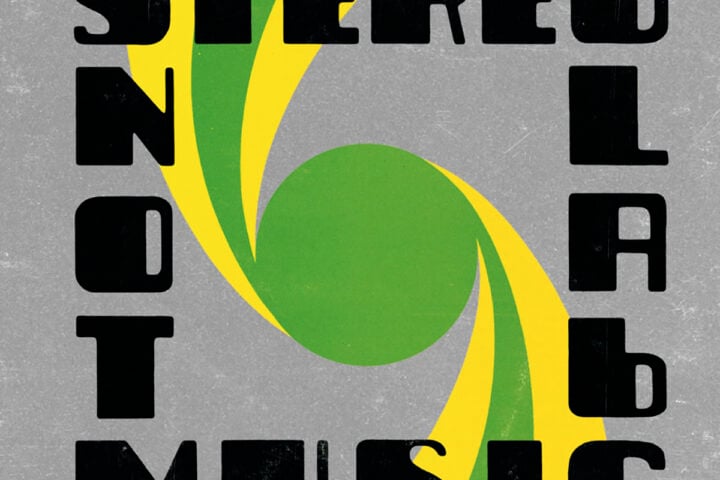
Every reunion faces the same question: Can the pieces still come together? For Stereolab, the magic has always been the pieces—their friction, their harmony, their interlocking together. The band’s first album since 2010’s Not Music, Instant Holograms on Metal Film, proves that nothing has come loose over the last 15 years.
Pulling melodies, textures, and ideas from both the pop mainstream and the avant-garde, Stereolab has always made the radical sound inviting. The parts themselves are often simple—a synth arpeggio here, a guitar strum there—but it’s the way they fall into place that paints the full picture. In this way, the band is like a machine: precise yet unpredictable, built from small components that suddenly hum to life when assembled.
“Immortal Hands” is an exciting example of how Stereolab builds tension not just to simply release it but to nurture it. The track opens with a haunting blend of swirling keys and guitars before locking into a killer bass groove. From there, it drifts through a characteristic mix of dreamy ’70s pop and lite jazz, until an unexpected beat switch injects the track with new momentum. Electronic drums kick in, joined by horns, bright piano, flutes, and soaring vocals. What starts as eerie and uncertain gradually grows with anticipation, and finally, pure triumph.
Beginning sleepy and soft, “Vermona F Transistor” filters that approach through a trippier lens. Around the three-minute mark, the track explodes into a burst of funky, anthemic horns, then slowly winds itself back down. Throughout, a guitar arpeggio acts as the song’s anchor. “I’m the creator of this reality/Not the joker who pretends a god to be,” Lætitia Sadier sings—and in the context of the song’s intricate, unraveling construction, it’s a statement of intent.
A distorted rock guitar rips through “Esemplastic Creeping Eruption,” breaking the spell of the track’s woozy drift and, just for a second, letting the band fully rock out. Similarly, the playful and disorienting “Melodie Is a Wound” fades out about halfway through and pivots in a new direction before a high-pitched, right-panned guitar begins to sing—answered by a lower guitar growling on the left. They twist together in a hypnotic call and response until everything speeds up, glitches out, and collapses into an 8-bit sprint, speeding toward its own finale.
Even when the pieces of Stereolab’s music shouldn’t make sense together, they do. When the retro-futurist synths of “Melodie Is a Wound” collide with the cutting political lyrics—”So long, public’s right to know the truth/Gagged, muzzled by the powerful”—the contrast is purposeful and magnetic. Elsewhere, “Transmuted Matter” throws everything at you in the first 15 seconds: a drum fill, a bouncing bassline, multiple guitar hooks, a soaring vibraphone. Two lead vocal lines weave through like twin guides—sometimes parallel, sometimes diverging, but always in conversation: “Fully human, fully divine, entwined/Through our bodies, through our senses.”
Instant Holograms on Metal Film doesn’t attempt to reinvent Stereolab, and it doesn’t need to. More than three decades on from their debut, they’re still masters at making music that’s both tightly constructed and quietly profound. It clicks, it moves, and it sticks with you.
Since 2001, we've brought you uncompromising, candid takes on the world of film, music, television, video games, theater, and more. Independently owned and operated publications like Slant have been hit hard in recent years, but we’re committed to keeping our content free and accessible—meaning no paywalls or fees.
If you like what we do, please consider subscribing to our Patreon or making a donation.