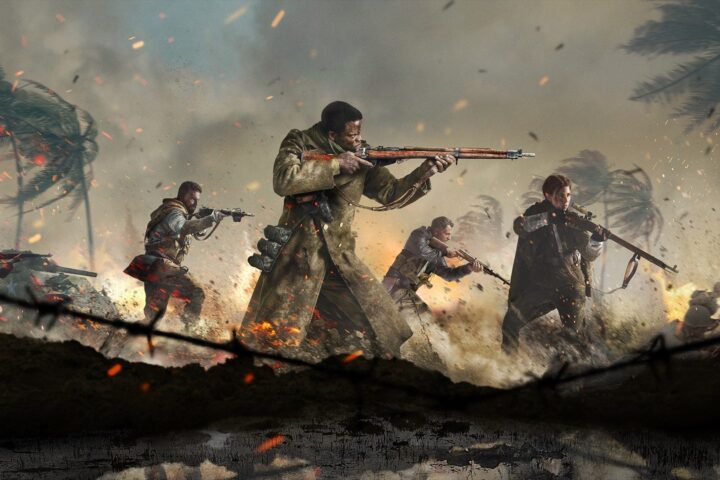
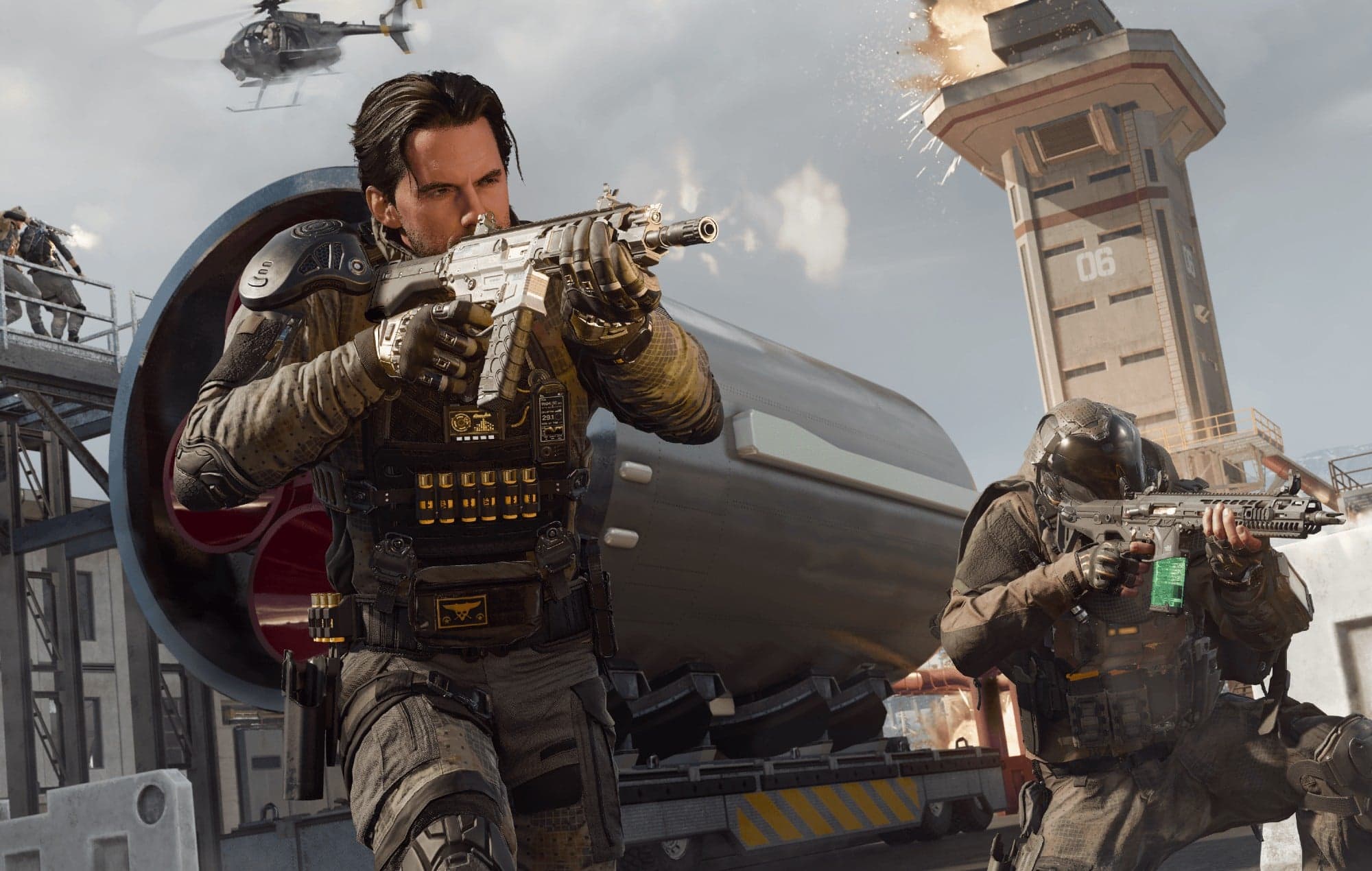
Call of Duty: Black Ops 7 is nothing if not weird. Its campaign expectedly leans into modern military shooter tropes, but this is a game where you’ll have to take on a big plant, alien spiders, zombies, and even a giant man (played by Michael Rooker) who attacks an aircraft carrier. Designed for four-player co-op, the story has returning characters hallucinating nightmare versions of past events after exposure to toxic gas.
That’s the kind of weirdness that more Triple-A games need more of. Previous entries in this series have featured hallucinatory sequences, but they’re usually backloaded in the campaign and are at least somewhat relevant to the plot. In Black Ops 7, things kick off with you fighting rogue cyborgs in a Quantum Computing lab before a drug-induced nightmare then sees you needing to avoid gigantic falling daggers on massive patches of farmland floating in the sky. It only gets more inexplicable from there, as well as increasingly meaningless.
This game’s strangeness scarcely counts as a unique spin on a familiar gameplay loop: of running from cover to cover, set piece to set piece, popping out to shoot opponents until they expire. Rinse, then repeat. Besides, stranger than whatever can be reasonably called surreal throughout Black Ops 7’s campaign is how the movement physics and aiming feel slightly off, and that’s made only worse by the bullet-spongy nature of the enemies.
To its credit, the multiplayer campaign smartly manages difficulty scaling, so that it’s engaging regardless of how many players are in the mix, or if a player unexpectedly drops out. The game, in the end, is quite beatable played solo or with a couple of players, even if that’s not the intended method of playing through it. Yet it’s always-online design undermines accessibility, as missions can’t be paused, and quitting mid-chapter forces a full replay.
Completing the single-player adventure’s 11 missions unlocks Endgame, an extraction-shooter mode, but locking such a major mode behind a campaign that many will skip feels misguided. Worse, and redolent of the controversy that surfaced from ARC Raiders, Black Ops 7 employs generative A.I. to produce cosmetic Calling Cards—graphics used to customize player’s profiles in game. Considering the enormity of the studios behind the game and the unbelievable amount of money invested in the product—and a product is very much what this is—the use of A.I. to create even minor graphics in lieu of hiring actual artists is offensive at best.
For most returning players, the main draw of Black Ops 7 will be its separate competitive multiplayer modes, which barely deviate from the established Call of Duty formula. A notable exception is Skirmish, a new 20-on-20 team-based mode wherein factions battle each on larger maps while completing objectives. In this mode, players can take advantage of wingsuits, grappling hooks, and vehicles to get around the map quickly, while trying to detonate bombs and capture locations in an orgy of destruction and nonsense. Skirmish captures some of the chaos of Battlefield while staying true to the fast-paced foundation that makes Call of Duty so addictive. It’s experimental and nonconformist. If only the rest of Black Ops 7 were as inspired.
This game was reviewed with a code provided by Step 3.
Since 2001, we've brought you uncompromising, candid takes on the world of film, music, television, video games, theater, and more. Independently owned and operated publications like Slant have been hit hard in recent years, but we’re committed to keeping our content free and accessible—meaning no paywalls or fees.
If you like what we do, please consider subscribing to our Patreon or making a donation.