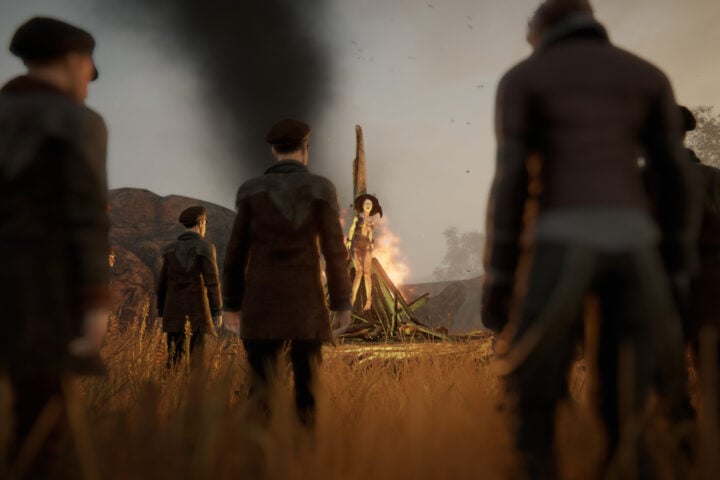
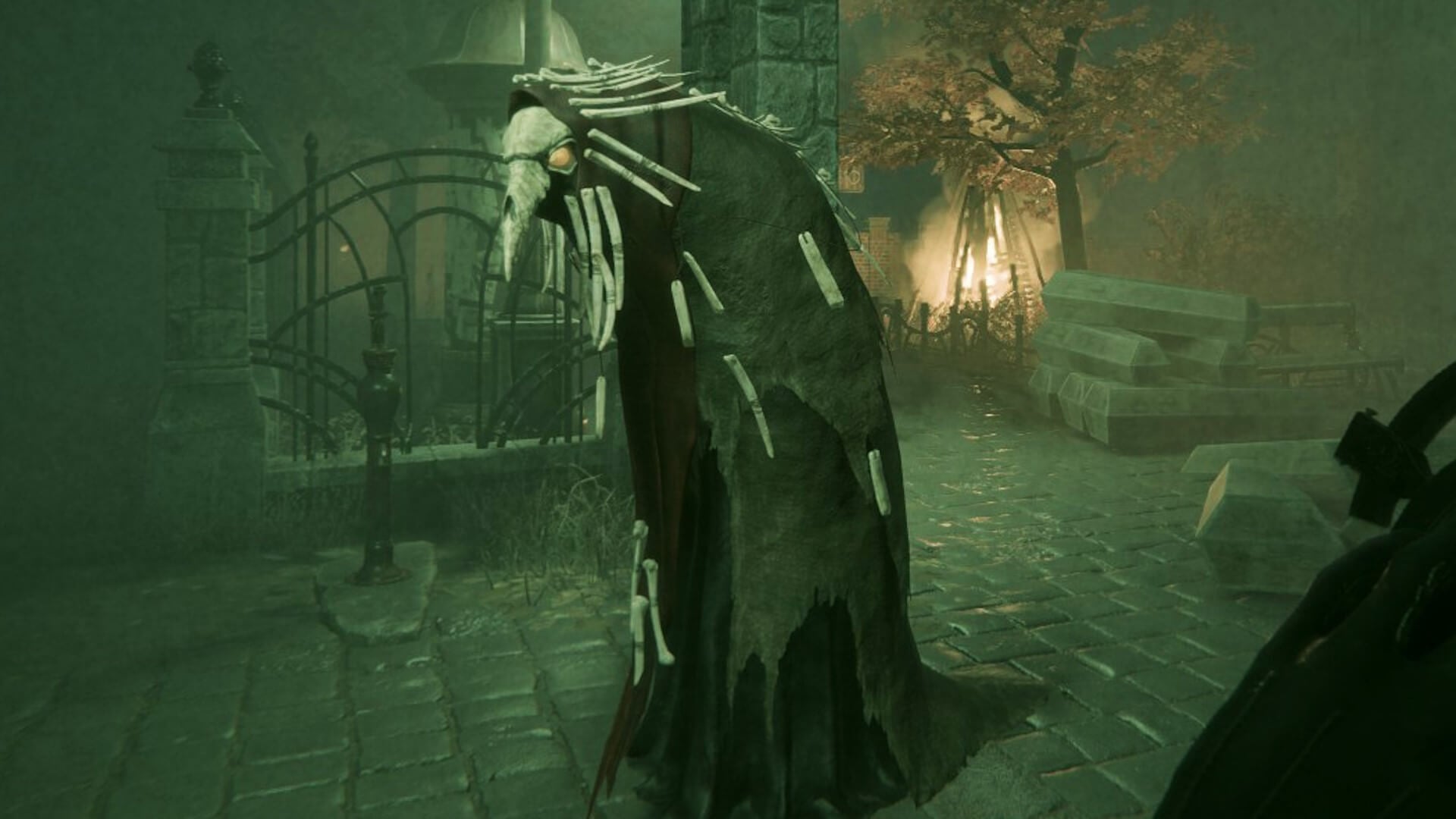
The town at the center of the Pathologic series, known only as Town-on-the-Gorkhon, is one of the great video-game settings. Built on the back of a bull-slaughtering industry that exploits the indigenous population, the Russian settlement is dense with symbolism and alive with big personalities vying for power. Its labyrinthine streets are dotted with impossible architecture—monuments to the aspirations and excesses of its ruling families. The town is a powder keg of human ambition and cruelty ignited by the onset of a devastating plague.
Of the cult 2004 original game’s three playable healers, the second game focused on just one, the Haruspex, as he undertook a haunted and surreal journey to reckon with the culture he left behind. The latest game shifts to another of the trio: the Bachelor of Medicine, Daniil Dankovsky, a university researcher and total outsider whose chief concern—initially, at least—is with his research back home rather than the calamity unfolding before his eyes.
For a first-person protagonist, Dankovsky is anything but a blank slate. His dialogue exchanges with the town’s characters are far longer than they were even in Pathologic 2, because, well, the famed thanatologist loves the sound of his own voice. And in a game that runs on a ticking clock, that means you can waste time going farther down dialogue trees than necessary just to get a few jabs in or assert intellectual superiority by muttering something rude in untranslated Latin.
But at the same time, there’s potential benefit to fully exploring the long-winded dialogue rather than cutting it off prematurely. Not only will you learn more about the town and its power players, but many dialogue choices affect Dankovsky’s overall mood bar, which replaces the meters for stats like hunger, thirst, and stamina that ruled the previous games.
At one extreme is mania, with Dankovsky saving great amounts of time by striding so quickly through the town that he practically glides—albeit with his health dwindling from strain on his heart. At the other is apathy, which causes him to trudge ever more slowly until he reaches such a peak of disillusionment that he’ll try to shoot himself in the head. Thus, to avoid using up the various mood-altering resources you scrounge around town, it may be in your best interest to spend some time berating unruly children and get the blood pumping—or to cut an introspective conversation short and escape the self-defeating apathy it has begun to induce.
While the simplification of the survival mechanics might sound like the Pathologic experience has been defanged, it’s very much consistent with the shift to the Bachelor’s perspective. Dankovsky has been placed in charge, which allows him to be privileged and single-minded. (Where Pathologic 2’s Haruspex spent his time slinking in the shadows and scrounging for a meal, the Bachelor is provided for.) In turn, he can focus on running both the makeshift hospital and the Emergency Command issuing decrees in response to the plague.
Dankovsky also isn’t bound by linear time. Across 12 in-game days in Pathologic 2, the Haruspex was forced to make difficult choices because questlines took him all over the map and he couldn’t be everywhere at once, creating a further sense of disempowerment; the game required you to fail, and then scramble to minimize the impact of your failures. The Bachelor, however, can be everywhere. He can time-travel back to the start of a day, resetting questlines to try for a better outcome while leaving others that have already achieved the desired result.
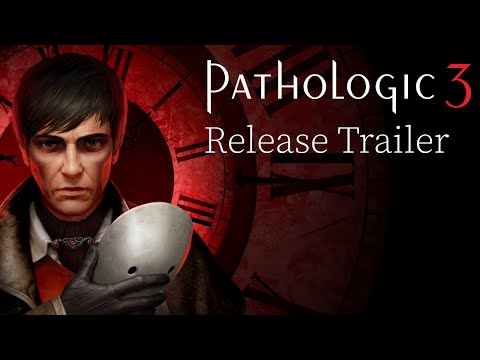
There is, unsurprisingly, a catch to your time travelling. The mechanic runs on a finite resource called amalgam, which you acquire through certain conversations or medical acts but most reliably through breaking mirrors around town. The farther in time you jump, the more amalgam you spend (with a jump to the start of the current day requiring none at all). What starts out feeling like an uncommonly generous allocation of resources for such an infamously punishing series becomes slowly suffocating as the game goes on; even after restarting a day, the mirrors stay broken and any other resources stay consumed. Only after tens of hours do you start to realize that you’re standing on the palm of a hand slowly closing into a fist.
Time travel is further limited by the simple fact that Town-on-the-Gorkhon needs to survive to a new day in the first place. The decrees you issue at the Emergency Command affect town-wide levels of plague infection and civilian unrest, and only by keeping those levels below a certain threshold can you ensure that there will, in fact, be a “next day” to time travel to. Completing quests earns you new decrees, the most pivotal being a day-long vaccine for the ever-mutating plague when you correctly diagnose all the patients in your hospital.
Admittedly, the town management and time traveling can be messy. One way to lower infection levels is to find the weakness for a monstrous personification of the plague called the Shabnak, and the process starts out rather simplistic and never grows in complexity. Diagnosing patients, by contrast, is delightfully involved and could be a whole game to itself—a series of logic puzzles that sometimes require you to catch patients in a lie by visiting where they live.
However invigorating it may be to get the diagnosis right on the first try, though, your ability to simply restart a day if you get it wrong saps no small amount of the tension. And at the time of writing, a week after the game’s initial release, time travel is often unreliable, particularly in the late game. Glitches cause questlines to reset on their own when you travel back to a day, or prevent their outcomes from sticking at all. Even when everything works as (presumably) intended, the logic for quest progression is inconsistent, sometimes requiring you to travel across the town to redo a conversation to get information you already have.
With that said, the Pathologic series has always demanded tolerance for a certain level of frustration because the payoff is so splendid, and in this regard, the third game is no exception. Intricately plotted and atmospheric, Pathologic 3’s great achievement is its reexamination of the series from a new perspective, with sweeping changes to the core that are as bold and ambitious as they are a totally natural extension of the new protagonist. It doesn’t match its predecessor’s level of tension, but in many ways it’s even more immersive and detailed. Not only does the Town-on-Gorkhon still make for one of the medium’s most transportive settings, but Daniil Dankovsky emerges as one of the medium’s richest protagonists.
This game was reviewed with a code provided by Hype Train Digital.
Since 2001, we've brought you uncompromising, candid takes on the world of film, music, television, video games, theater, and more. Independently owned and operated publications like Slant have been hit hard in recent years, but we’re committed to keeping our content free and accessible—meaning no paywalls or fees.
If you like what we do, please consider subscribing to our Patreon or making a donation.