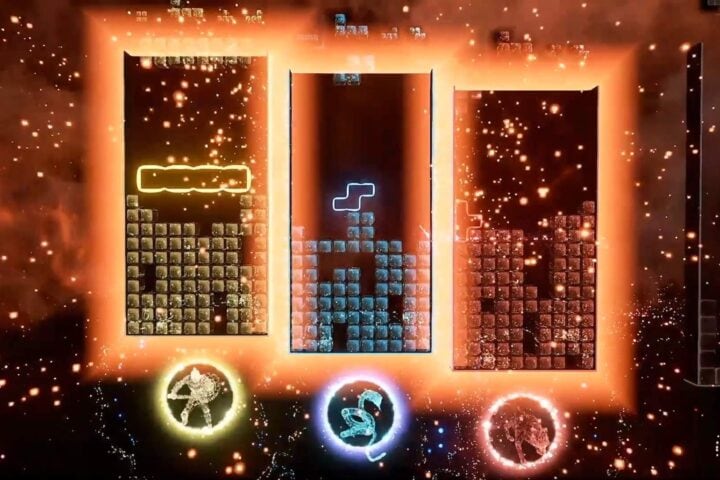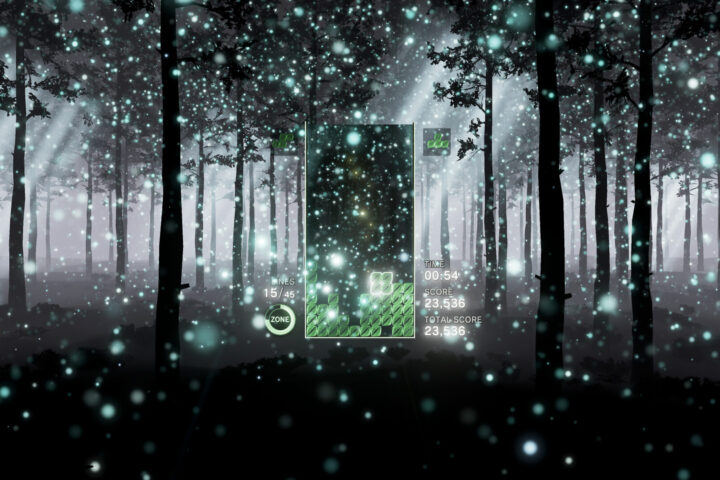
For those not up on their game development lore, the original Lumines: Puzzle Fusion on the dearly departed PlayStation Portable only happened because its director, Mizuguchi Tetsuya, couldn’t land the licensing rights to Tetris. Fast-forward 15 years and, after a meeting with license holder Henk Rogers, Mizuguchi was finally able to realize his vision of a psychedelic Tetris called Tetris Effect. And if you thought that game was the ne plus ultra of synaesthetic splendor, Lumines Arise is here to say, “Hold my edibles.”
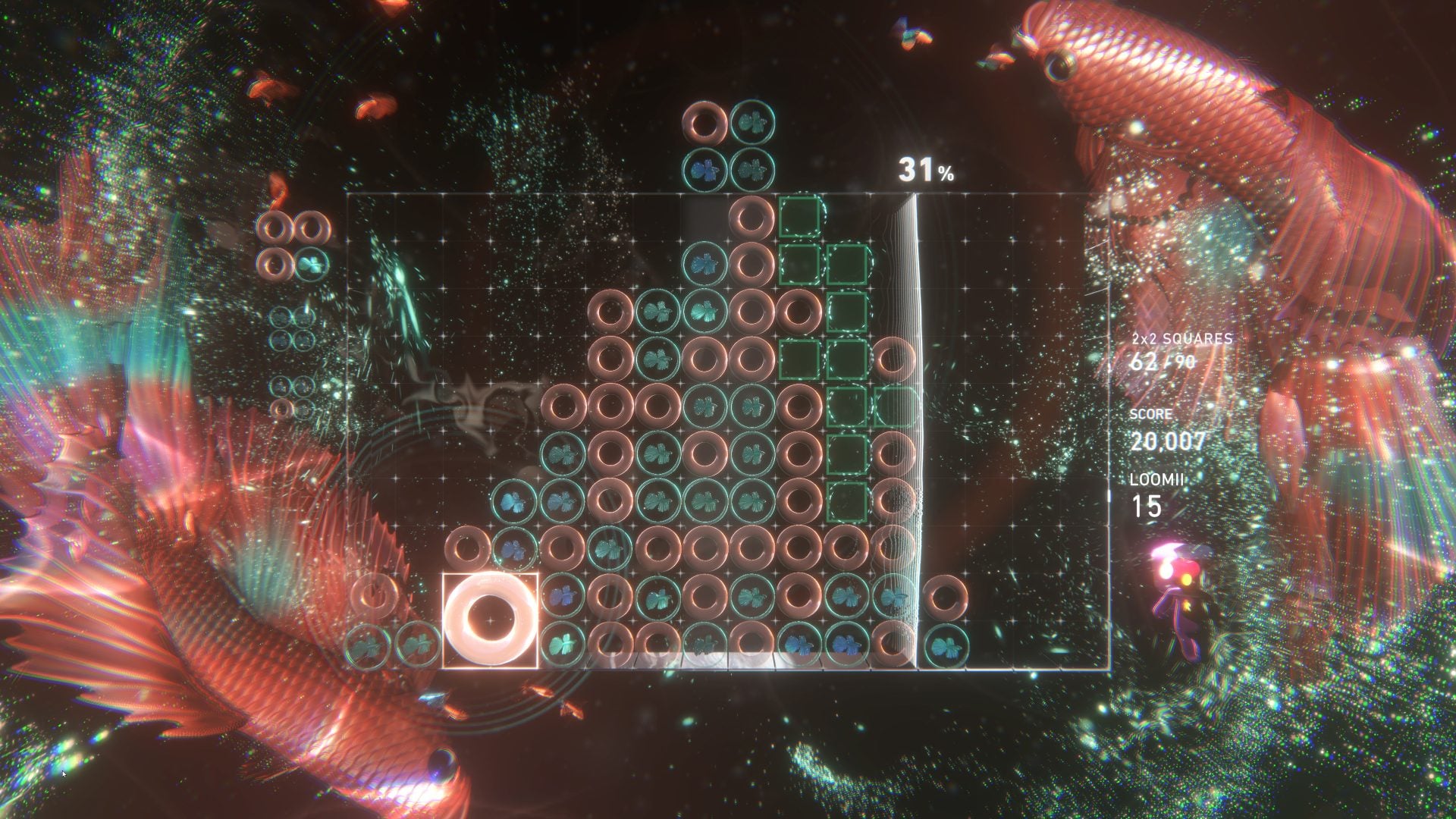
The game’s basic mechanics are relatively simple. Two-by-two bi-colored blocks fall from the top of the screen, and the player’s job is to match the colors into as big a square as possible. Where the rhythm element comes into play is that a line sweeps across the screen, left to right, in 4/4 time with the music playing on that particular stage. When that line reaches the end of the playing field, any completed squares disappear from the screen.
The eclectic soundscape of Lumines Arise brings with it different time signatures, slowing, speeding up, even changing up mid-song. Sometimes, the sweep line and the block speed are moving at a similar pace, but the stages where the new blocks fall faster than the sweep line can take completed ones away are trickier. That makes for more of a challenge, but to the surprise of no one who’s played another Mizuguchi game, the controller vibration, the visual cues, and the music are all perfectly calibrated to keep players on task, as long as they can keep a beat.
Lumines Arise also has its own version of the Zone ability from Tetris Effect called Burst, allowing players to slow time and create as massive a block as possible before time returns to normal. There’s less room for error with Burst, but the effort is worthwhile. Building a bigger square requires a clear enough playing field and the luck of the draw when it comes to the pieces you subsequently get. Anything short of perfection just stacks up the unusable bricks to top of the screen, but clearing a square wipes away a huge portion of the playing field, and typically leaves behind all blocks of the same color, which will get cleared by the next sweep. Combined with the soothing pale white aesthetic, and the way you also get an ethereal new mix of whatever song is playing during, the build and release after a successful Burst is utterly euphoric.
Lumines Arise’s aesthetic choices are tailor made to send the player’s soul into the stratosphere. The very first stage features soaring, dream-pop vocals laid over visuals of exploding stars and neon people. Another sees a cyborg weaver spinning the entire level together from metal thread, all set to a killer experimental industrial soundscape. Later come the real-deal weirdo moments, like a stage where all the blocks are fruits and vegetables, and another where the blocks are chicken feathers and eggs, with an acid jazz/EDM blast beat soundtrack. One stage, based around jungle flowers, has the sickest trap beat you’re likely to hear all year.
The commitment to the visuals does have its drawbacks, as there are a couple of stages where the visual activity gets overwhelming even by this game’s standards. But, then, it’s nothing short of surprising how rare those moments are, given how hyperactive the stage concepts can be.
The vast majority of Lumines Arise’s stages are extravagantly crafted, zen-gifting palaces that feel as if they’re offering up glimpses of a New-Agey utopian future. More than Tetris Effect, Lumines is defined by its relationship to its music and aesthetic, with its sounds guiding your actions in ways that you never consciously realize in the moment. No matter how loud or soft the stage, playing Lumines Arise feels like meditation, a re-centering of the brain. Every sweep of the line presents another opportunity to harmonize with the rest of the soundscape using the indirect instrument of a puzzle game. This is Lumines in its most perfect, evolved form.
This game was reviewed with a code provided by Enchance PR.
Since 2001, we've brought you uncompromising, candid takes on the world of film, music, television, video games, theater, and more. Independently owned and operated publications like Slant have been hit hard in recent years, but we’re committed to keeping our content free and accessible—meaning no paywalls or fees.
If you like what we do, please consider subscribing to our Patreon or making a donation.