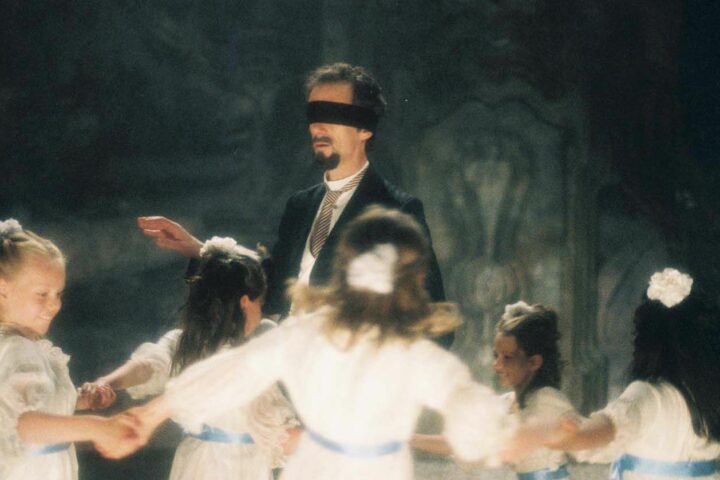
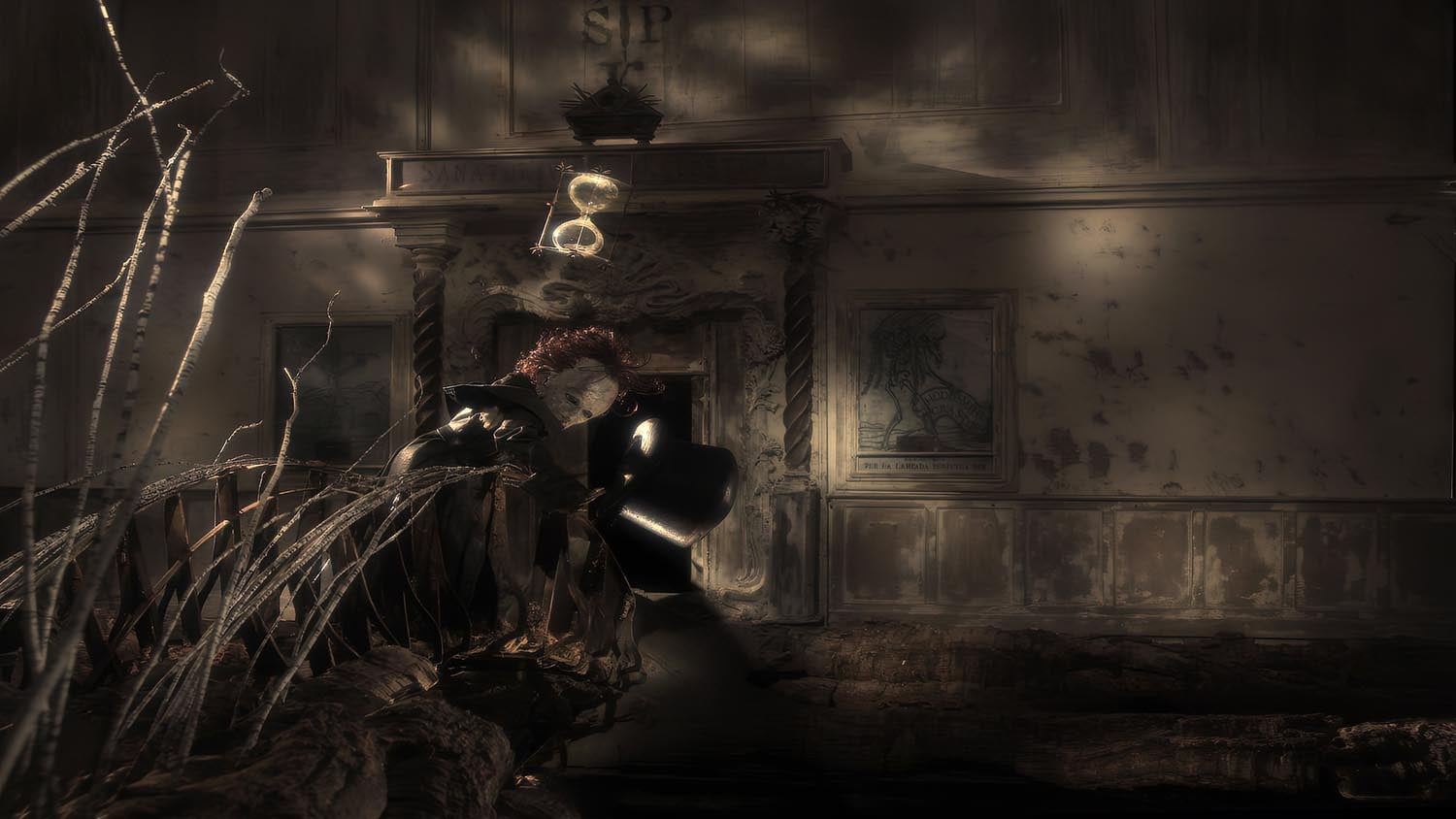
In their first feature-length film since 2005, Stephen and Timothy Quay draw once again from Polish writer Bruno Schulz, whose story “Street of Crocodiles” inspired their famous 1986 short film of the same name. Loosely adapted from Schulz’s novel Sanatorium Under the Sign of the Hourglass, the Quay brothers’ latest furthers their unmistakable style of stop-action that pays homage to the Czech and Polish traditions of puppet animation, set to an eerie original score composed by long-time collaborator Timothy Nelson.
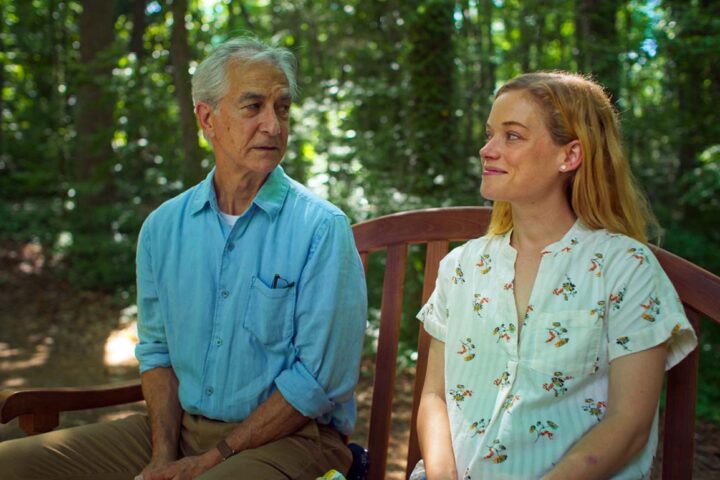
The source material is a series of linked short stories, and while the title story supplies the film’s narrative backbone, the Quays fold in themes developed throughout the book. Entering by way of a live-action frame narrative, we follow Józef as he arrives by train to a remote sanatorium. Here, thanks to a treatment developed by the six-armed Dr. Gotard that involves “putting back the clock,” his dead father remains alive. But Józef, like his father, finds himself immured in this labyrinth of memories and nightmares where he falls asleep literally at the drop of a hat.
As it happens, some of the film’s most captivating sequences revolve around Józef’s ponderous stovepipe hat, from which, for instance, a family of smaller hats within hats emerge as if from a Matryoshka doll. The same degree of attention is paid to many objects that populate the film. With the magic of reversed footage, bits of chalk crumble to dust and reform at will, recalling the screws from “Street of the Crocodiles” that unscrew themselves in order to pirouette around the set. The Quays view animation in an almost metaphysical sense, transforming inanimate objects into characters in their own right, like Geppetto bringing Pinocchio to life.
Given the Quays’ overt literary influences—echoes of Franz Kafka, Jorge Luis Borges, and other figureheads of the literature of the fantastic abound—no small part of the pleasure to be gleaned from the film is in tracing the differentials between adaptation and source material, not the least of which is tonal. Where Schulz can be playful to the point of whimsy at times, the Quays tend to underscore his work’s more macabre elements. Though some of dialogue is drawn word for word from Schulz’s idiosyncratic prose, many of the themes and images here are extrapolated from the book rather than recreated wholesale, much to the Quays’ credit.
Take their shared fixation with intricate, fanciful mechanisms. In the film, we encounter a funerary cabinet with seven randomly placed viewports, each corresponding to one of the film’s numbered sections). An obvious metaphor for the cinematic apparatus, this so-called “Maquette for the Sepulcher of a Dead Retina” may not appear in the source material, but it corresponds obliquely to such instruments as a telescope that, in Schulz’s words, unfolds into a “long complex of camera obscuras, one within the other” and then an “enormous paper arthropod with two imitation headlights on the front” which Józef takes out for a spin.
The Quays take Schulz’s idea of “turning back the clock” to its logical conclusion, transforming the film itself into one such mechanism. Across Sanatorium Under the Sign of the Hourglass, the editing self-consciously disrupts linearity through dreamlike repetition and displacement. To this effect, one technique sees slices of footage repeated many times over, the image shrinking with each iteration so that it appears inset deeper inside the frame.
As with Schulz, there are moments where stylistic pyrotechnics evoke fascinating interior landscapes, while others come across as overwrought and tedious. The immediacy of the uncanny surrealist imagery counterbalances this hermeticism somewhat, but with only the most rudimental story to impart a sense of momentum or trajectory, these images start to hit a single tonal register. The film’s runtime, though, is brisk enough to stave off monotony.
If the film makes any commentary on our own times, it does so obliquely. From their influences and heavy emphasis on form, it’s clear that the Quays idolize a pessimistic, literary brand of modernism. There’s more at hand than mere play in giving man-made objects like chalk and hats, or even whole settings, as much, if not more, to do than the human characters.
This tendency, though, also darkly suggests that we aren’t the masters of our own creations. The Quays’ love of baroque decrepitude, while it couldn’t be farther from the sleek minimalism that’s the de rigueur aesthetic of their contemporaries, expresses a dread lurking just beneath the surface of our reality with greater fidelity than many other “up-to-date” styles. Sanatorium Under the Sign of the Hourglass becomes a film about its own condition of being an outsider to its own time, lost as it is in the aesthetics of another time that it views with nostalgic disquiet.
Since 2001, we've brought you uncompromising, candid takes on the world of film, music, television, video games, theater, and more. Independently owned and operated publications like Slant have been hit hard in recent years, but we’re committed to keeping our content free and accessible—meaning no paywalls or fees.
If you like what we do, please consider subscribing to our Patreon or making a donation.