With its focus on looted African art, Mati Diop’s captivating, fabulistic documentary Dahomey confronts the reality of how modernity has been shaped by the West’s theft of cultural heritage. Named after the seat of power in the historical Kingdom of Dahomey (present-day Benin), the film narrates the 2021 return of 26 artifacts that France had stolen from the former kingdom when, after centuries of occupation and colonial meddling, it was finally conquered and ransacked in the 1890s. Since then, some 7,000 Beninese artworks, many of them taken directly from the royal palace, have been on display in French museums.
As in her last film, the fictional feature Atlantics, Diop concerns herself here with restoring a sense of enchantment to a world that no longer thinks of the dead—the past—as existing both materially and spectrally alongside the present. The film’s narrator, such as it is, is the spirit embodied by the statue of a Dahomey king, represented by a reverberating, multitracked voice that periodically dominates the soundtrack. Throughout the 69-minute film, the spirit bemoans, in an imposingly neutral rather than defeated tone, that it’s been identified for decades as merely “Number 26,” and that it’s spent so long in what it describes as a dark, empty night.
The effect is haunting and powerful, a vivid reminder that in their original context, these figures had a presence and a personality suppressed but not erased by the distanced, anthropological gaze of the museum. Often Number 26’s voice booms over a black screen that Diop holds for what can feel like an eternity, evoking the decades that this and other artworks have spent in storage lockers and shipping containers—as well as the blank spot left in Benin’s cultural patrimony. We even appear to follow the statue on its return journey to Benin, as we watch from inside the wooden crate as it’s hammered closed, and spend some of the journey listening to the sounds of, for example, jet engines roaring over the pitch-black frame.
But Dahomey isn’t purely an impressionistic documentary, a story told entirely from the perspective of an ensouled inanimate object—nor does it suggest simplistic, uncritical praise for France’s decision to repatriate the stolen art, or even for Benin itself. Diop balances the regal, old-world, quasi-divine perspective of the spirit with a sober, interrogative depiction of the modern spaces and procedures that store and transmit these once-sacrosanct artifacts. Diop’s camera estranges the space of the museum, showing exhibition spaces that are oddly deserted or shooting them in oblique ways, lingering in the antiseptic hallways of the underground archives.
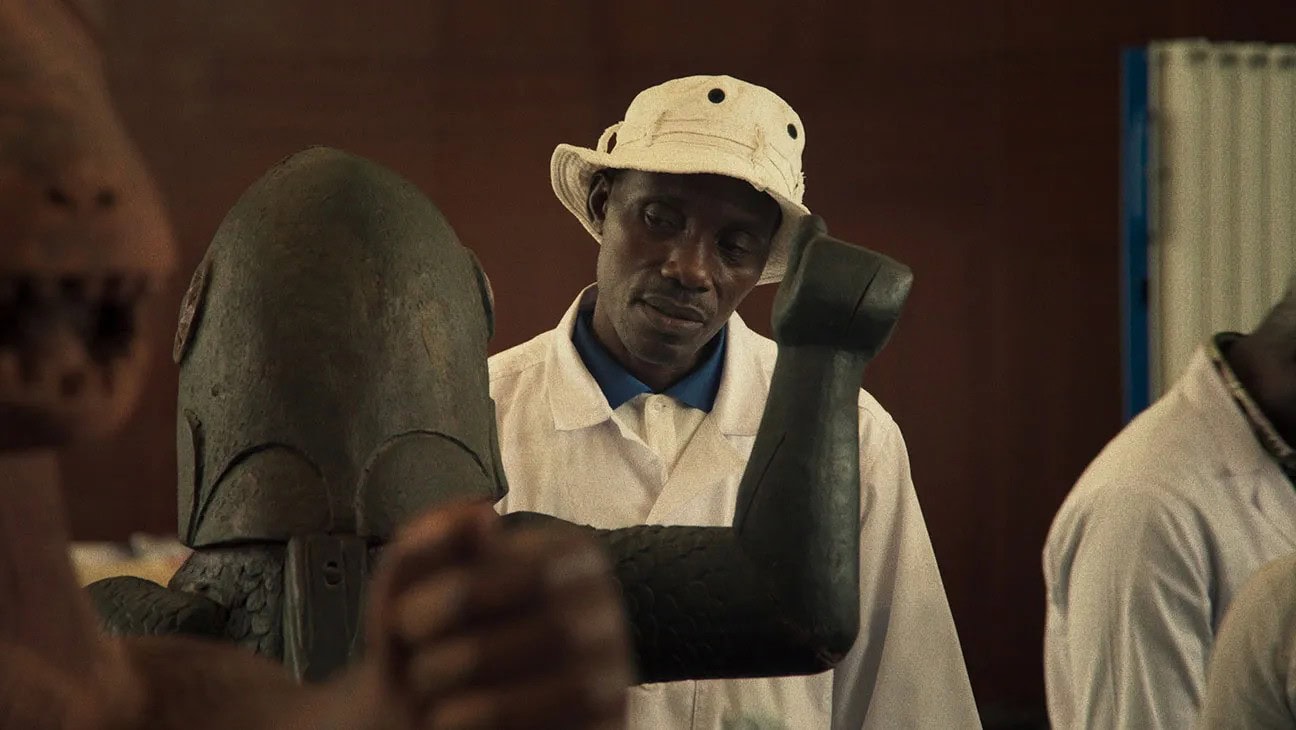
Diop also turns our attention to the flesh-and-blood people facilitating and receiving the transfer. We see the care, however clinical and unceremonious, with which researchers and workers handle the aged statues. When the procession of tractor trailers carrying the repatriated works rolls through the streets after arriving in Abomey, Benin, she shows us revelers crowding the sidewalks, greeting the return of their cultural heritage with cheers and dances.
Precisely at this point in Dahomey, where it seems like colonizer and colonized have been partitioned into villain and hero, and the repatriation of the artworks is seen as a cause celebré, Diop complicates the narrative. A good portion of the film’s second half is dedicated to a public debate, largely run by young Beninese, over the meaning of the statues and France’s belated decision to send them back. Here, we see that the return of Number 26 and the other artworks doesn’t grant them an unambiguous place in contemporary Beninese society.
The people at the public gathering ask each other and themselves whether the return of 26 out of 7,000 items can be considered a truly magnanimous gesture. And was this all a consequence of a political maneuver on the part of the president of Benin, Patrice Talon, to gain face? Finally, one young woman questions, what about the statues themselves? While some present want to re-sacralize them, she views them as cultural works valuable in a secular sense, professing herself to be utterly put off by the idea that they actually hold mystical power.
The disagreement upon the reception of the statues is hardly a depiction of chaotic discord, of the dysfunction of a fragile society. The energy captured by Diop and her generous attention to each perspective is a deeply democratic one, a process of collective meaning-making as the place of the stolen pieces in Beninese culture is determined. It’s a familiar enough process. Indeed, one can imagine a less civil version taking place at a city hall meeting about Confederate statues or controversial artists somewhere in the United States. What one realizes watching Dahomey is that this—not just some statues, not just the spirit of a dead king—is a vital piece of what was stolen from Benin when European soldiers sailed off with their heritage.
Since 2001, we've brought you uncompromising, candid takes on the world of film, music, television, video games, theater, and more. Independently owned and operated publications like Slant have been hit hard in recent years, but we’re committed to keeping our content free and accessible—meaning no paywalls or fees.
If you like what we do, please consider subscribing to our Patreon or making a donation.